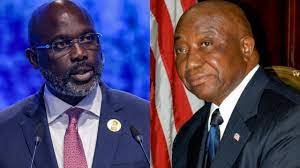
Liberians commenced voting on Tuesday to determine whether to grant former football star George Weah a second term as president, despite a controversial record, or to elect political veteran Joseph Boakai, notwithstanding his age.
The run-off is expected to be closely contested between the rivals, who also squared off in 2017 when Weah secured victory in the second round with over 61 percent of the votes.
In the initial round of voting on October 10, Weah, aged 57, and Boakai, aged 78, were nearly tied, both securing slightly over 43 percent, with the incumbent holding a 7,126-vote lead.
Taiyee Success Iledare, a 22-year-old student awaiting her turn to cast a ballot in Duazon, a suburb of the capital Monrovia, expressed her support for Weah. “I believe he is the best candidate. When you look around, you see a lot of development. If he wins, I want him to address the issue of drugs destroying our young people,” she told AFP in a suburb.
Irene Palwor, a 41-year-old petty trader, indicated her backing for Boakai, popularly known as JNB. “I feel that he will make a change… JNB will create job opportunities for women and for the youth.”
This year’s election marks the first since the United Nations ended its peacekeeping mission in Liberia in 2018, established after more than 250,000 people died in two civil wars between 1989 and 2003.
Over 2.4 million people are registered to vote, with polls open from 8:00 am (0800 GMT) to 6:00 pm (1800 GMT).
The incumbent is popular among young people but faces scrutiny for a controversial record, while Boakai is an experienced figure with a diverse background in both the public and private sectors.
The electoral commission has 15 days to publish the results but might do so sooner, according to one of its officials, Samuel Cole.
Since the first-round results, the two political camps have concentrated on securing the votes of supporters of the 18 candidates who did not advance. Edward Appleton, who came third, has endorsed Boakai, along with two of the other top six candidates.
Turnout could be a crucial factor, noted Lawrence Yealue, who leads the civil society group Accountability Lab Liberia. He anticipates lower turnout compared to the record 78.86 percent on October 10, when the presidential vote coincided with parliamentary elections.
Weah, the only African to win football’s Ballon d’Or, is widely seen as approachable and peaceful. He claims to have supported education, infrastructure development, and healthcare while bringing electricity into homes. However, critics argue he is out of touch with the harsh realities of soaring prices and shortages, with over a fifth of Liberians living on less than $2.15 a day, according to the World Bank.
Boakai attributes corruption, prevalent in Liberia and worsening under Weah’s tenure, to his opponent. The former vice president has formed alliances with local figures, including former warlord and senator Prince Johnson, who supported Weah six years ago.
Clashes during the campaign resulted in several fatalities, raising concerns about potential post-election violence. Boakai reported an attack on a convoy carrying Prince Johnson and vice presidential candidate Jeremiah Kpan Koung on Sunday, with seven people reportedly injured. Boakai’s camp also decried irregularities during the first round.