Opinion
The Task Before ‘North Central Development Commission’
Published
8 months agoon
By Bridget Tikyaa
The creation of the North Central Development Commission by President Bola Ahmed Tinubu has rekindled hope and set the tone for a new lease of development in the entire states of Benue, Nasarawa, Kwara, Kogi, Niger and Plateau, as well as the Federal Capital Territory (FCT).

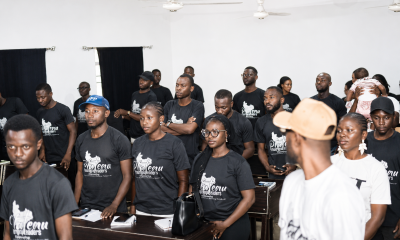
Right to Left SGF Sen George Akume,Cosmos Akirghir Esq,Board Governing Chairman NCDC and other Members of the Commission during the presentation of appointment Letters In Abuja
These are states that have suffered long years of economic hardship, insecurity, displacement, disruption of basic services including schools and health infrastructure, and much more.
With the inauguration of the board of the commission, whose headquarters is in Lafia, Nasarawa State, all is now set for the commission to articulate its programmes and swing into action.
Already, the Federal Government has made provisions in the 2025 budget for the funds with which the commission will execute its programmes and projects.
One of the key tasks the commission must plan for and address is the endemic rural poverty and economic hardship in the North central region.
Over 75% of rural Nigerians live below the poverty line, with widespread economic stagnation, inflation, and insecurity contributing to severe economic hardship.
The region’s dependence on oil and limited diversification have exacerbated poverty, with 30.9% of Nigerians living below the international extreme poverty line of $2.15 per day. This, no doubt, deserves frontal, timely and decisive action to contain.
Another troubling aspect in the region is the level of insecurity and conflict being witnessed from Benue to Niger, Kwara and Kogi, Nasarawa and Plateau.
The region is plagued by conflicts between farmers and herders, banditry, local militias particularly in Benue and Plateau states, resulting in loss of lives, displacement of communities, and decline in agricultural productivity. Insecurity has also limited access to cropland and restricted access to agricultural inputs.
It is therefore imperative for the commission to interact with key stakeholders and devise a regional approach to the security challenges, including the establishment of a regional security, including support to existing security agencies to ensure a decisive and prompt response to the challenges.
The safer the region, the more it takes the right steps to address other challenges.
The North Central Development Commission should also have a blueprint to respond to the climate change and environmental issues in the region, from rising temperatures, erratic rainfall, flooding, and drought, to erosion and deforestation.
Presently, these challenges have intensified existing vulnerabilities, disrupting education, health services, and community protection mechanisms. Climate change has also contributed to resource-based conflicts over land, water, and minerals as in Benue, Niger and Plateau states.
One fundamental issue the commission must develop a Marshal plan for is the scourge of displacement and humanitarian crisis due to conflicts that had made over 300,000 homeless in just four states, including Benue and Nasarawa.
This has resulted in increased vulnerability to gender-based violence, exploitation, and abuse, particularly among women and girls.
These vulnerable population needs protection, security, emotional and economic support, and mental health evaluation, among others.
The commission, therefore, has a huge task ahead of it, working in sinc with the government of the six states, development partners and other stakeholders, to justify its creation by making a huge presence in the lives of the people of the region.
The six states in the North Central also face limited access to basic services, including healthcare, education, and protection mechanisms.
There are a number of areas where health facilities and schools have been destroyed or disrupted, thereby exacerbating the existing vulnerabilities.
There is also the governance and leadership challenges due to weak governance structures, corruption, and poor management of the region’s natural resources.
Over the years, the lack of effective leadership and accountability has hindered efforts to address poverty, insecurity, and climate change in the region and other parts of the country.
These interconnected challenges, no doubt, require a comprehensive and multi-faceted approach to address, and the North Central Development Commission can greatly contribute to the solutions by vigorously promoting the region’s development, sustainable growth and stability.
Bridget Tikyaa is a Media Expert
You may like
-
Zuba: Commuters, Residents Protest Lack of U Turn, Halt Construction Work
-
FCT Varsity to Begin Operations Soon, Wike Assures
-
ASP Justina Amah Emerges Star Performer, Wins Gold, Silver, Bronze
-
Knights Defend Church Yet Losing Faithful, Says Obiora
-
CSN, SGF, Laity Charge Catholics to Apply CST to National Development
-
Alia Seeks Collaboration with North-Central Development Commission
Opinion
APC E-Registration: Benue Flying Broom To Success
Published
2 months agoon
January 20, 2026By
OD
By Bridget Tikyaa
Political party membership registration is a key step to ensuring a vibrant democracy, because it is the key to having one’s voice heard in shaping party’s direction, participation in primaries and selection of candidates who’ll represent one’s interests, and an opportunity to influence policies and ideology, participate actively in party activities, meetings, and even leadership. A card carrying member of a political party often get access to party funding, training, and other resources, an opportunity to click with like-minded people and potential allies, contribute to shaping the party’s stance on key issues, and build a political career.
For young people, party membership can be a game-changer, because it will connect them with experienced politicians and professionals who can guide them, get involved in youth wings, campaigns, and other party activities and invariably build connections and experience that can lead to roles in government, politics, or public service. It is also a fundamental route to community engagement, understanding issues, and making a difference and name, thus building a political structure and asset.
Since the commencement of the nationwide e-registration of members of the All Progressives Congress (APC), millions have registered in less than a week of the exercise.
In Benue State, the state Governor Rev. Fr. Hyacinth Alia led the line up of millions of old and new supporters of the APC in obtaining his membership card.
At the flag-off of the e-registration on Monday, January 12, 2026, the governor said it is a landmark initiative aimed at strengthening the party’s structure and demonstrating its numerical strength.
The flag-off ceremony took place at the RCM Primary School, Ihugh, the headquarters of Mbadede Council Ward in Vandeikya Local Government Area, where the governor urged all APC members to return to their wards and register, noting that the process was simple, fast, and would take only a few minutes.
To ensure that no party supporter is left out, Governor Alia has directed party officials and elected local officials across the 23 local government areas of the state to mobilize party members to participate in the exercise. The Local Government Areas with the highest number of registered APC members are taking home a surprise package.
The has a clear message to all party supporters. “In 2023, you demonstrated to the entire world that Benue is APC. You demonstrated through the ballots that you love me and Mr. President, Bola Ahmed Tinubu. We have both remained faithful to the promises set out in our policy blueprints. I therefore urge you to come out and use this opportunity to once again demonstrate that you are ready to vote for consolidation. My administration will give priority attention to the most registered areas because this is an APC administration.”
He therefore tasked all council chairmen and party chairmen at the Local Governments in the state to give the registration agents all the needed support and to mobilize the people to participate in the exercise.
For APC Benue’s number 001, “This is the beginning of another level of progression of the All Progressives Congress. It is something that has not happened with any political party in Nigeria.” It is an apt bragging right. Because the e-registration would help the party accurately determine its strength at the ward, local government, and state levels.
Unlike the 2023 voter registration, the APC e-registration is designed to clearly showcase party membership, seriousness, and direction. That’s why the party leadership took time to train the registration personnel before deploying them across the state. “I want the whole Nigeria and the world to know that when we say Benue State is APC, we are ready to demonstrate it by action, backed by facts and reality on the ground.”
The Speaker, Benue State House of Assembly, Berger Alfred Emberga, described the flag off as a critical step towards deepening internal democracy within the APC, stressing that a robust, accurate, and verifiable membership database would strengthen governance, enhance party cohesion, and boost grassroots mobilisation.
“This e-registration exercise is fundamental to the future of our party. I urge my colleagues in the Benue State House of Assembly, party leaders, and members across the state to participate actively and mobilise their constituents to ensure a successful and credible exercise,” Hon. Emberga said.
While urging the people of Benue State to remain steadfast in their support for the Alia administration, the Honourable Speaker also encouraged APC members and supporters to register and obtain their Permanent Voter Cards (PVCs). He stressed that widespread PVC ownership is essential to enable party members to vote for Governor Alia and all APC candidates in the 2027 general elections.
Also speaking, the State Coordinator of the APC e-registration, Hon. James Ornguga, alongside the State Chairman of the party, Chief Dr. Ben Omale emphasised the importance of accurate data capturing. They noted that the exercise would reposition the party for improved organisation, accountability, and electoral success.
They applauded Governor Alia for funding and supporting the e-registration exercise, describing the gesture as a clear demonstration of the governor’s commitment to building a strong, inclusive, and data-driven party structure.
Orgunga particularly called on local government chairmen, party executives, Stakeholders and political gladiators to give full support to registration agents and intensify grassroots mobilisation to ensure the smooth and hitch-free conduct of the exercise across all wards of the state.
The State Coordinator of the APC e-Registration, who is also the State Organizing Secretary of the party, explained that the registration process is straightforward, requiring only voters card and a National Identity Card.
Omale, on the other hand, has nothing but commendation for President Bola Tinubu and the National Chairman of the party for the initiative. He thanked Governor Alia for sponsoring the exercise in the state, urging all APC faithful in Benue to embrace the e-registration, so as to formally confirm their membership.
Already, the e-registration has gathered momentum, recording huge turnout which necessitates the training of additional registration agents. The quick intervention in the 276 wards will address the early challenges linked to manpower and logistics, speed up the ongoing e-registration exercise, and avoid delays that could discourage interested members. The additional agents are to support those already deployed, ensuring wider coverage and smoother registration for prospective members.
The APC State Caretaker Chairman, Chief Benjamin Omale, said the electronic registration is critical to building a credible and verifiable membership register that reflects the true strength of the party while the e-registration coordinator, Hon. James Ornguga, said the supplementary training is a booster session designed to equip the new agents with the technical skills required to handle the digital platform and take the registration exercise closer to the grassroots.
“Our aim is to make the process inclusive and efficient. With more agents at the ward level, people will be able to register without unnecessary delays,” he said.
Bridget Tikyaa is the PSA Media Publicity and Communications Strategy
By Oyekunle Olalekan
That fragile moment when the body relaxes before the journey ends. When the mind moves ahead of the plane, stepping already into tomorrow. Below them, the land unfolded – wet, familiar, waiting. Port Harcourt breathed under the rain, unaware of how many stories were descending toward it.
They were aboard Sosoliso Airline Flight 1145, traveling from Abuja, descending toward Port Harcourt.
A routine journey. A trusted path.
Among them were students. Young voices carrying laughter from Abuja back to the places that shaped them. Schoolbags tucked beneath seats, futures folded carefully inside. The cabin filled with normal sounds. Seatbelts fastened. A familiar announcement.
But they were not alone.
There were parents too, travelling with quiet endurance. Strangers bound together briefly by chance and shared air. Lives intersecting for only a few hours, never knowing how closely their fates had aligned. Each seat held a history. Each name carried someone else’s heart.
The cabin was filled with normalcy. Seatbelts clicked. The familiar announcement was made. Almost there. No one prepares for loss while preparing to land.
Rain followed them in silence. It fell steadily, blurring sky and earth, erasing certainty. The city below dimmed, and in that narrowing space between cloud and ground, time faltered. What happened next came without permission, without mercy.
And then… impact.
And then… absence.
What remained was not only twisted metal, but waiting. Phones that rang into nothing. Families pacing airport floors long after arrival time had passed. Names repeated until they lost their shape.
They were students.
They were parents.
They were individuals whose lives did not deserve to end as headlines.
Twenty years have passed. Twenty years of birthdays uncelebrated. Of classrooms that never felt quite full again. Of parents who learned how to live with a silence that does not heal. Time moved forward, as it always does, but grief did not dissolve; it only changed shape.
A nation mourned not just what was lost, but what was unfinished, the futures that never unfolded, the questions that lingered about responsibility, about safety, about whether this loss could have been prevented.
Grief does not discriminate. It visits the young and the old alike. It settles into uniforms never worn again, into meals cooked for those who will never return.
They were almost home. That is what makes the loss unbearable. Not the distance, but the nearness. Not the journey, but the promise of arrival.
This is more than the story of a crash that happened twenty years ago. It is a reminder that every passenger matters, that safety is a responsibility, not a suggestion, that memory must outlive negligence.
They were almost home.
And now, two decades later, they live in remembrance.
RIP to the 107 lives lost that day.
Gone from sight, but never from memory.
Opinion
Kogi: The Road That Connects Every Region Now Endangers Every Home
Published
3 months agoon
December 8, 2025By
OD
By Oyekunle Olalekan
There was a time when the long stretch of highway running through the middle of Nigeria symbolised unity. It was the route that carried families to reunions, traders to markets, students to school, and workers to opportunity. That road was the lifeline that stitched our regions together, a shared path, a shared hope.
But today, that same road has become the nation’s most painful wound.
Across the central corridor, travellers now journey with trembling hearts. Buses move in fear, not confidence.
Every stop along the highway comes with silent prayers. The road that once connected homes now threatens to break them.
In recent months, the nation has woken up repeatedly to chilling news: travellers ambushed in the middle of the highway, entire buses hijacked, ransom calls echoing through the phones of helpless families.
Stories of kidnapped students, traders, children, and clergy have shaken communities to their core. Some victims were rescued after courageous operations; others are still missing, their families clinging to hope in the dark.
The human cost is immeasurable. Mothers stay awake through the night waiting for travel updates. Fathers count the hours, fearing the worst. Students postpone journeys out of dread.
Traders lose income because the safest option is to stay home. Even the most essential movement, the simple act of travelling across one’s own country has become a gamble with fate.
This is more than a regional crisis. When danger grips the central road that binds the country together, the entire nation bleeds. If that artery fails, movement fails. If movement fails, unity fails.
Zuba: Commuters, Residents Protest Lack of U Turn, Halt Construction Work
FCT Varsity to Begin Operations Soon, Wike Assures