By Adenike Lawal
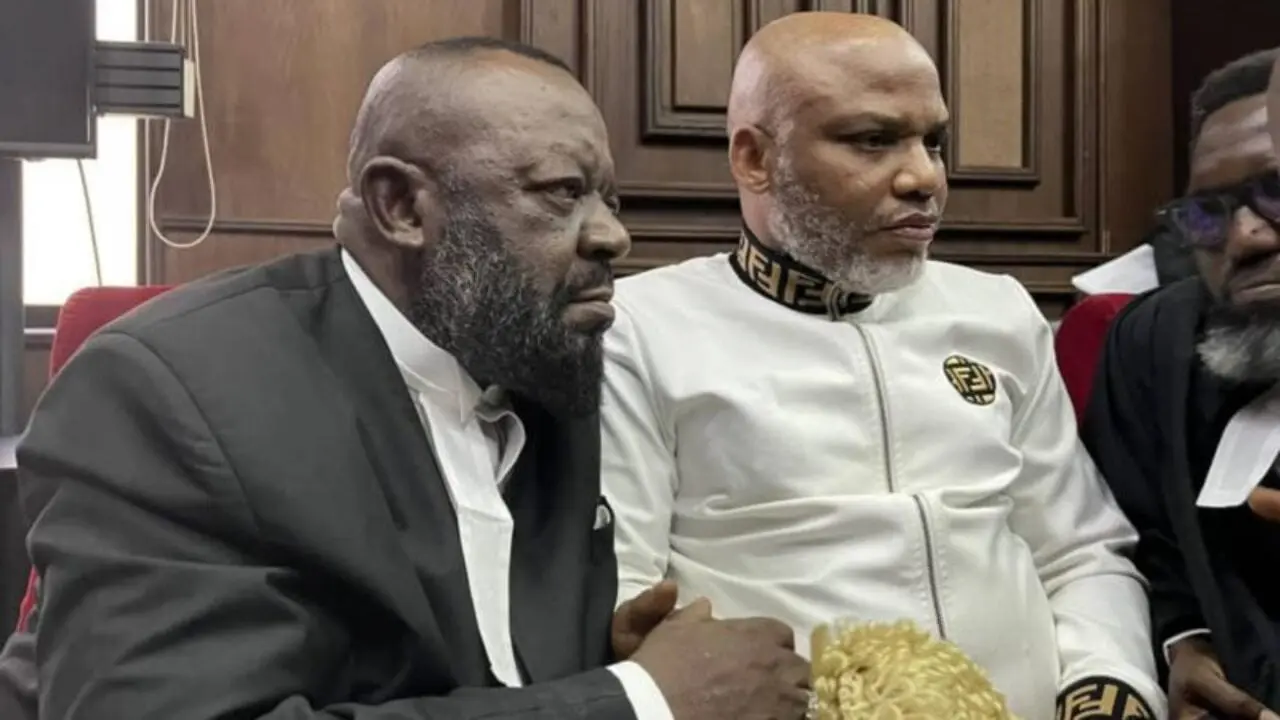
The trial of Nnamdi Kanu, leader of the proscribed Indigenous People of Biafra (IPOB), resumed at the Federal High Court in Abuja on Tuesday, with a senior operative of the Department of State Services (DSS), testifying as the third prosecution witness.
Identified by the pseudonym Mr. CCC, the witness-who has served in the DSS for 27 years-described Kanu as the head of IPOB and the commander of its armed wing, the Eastern Security Network (ESN).
He alleged that Kanu used broadcasts on Radio Biafra to incite violence and instigate killings across parts of the country.
Mr. CCC stated that he first encountered Kanu in October 2015, during which he conducted a series of recorded interviews with him between October 21 and 24 at the DSS headquarters.
According to the witness, Kanu did not object to the interviews being recorded and voluntarily submitted three written statements.
Prosecuting counsel, Adegboyega Awomolo (SAN), presented two CDs purportedly containing the video recordings of those interviews, which Mr. CCC confirmed and were subsequently admitted into evidence by the court. Three written statements allegedly made by Kanu were also tendered.
Initially, Kanu’s defense team did not object to the admissibility of the statements.
However, following a consultation, lead defense counsel Chief Kanu Agabi (SAN), informed the court that his client claimed the statements were made under duress.
In response, Justice James Omotosho requested that the defense specify the elements of coercion alleged.
Agabi requested more time to confer with Kanu, which the court granted.
Upon resumption, Agabi told the court that Kanu claimed he had asked for legal representation during the DSS interrogation, but was denied.
Kanu also alleged he was held in solitary confinement in an underground cell, where he was threatened by a DSS operative named “Mr. Brown” to write dictated statements.
He further claimed he was forced to make disparaging remarks about former President Goodluck Jonathan and ex-Imo State Governor Rochas Okorocha.
Kanu reportedly experienced frequent nosebleeds during his detention.
A DSS doctor had advised he be allowed an hour of fresh air daily to ease his condition-an allowance the defense alleges was used as leverage for compliance.
The prosecution, however, dismissed these claims. Awomolo argued that the statements were made voluntarily, adding that video evidence of the interviews would demonstrate that no intimidation or coercion occurred.
To determine the voluntariness of Kanu’s statements, Justice Omotosho ordered a “trial within trial”, a legal process aimed at evaluating the legitimacy of the allegations.
Testifying in the mini-trial, Mr. CCC denied knowledge of any DSS operative named “Mr. Brown” and stated that only he and another officer named Ibrahim were involved in the interrogation.
He refuted claims of solitary confinement and maintained that Kanu never requested legal representation.
“I am genuinely surprised to hear these claims of duress now,” the witness told the court, describing the allegations as fabricated.
Mr. CCC further testified that during the October 24, 2015, session, Kanu was shown a video of an interview he had granted to Sahara Reporters, in which he allegedly referred to Nigeria as a “zoo,” accused Okorocha of attempting to Islamize the Southeast, and made derogatory remarks about then-President Muhammadu Buhari. Kanu, according to the witness, admitted to being the person in the video.
The prosecution also submitted footage from a November 4, 2015, interview in which Kanu allegedly discussed inspecting a smuggled radio transmitter installed in Anambra State. Mr. CCC confirmed that Kanu identified himself in that recording as well.
The court admitted the corresponding CD into evidence.
The trial continues as the court weighs the credibility of the duress claims against the evidence presented by the prosecution.