
Education
Ex-VC Bamiro Advocates for Financial Reforms in Universities to Combat Dependency on Government Funding


By Samson Adeyanju
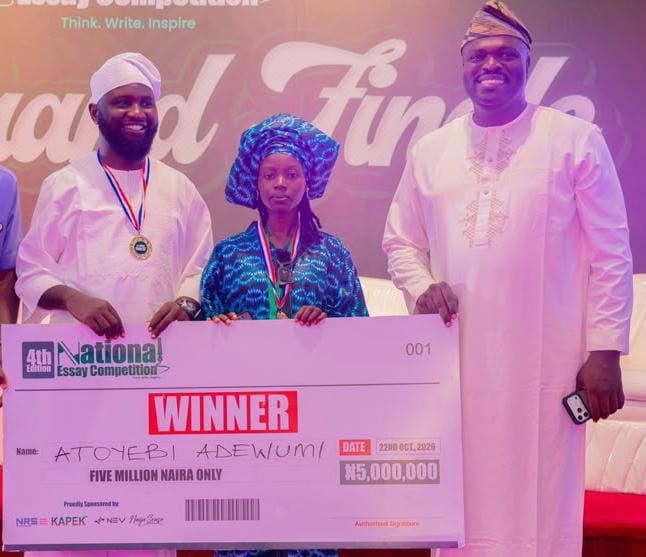
Atoyebi Adewumi has emerged winner of the fourth edition of the National Essay Competition, beating more than 2,000 contestants in an intellectual contest aimed at promoting academic excellence, critical thinking and creative writing among young Nigerians.
The competition, which focused on the relevance of taxation to national development, challenged participants to examine the role of tax revenue in financing public services, stimulating economic growth and strengthening the relationship between government and citizens.
The initiative provided a platform for young Nigerians to demonstrate their writing skills, articulate informed perspectives on national issues and contribute ideas towards building a more responsible and progressive society.
Speaking after being declared winner, an elated Adewumi expressed gratitude to the convener, Foluso Sylvanus Ojo, and the organising team for providing young Nigerians with an opportunity to showcase their intellectual abilities.
“I am so glad, very, very glad, to have this privilege of emerging as the winner. I am grateful to the convener and the entire team, as well as everyone who supported this vision,” Adewumi said.
In his remarks, Ojo expressed concern over the tendency to criticise the attitudes and lifestyles of younger generations without providing adequate opportunities to nurture their talents and channel their energies towards productive pursuits.
He called on the government, corporate organisations and nongovernmental organisations to invest more in educational initiatives that promote intellectual excellence, creativity and responsible citizenship.
According to him, sustained investment in academic competitions and youth development programmes would encourage discipline, innovation and a stronger commitment to national development.
Drawing a comparison with the substantial cash prizes awarded in some reality television competitions in Nigeria, Ojo argued that students and intellectually gifted young Nigerians deserved greater recognition, financial support and encouragement.
“I believe the government should support initiatives like this because individuals need supportive hands, especially from the government. When they receive such support, they become more confident and motivated to continue their good work,” he said.
Ojo maintained that society could not continue to complain about the attitudes and lifestyles of young people without deliberately investing in programmes that encourage positive values and productive engagement.
The fourth edition of the competition also underscored the importance of tax awareness among young Nigerians, highlighting how effective taxation, transparency and accountable governance could contribute to improved infrastructure, education, healthcare and other essential public services.
Beyond celebrating the winner, the competition reinforced the need to identify, encourage and empower emerging intellectual talents capable of contributing meaningfully to Nigeria’s development.

Winner of the 5,000,000 naira 
Winner of 3,000,000 naira 
Winner of 2,000,000
All the participants


By Samson Adeyanju
Twenty finalists from across Nigeria have begun the final stage of the fourth edition of the National Essay Competition in Abuja, following an orientation session designed to prepare them for the decisive examination.
The finalists arrived in the Federal Capital Territory for a four-day, all-expenses-paid programme featuring the essay examination, institutional tours and opportunities for learning and networking.
The competition, the brainchild of Mr Foluso Ojo, is sponsored by the Nigeria Revenue Service (NRS).
Ahead of the examination, the finalists participated in an orientation session led by Professor Omotosho Borisade of Ekiti State University, who serves as the competition’s umpire.
The session familiarised participants with the competition’s rules and regulations, examination guidelines and assessment criteria, helping them understand the requirements of the final stage.
The essay examination is scheduled to begin today at 9 a.m., after which the finalists are expected to embark on institutional tours around Abuja.
The programme is designed to extend beyond the contest itself, exposing the finalists to new learning opportunities, professional connections and experiences in the nation’s capital.
The competition brings together young Nigerians to demonstrate their writing ability, knowledge, creativity and critical-thinking skills as they compete for the top honours.
With the finalists prepared for the examination, attention now turns to their performance and the eventual emergence of the competition’s champion.






Bwala Projects APC Wins in Three South-East States, Cites Obi’s Influence

Abuja’s Property Agents: The Growing Business of Exploiting House Hunters

CAS Set To Decide Senegal, Morocco AFCON 2025 Title Controversy On Tuesday



-
 Business12 hours ago
Abuja Entrepreneurs Battle Rising Costs, Weak Consumer Spending
-
 News10 hours ago
Atiku Support Groups Back Obi, but Opposition Alliance Remains Unsettled
-
 Abuja Reports10 hours ago
‘Even in Aso Rock, Water No Dey’: Tinubu Recalls Villa Outage
-
 Abuja Reports9 hours ago
Abuja’s Property Agents: The Growing Business of Exploiting House Hunters
-
 News12 hours ago
Outrage As Foreign Tourist Accuses Daura Emir Of Sexual Assault Inside Palace
-

 Sports12 hours ago
Liverpool Humiliate Man United as Leeds Shock Chelsea in Dramatic Premier League Weekend
-
 Sports9 hours ago
CAS Set To Decide Senegal, Morocco AFCON 2025 Title Controversy On Tuesday
-
 2027 General Elections6 hours ago
Bwala Projects APC Wins in Three South-East States, Cites Obi’s Influence