Connect with us

News

2024 Africa Sustainable Development Report Highlights Urgent Need for Enhanced Financing, Reforms

Published

on

The United Nations Development Programme (UNDP), the United Nations Economic Commission for Africa (ECA), and the African Development Bank (AfDB) presented the 2024 Africa Sustainable Development Report (ASDR) at an event held on the margins of the UN High-Level Political Forum for Sustainable Development in New York. The report, titled “Reinforcing the 2030 Agenda and Agenda 2063 and Eradicating Poverty in Times of Multiple Crises: The Effective Delivery of Sustainable, Resilient and Innovative Solutions,” calls for scaled-up access to concessionary development financing, strengthened climate information and early warning systems, and economic reforms.

The report provides an in-depth review of African countries’ progress towards five sustainable development goals (SDGs) and their 32 targets to meet the 2030 Agenda and the African Union 2063 Agenda. The five SDGs under review are: ending poverty (Goal 1); eliminating hunger (Goal 2); combating climate change (Goal 13); promoting peaceful societies (Goal 16); and strengthening global partnerships (Goal 17).

Research indicates that Africa is on track to reach fewer than three of the 32 targets assessed in this report. Setbacks have been recorded for eight targets, with slow progress or status quo registered for the remaining targets.

“Advanced economies have rebounded from COVID-19, but many countries in Africa struggle with high debt, double-digit inflation, and limited access to crucial development and climate funding. Disparities in the Human Development Index are widening between top-ranking nations and those at the bottom, highlighting significant challenges across Africa despite some progress in recent decades,” said Claver Gatete, ECA Executive Secretary.

Official Development Assistance (ODA) to Africa increased by two percent in 2023, but the total ODA remains at 0.37 percent of donors’ combined Gross National Income, well below the 0.7 percent target agreed on by UN Member States. Given the short period remaining before the 2030 SDG deadline, most countries may fail to mobilize adequate resources to close their financing gap.

“African countries have made some significant progress in important areas, but we are running out of time,” stressed Matthias Naab, UNDP Africa Deputy Regional Director a.i. “It is imperative we reinforce partnerships and look at innovative solutions to stop the current deceleration—and even reversal in some areas—and work more closely with African countries and people to get back on track towards our Global Goals and the Africa We Want. This report provides a path to this critical acceleration.”

Africa has made strides in poverty reduction (Goal 1), despite setbacks from crises like COVID-19, which significantly increased poverty rates. In 2022, Africa accounted for more than half (54.8 percent) of people living in poverty worldwide. Efforts are underway to enhance social protection systems, currently covering only 17.4 percent of the population, though still below the global average. Access to drinking water has increased from 68.7 percent in 2015 to 72.9 percent, and basic sanitation services now reach 52 percent of the population, with ongoing efforts to meet global standards.

Efforts to combat hunger, undernourishment, and stunting (Goal 2) in Africa are crucial. Despite challenges, such as increased hunger affecting 281.6 million people in 2022, initiatives are underway to address these issues and need urgent support. Measures include improving agricultural investment and aid to enhance food security.

Africa has demonstrated remarkable resilience and commitment to addressing climate change (Goal 13). Efforts to enhance disaster risk reduction continue, though the number of countries having established national and local disaster risk reduction strategies remains at 29 out of 54 since 2015. Financing climate action in Africa is paramount; however, only $29.5 billion of the $2.8 trillion needed between 2020 and 2030 for African countries to implement their NDCs under the Paris Agreement has been mobilized.

“Financing remains a challenge for Africa. It needs between $118.2 billion and $145.5 billion per year to implement the continent’s climate action commitments and Nationally Determined Contributions. This requires development partners to scale up their support, including by strengthening the system of public development banks focusing on enhancing productive capacities, infrastructure, and human capital development. African countries must prioritize domestic resource mobilization through reforms such as digitizing tax administration systems, implementing progressive taxation, and leveraging digital payment platforms,” explained Al Hamndou Dorsouma, Manager of the AfDB Climate Change and Green Growth Division.

In terms of governance (Goal 16), some nations, such as Malawi, have taken significant measures to combat corruption, though it remains a significant challenge in many African countries, with stagnant progress and rising instances of bribery. High illicit financial flows, totaling around $1.3 trillion in outflows and $1.1 trillion in inflows in 2020, continue to hinder the financing of key agendas, with Africa losing about $88.6 billion annually.

The ASDR also highlighted key data gaps in many countries on the continent and recommends that policymakers and academics prioritize skills and capacity building to have a more accurate picture of the state of countries’ achievements and needs in terms of inclusive and sustainable development.

“This new report underscores African countries’ commitment and progress, but it also highlights the challenges that remain for us to shape up ‘The Africa We Want.’ It stresses the urgent need to accelerate sustainable development actions and the imperative for African countries to step up their efforts and empower communities for more inclusive growth. It also clearly shows how innovative financing and strengthened partnerships are key for countries to redouble their efforts,” said Monique Nsanzabaganwa, Deputy Chairperson of the African Union.

Continue Reading
Click to comment

Leave a Reply

Your email address will not be published. Required fields are marked *

News

Pastor Ogundipe Decries Lack of Integrity Among Educated Nigerians

Published

on

By

By Samson Adeyanju

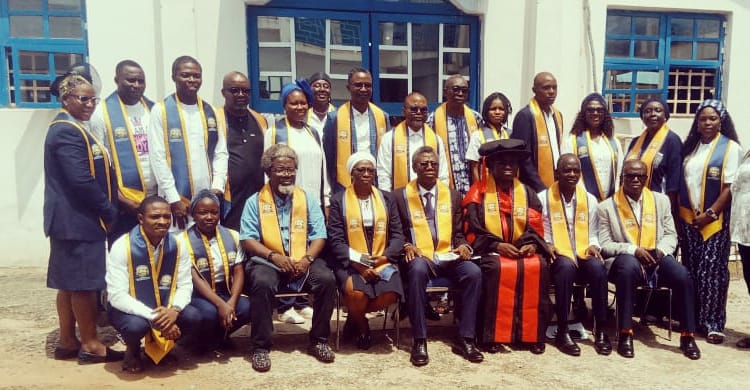
Pastor Alex Ogundipe, Chairman of the Governing Board of Christian Heritage International Bible College, Kubwa, Abuja, has expressed concern over the growing number of educated Nigerians who lack the character and integrity required to make meaningful contributions to society.

Ogundipe raised the concern during the matriculation ceremony of the institution’s 60 pioneer students, stressing that academic qualifications without moral discipline and upright character could undermine national development.

According to him, Nigeria has many knowledgeable and academically accomplished individuals whose inability to demonstrate integrity has negatively affected their contributions to their families, workplaces and communities.

“We have too many people in this country who are knowledgeable and wise in their own ways, but they do not have character and integrity. That affects their ability to impact their communities,” he said.

The cleric emphasised that education must go beyond the acquisition of certificates to the development of individuals who demonstrate honesty, accountability, faithfulness and commitment to serving humanity.

He explained that true integrity required consistency in personal conduct, whether at home, in the church, at work or within the larger society.

Ogundipe said the college was established not merely to impart biblical knowledge but to raise men and women whose lifestyles reflect Christian values and whose contributions would positively influence society.

He urged Christian leaders to demonstrate their faith through practical actions rather than mere religious declarations.

Speaking on Nigeria’s future, the cleric encouraged citizens to remain hopeful, pray for the country and contribute meaningfully to national peace, unity and development.

Earlier, the Rector of the institution, Pastor Samson Olukayode Aliyu, challenged the matriculating students to prioritise spiritual maturity and moral discipline alongside academic excellence.

Aliyu warned against examination malpractice, plagiarism, dishonesty and other forms of misconduct, stressing that academic certificates could demonstrate knowledge but could not substitute for good character.

“The Church does not only need gifted people; it needs godly people. We need leaders who will choose integrity over compromise, humility over pride, faithfulness over convenience and service over self-interest,” he declared.

He explained that the college offers six-month certificate programmes in theology and one-year diploma programmes in theology, leadership and prophetic studies.

One of the matriculating students, Akeem Omobolanle, who enrolled in the Diploma in Leadership programme, commended the institution’s approach to biblical education and expressed optimism that the training would strengthen his understanding of the Scriptures and prepare him for greater service in Christian ministry.

The ceremony marked the formal admission of the college’s pioneer students into its academic community.

Continue Reading

Economy

Private Capital Critical To Nigeria’s Industrial Future -Omoyele

Published

on

By

By Samson Adeyanju 

Private capital will be critical to Nigeria’s industrial future as the country seeks to address infrastructure gaps, improve energy supply and strengthen economic productivity, Bayonle Omoyele has said.

Omoyele, a PhD student and guest speaker at the Abuja Economic Dialogue organised by the Faculty of Management Sciences, Nile University of Nigeria, Abuja, said the discussion would examine Nigeria’s economic situation and trade outlook in simple, everyday language.

The dialogue, scheduled for October 6, 2026, has as its theme, “Powering the Next Economy: Energy, Infrastructure & the Private Capital Imperative for Nigeria’s Industrial Future.”

Omoyele said the dialogue would also examine why people in the informal sector and at the bottom of the economic pyramid continue to struggle despite various microeconomic and macroeconomic policies.

He said the discussion would interrogate the gap between economic policies and their impact on the daily lives and businesses of ordinary Nigerians.

A major focus will be the role of private investment in addressing energy and infrastructure challenges affecting productive activities and industrial development.

The dialogue is also expected to examine how Nigeria can create conditions that encourage private capital to flow into productive sectors while expanding economic opportunities for businesses and individuals in the informal sector.

The discussion will further consider Nigeria’s trade outlook and the structural issues affecting the country’s prospects for sustainable and inclusive economic growth.

The event is scheduled to hold from 10 a.m. to 12 noon at the Block A, second-floor Conference Hall, Nile University of Nigeria, Abuja.

Continue Reading

Judiciary

Chamber Commissioning: Every Empire Will Expire, Akintola Tells Nigerian Leaders

Published

on

By

By Samson Adeyanju

A Senior Advocate of Nigeria, Chief Adeniyi Akintola, has cautioned Nigerian leaders and public office holders against abusing power, stressing that no position of authority or political influence is permanent.

Akintola gave the warning at the commissioning of Dayo Ajibola & Associates, also known as SBA Chambers, where he urged those in positions of authority to remain humble, remember their roots and prepare for life after office.

“Every empire will expire. Let those who are holding public office get this into their heads. Every empire will expire. Every person in a position of authority will come to a time when he will no longer be relevant,” he said.

The legal practitioner also warned politicians against sacrificing people for political interests, urging professionals who interact with political leaders to be cautious and maintain clear boundaries between their principles and political relationships.

He said money should not be allowed to determine a person’s values or professional decisions, urging young lawyers to resist the temptation of seeking immediate financial rewards.

According to him, younger lawyers should focus on building credibility, relationships and professional competence rather than demanding large fees from every client.

“The younger generation lawyers are making the mistake of wanting that money now, now, now. It doesn’t work that way,” Akintola said.

He advised lawyers to carefully assess the clients they represent and avoid fraudulent individuals and activities.

“We have a standard in our office. No room for 419,” he said, stressing that professional reputation remained more valuable than short term financial gains.

Akintola further urged young professionals not to live beyond their means, saying proper financial planning was necessary for sustainable careers and businesses.

He explained that his law office makes provisions for the maintenance and replacement of office equipment, noting that professionals must plan for unforeseen expenses instead of spending all their earnings.

“If you take good care of your job, your job will take good care of you,” he said.

The Senior Advocate also emphasised discipline and commitment to legal practice, particularly punctuality and diligence in handling clients’ briefs.

“The court will not wait for you. You should be in court latest by 8:30. The client that gives you a brief is not waiting for stories. He wants results,” he said.

Akintola urged senior lawyers to continue mentoring younger practitioners and advised employees to remain loyal and committed to their employers.

He also encouraged the new generation to remain prayerful, disciplined and patient, saying genuine professional success is built over time.

Speaking at the occasion, Senator Abdulfatai Buhari, representing Oyo North Senatorial District, commended Akintola for his commitment to mentoring younger professionals.

Buhari, who said he had adjusted his international travel plans to attend the event, congratulated Dayo Ajibola on the commissioning of the chambers.

He said the presence of senior practitioners and other distinguished personalities at the event demonstrated the respect Akintola had earned through his character and professional relationships.

Buhari urged Akintola to remain focused despite betrayal, blackmail and disappointment, saying the growth of people he had mentored should give him satisfaction.

“People will still continue to betray. People will continue to blackmail. People will continue to misbehave, but just be happy that the people you are training are coming up, and you are seeing them growing,” he said.

In his vote of thanks, Barrister Dayo Ajibola, principal of the newly commissioned chambers, expressed appreciation to Akintola, senior lawyers, public officials, friends and other guests for honouring the occasion.

Ajibola, who became emotional while recounting some of the challenges he had overcome, attributed his survival and progress in life to God’s protection, prayers and the support of family, mentors and friends.

He disclosed that he had obtained bachelor’s and master’s degrees before returning to study law, describing his journey into the legal profession as one marked by several challenges and near tragedies.

Ajibola thanked Akintola for his mentorship and described his presence at the commissioning as a significant honour.

He also expressed appreciation to the senior members of the legal profession who attended the ceremony, saying their support had encouraged him to continue building the new law firm.

The commissioning marked a significant milestone for Dayo Ajibola & Associates and brought together members of the legal profession, political figures, friends and associates.

Continue Reading

Trending