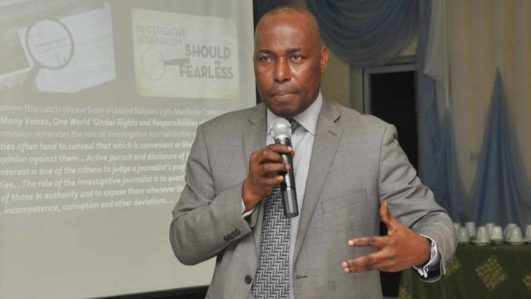
To enhance Nigeria’s global competitiveness in the education sector and attract international students and researchers, The Guardian’s Managing Director and Editor in Chief, Martins Oloja, emphasized the necessity for urgent government policies. In a lecture at Adekunle Ajasin University, Akungba Akoko (AAUA), titled ‘Internationalization of university education for global relevance: Experiences, barriers, and prospects,’ Oloja urged the government to prioritize teacher training, create conducive learning environments, and revive the culture of scholarship.
Oloja stressed the importance of national strategies to attract the best international students and researchers. He called for increased funding, motivation for teachers and students, and the provision of necessary tools to enable growth, development, and effective functioning in the global economy. He highlighted the need for well-equipped schools with functional libraries, modern instructional technologies, and relevant courses preparing students for the challenges of the 21st century economy.
The media chief advocated for admissions based on merit, relevant courses, and tuition payment in tertiary institutions. Oloja argued that higher education should not be free, emphasizing the importance of paying for services to ensure accountability and quality. He proposed the use of ‘Professors of Practice’ and questioned the status of the NUC’s Linkages with Experts and Academics in the Diaspora Scheme (LEADS), urging its revival to attract Nigerian academics abroad.
Calling for a genuine emergency on education, Oloja warned of the consequences of inferior education, mass unemployment, and social vices if the crisis in the sector is not treated as a public health issue. He urged the government to invest consciously and sincerely in the sector to attract foreign students and scholars, citing successful models like Afe Babalola University (ABUAD) and Federal University, Oye Ekiti (FUOYE), which employ ‘Professors of Practice.’
Oloja concluded by calling for the involvement of the diaspora commission to create a register of the country’s professors abroad and revive the LEADS project.