Connect with us

News

Tinubu Dismisses Opposition, Declares APC Best Choice Ahead of 2027 Elections

Published

on

By Patrick Idowu

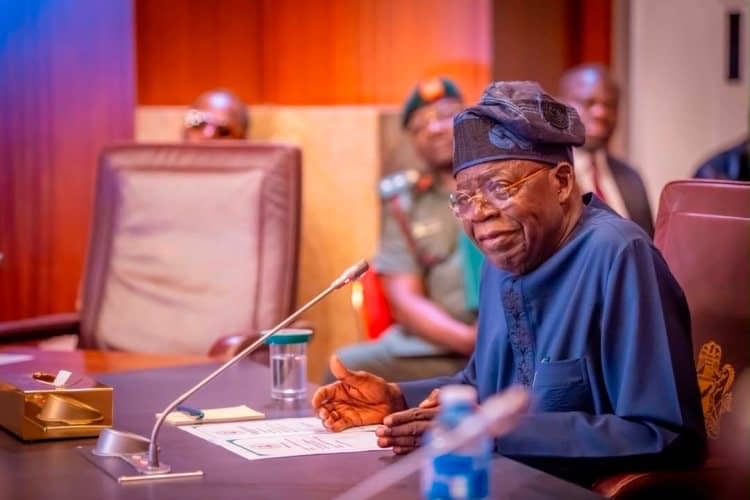
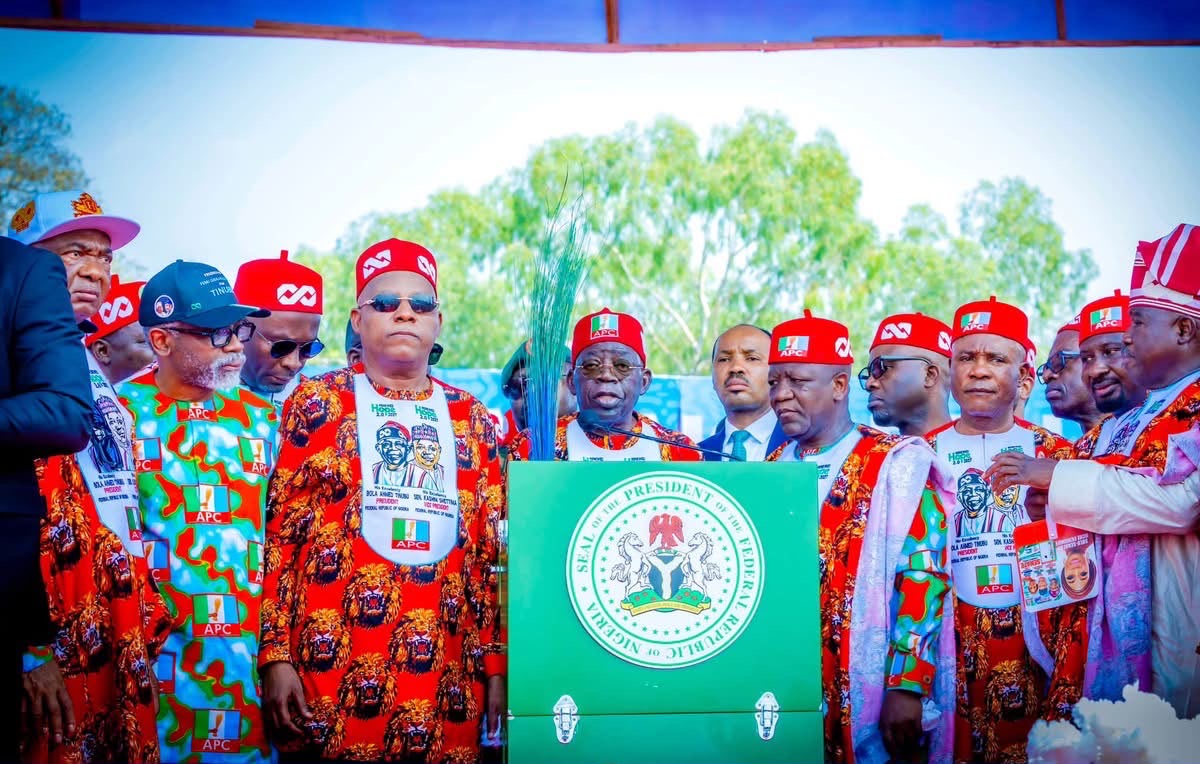
President Bola Tinubu has declared that opposition parties no longer pose a credible challenge to the All Progressives Congress (APC), urging voters in Enugu State and across the South-East to throw their weight behind the ruling party in the 2027 general elections.

The President made the declaration on Saturday during the flag-off of the APC campaign rally in Enugu, where he called on residents to obtain their Permanent Voter Cards (PVCs) and mobilise their families, friends and communities to vote for all APC candidates.

Addressing the crowd, Tinubu dismissed opposition parties as lacking the vision and capacity to lead the country, insisting that the APC remained the best platform for national unity, peace and development.

“Don’t let anybody deceive you. The other parties, they don’t exist, they don’t have plans, they don’t know the road,” he declared.

The President also expressed confidence in the growing political support for the APC in the South-East, citing the presence of prominent political figures, including former Abia State Governor Orji Kalu, former Senate President Pius Anyim, Deputy Speaker of the House of Representatives Benjamin Kalu and businessman Arthur Eze.

He urged the electorate to extend their support to the APC beyond the presidential election by voting for its candidates in National Assembly and other electoral contests.

In a major announcement at the rally, Tinubu disclosed that his administration had approved the Eastern Rail Line project and a 400-kilometre gas pipeline for the South-East, describing the projects as concrete commitments to the region’s development.

According to him, the Eastern Rail Line would improve connectivity between the South-East, South-South and Northern parts of the country, while addressing longstanding concerns about the region’s inclusion in national infrastructure development.

He also pledged interest-free loans, financial assistance and improved infrastructure for farmers to boost agricultural production and reduce the cost of farming.

Vice-President Kashim Shettima, who also addressed the gathering, urged the South-East to consolidate its political relationship with the APC, arguing that the region stood to benefit from its alliance with Tinubu.

Shettima described the President as an alliance builder and maintained that the South-East could not afford to remain outside the ruling party’s political arrangement.

He also took a swipe at opposition figures, including former Vice-President Atiku Abubakar and former Anambra State Governor Peter Obi, suggesting that their political ambitions would end in defeat.

In a humorous remark, the Vice-President said Atiku would be returned to Adamawa after the election, while joking that Tinubu could appoint Obi as chairman of the South-East Development Commission after the 2027 polls.

Deputy Speaker Benjamin Kalu also called on the people of the South-East to support Tinubu’s second-term ambition, arguing that the President had demonstrated commitment to the region through infrastructure projects and the establishment of the South-East Development Commission.

Meanwhile, Imo State Governor Hope Uzodinma, speaking on behalf of the South-East governors, declared that the region was prepared to deliver massive votes for Tinubu and all APC candidates in 2027.

Uzodinma, who chairs the Progressive Governors Forum, said the decision followed an assessment of the President’s performance and federal government interventions in the region between 2023 and 2026.

He described the administration’s record as more significant than the contributions of previous federal governments to the South-East since the end of the Nigerian Civil War.

All five South-East governors received Tinubu at the Akanu Ibiam International Airport in Enugu, alongside the Governor of Delta State.

However, Abia State Governor Alex Otti left after the airport reception, while Anambra State Governor Chukwuma Soludo joined the presidential campaign procession to Okpara Square and remained at the rally until its conclusion.

The Enugu rally forms part of the APC’s efforts to strengthen its political foothold in the South-East ahead of the 2027 general elections.

Continue Reading
Click to comment

Leave a Reply

Your email address will not be published. Required fields are marked *

Abuja Reports

Abuja Police Move to Prosecute Woman Over Alleged Suicide Attempt in Hotel

Published

on

By Patrick Idowu

The Federal Capital Territory (FCT) Police Command is considering legal action against a woman identified as Ms Jumoke following an alleged suicide attempt at a hotel in Jikwoyi, Abuja.

The woman was reportedly rescued by police operatives after she allegedly ingested a poisonous insecticide suspected to be Sniper inside her hotel room.

The incident occurred on November 26, 2026, after she checked into the hotel at about 12:30 p.m. She was later discovered gasping for breath by a visitor who had come to see her.

According to a statement issued by the command’s spokesperson, CSP Josephine Adeh, the Jikwoyi Police Division received information about the incident at approximately 2 p.m. and immediately deployed officers to the scene.

Preliminary investigations reportedly indicated that the woman had consumed the suspected poisonous substance, while an empty bottle of Sniper insecticide was recovered from the room.

She was subsequently rushed to a nearby hospital, where medical personnel confirmed the ingestion and commenced treatment.

The police said further investigations were ongoing, with the possibility of prosecution being considered in connection with the incident.

Continue Reading

News

Tinubu Seeks ₦3.1trn Budget Cut as ₦31.4trn Deficit Remains

Published

on

By Edisemi Andrew

President Bola Tinubu has asked the National Assembly to approve a ₦3.147 trillion reduction in the 2026 Federal Government budget, proposing a downward revision of total expenditure from ₦68.323 trillion to ₦65.176 trillion.

The request, contained in a letter transmitted to the Senate and the House of Representatives, seeks legislative approval for a revised 2026 Appropriation Bill and an updated fiscal framework aimed at aligning government spending with available resources and existing financial obligations.

Under the revised proposal, projected government revenue, including receipts from government-owned enterprises, stands at ₦33.720 trillion, while capital expenditure is estimated at ₦26.232 trillion.

However, despite the proposed reduction in overall spending, the Federal Government’s projected fiscal deficit remains unchanged at ₦31.457 trillion, representing 5.64 per cent of the country’s Gross Domestic Product.

The proposed borrowing target has also been retained at ₦29.218 trillion, comprising ₦18.428 trillion in domestic borrowing and ₦10.790 trillion in external borrowing.

Explaining the rationale behind the adjustment, Tinubu said the revision was intended to prioritise existing government commitments, improve budget credibility, strengthen capital budget implementation and maintain fiscal discipline.

The President also explained that the proposed $7.7 billion external loan, estimated at approximately ₦10.368 trillion, would finance an existing foreign borrowing provision rather than increase the overall borrowing limit already captured in the fiscal framework.

The revised proposal reportedly makes provisions for outstanding obligations, debt-service requirements, capital warrants and commitments involving ministries, departments and agencies.

Some additional capital provisions have also been included for priority interventions, particularly critical road projects, agricultural production, improved market access and water security.

The proposal has been referred to the appropriate Senate committee for legislative consideration, with the National Assembly expected to scrutinise the revised estimates before reaching a decision.

The proposed adjustment raises important questions about the country’s fiscal position, particularly the decision to reduce total expenditure without a corresponding reduction in the projected deficit or borrowing requirement.

With projected revenue significantly below proposed expenditure, the government will continue to depend heavily on borrowing to finance its obligations and development programmes.

The retention of the deficit also raises questions about the extent to which the proposed spending reduction will ease pressure on public finances, especially considering the country’s existing debt-servicing commitments and competing development needs.

For Nigerians, the implications extend beyond the figures presented to lawmakers. Changes to capital expenditure could affect the pace of infrastructure delivery, federal projects and other public investments, making transparency around affected projects particularly important.

The National Assembly’s consideration of the revised framework will therefore be an important opportunity to examine the assumptions behind the government’s revenue projections, borrowing plans and expenditure priorities.

Ultimately, the effectiveness of the proposed review will depend on whether it improves budget implementation, reduces waste and ensures that public borrowing translates into measurable economic and social benefits.

The revised proposal now awaits legislative approval, as attention increasingly turns towards the Federal Government’s preparation and presentation of the 2027 national budget.

Continue Reading

News

Atiku, Obi, Makinde Lead Opposition Push for Unity Pact Ahead of 2027

Published

on

By Edisemi Andrew

Opposition political leaders are preparing to take another step towards a possible common political front against President Bola Tinubu and the ruling All Progressives Congress (APC), with a coalition summit scheduled for Monday, November 30, in Abuja.

The meeting, organised under the Coalition for Democracy, is expected to bring together prominent opposition figures, including former Vice-President Atiku Abubakar, former Anambra State Governor Peter Obi and Oyo State Governor Seyi Makinde, alongside other party leaders and presidential candidates.

The coalition, which brings together six political parties and political factions, is seeking to move ongoing consultations beyond political discussions towards a formal agreement on cooperation ahead of the 2027 general elections.
Its participating groups include the African Democratic Congress (ADC), Allied Peoples Movement (APM), Nigeria Democratic Congress (NDC), a faction of the Peoples Democratic Party (PDP), Peoples Redemption Party (PRP) and Social Democratic Party (SDP).

According to Salihu Mohammed Lukman, one of the coalition’s conveners, the summit will consider three foundational documents: the National Covenant for Democratic Renewal, the Framework for Opposition Unity and the National Reform Programme.

The documents are intended to establish common principles for political cooperation, democratic reforms, electoral integrity and a shared approach to national governance.

The coalition’s leadership has also indicated that member parties agreed to suspend campaign activities on the day of the summit to facilitate the participation of their presidential candidates and national party leaders.

However, the proposed alliance faces a significant challenge: reconciling the individual presidential ambitions of its leading members.

Atiku, Obi and Makinde are associated with different political platforms and have their respective electoral interests to protect. Other candidates, including Donald Duke and Adewole Adebayo, are also part of the wider opposition discussions.

Although reports have suggested negotiations over possible political arrangements and power-sharing, no publicly confirmed agreement on a joint presidential candidate has emerged.

The situation has also attracted criticism from within party structures. An APM chieftain in Oyo State, Adebisi Olopoeyan, recently questioned Makinde’s authority to negotiate on behalf of the party’s state structure, citing an unresolved internal leadership dispute.

The ruling APC, meanwhile, has indicated that it is not threatened by the opposition discussions, maintaining that the emergence of a coalition does not automatically translate into electoral strength.

Beyond the question of who leads a possible joint ticket, the opposition will also have to address the practical issues of party structures, campaign financing, candidate selection, internal disputes and coordination of polling-unit agents.

The November 30 summit could therefore become an important test of whether Nigeria’s opposition parties can translate their shared desire to challenge the ruling party into a workable political arrangement.

For Nigerians, the significance of the proposed coalition will ultimately depend on more than the number of political leaders attending the meeting. Its ability to present a credible alternative, articulate clear policy priorities and maintain internal unity will determine whether it can become a serious force in the 2027 elections.

Continue Reading

Trending

taraftarium24seo ajansıseo ajansıgiftcardmall/mygiftjustin tvcasibomcasibomGrandpashabetjojobettaraftarium24taraftarium24rojadirectajustin tvJojobet Akış ve DuyurularGrandpashabet Yayın ve DuyuruGrandpashabetGrandpashabetgrandpashabetGrandpashabetGrandpashabetGrandpashabetMatbetholiganbetHoliganbet girişholiganbetHoliganbetmrkingcasibomholiganbetcasibomgrandpashabetDeneme Bonusu Veren SitelervdcasinovdcasinosahabetsahabetvdcasinovdcasinoJojobetMatbetMatbetjojobetcasinolevantcasinolevantcasinolevantjojobetcasibomjojobetjojobetgrandpashabetgrandpashabetmatbetvdcasinosahabetmarsbahismatbetjojobetGrandpashabetJojobetcasinolevantmarsbahismarsbahismarsbahisgrandpashabet girişGrandpashabetjojobetjojobetjojobetjojobetjojobetjojobetmrkingdedebetDeneme Bonusu Veren Sitelerjojobetjojobet girişvdcasinojojobet