Connect with us

News

Nigerian Researcher Develops AI Model for Personalized Cancer Treatment

Published

on


By Huldah Shado

A Nigerian-born researcher in the United States has achieved a major breakthrough in the fight against cancer through the development of an innovative artificial intelligence (AI), model.

Dr. Kayode Raheem, a PhD researcher in Bioinformatics and Systems Biology at the University of Nebraska Medical Center, has created SpatioMorph-Rx, an advanced AI model designed to accurately predict how cancer cells respond to treatment.

The model integrates high-resolution imaging and genetic data to pinpoint tumor regions that are resistant to therapy.

This enables oncologists to personalize treatment strategies for each patient, improving effectiveness and minimizing harmful side effects.

Describing the model, Dr. Raheem said it functions like a digital microscope, zooming in on individual cells to analyze their reactions to specific drugs.

It maps clusters of resistant cells within tumors and provides a visual guide that clinicians can use to better target therapy.

Tested using data from non-small cell lung cancer patients, SpatioMorph-Rx successfully identified both treatment-resistant and sensitive areas within tumors.

The model is powered by a sophisticated AI engine capable of learning from existing patient data and applying its insights to new cases.

Crucially, the model employs Explainable AI techniques, allowing doctors to understand the genetic and visual markers driving resistance.

This transparency ensures clinical usability and trust in its recommendations.

Beyond this innovation, Dr. Raheem is leading other pioneering projects. In one, he used AI to design personalized neoantigen mRNA vaccines for breast cancer patients; vaccines tailored to trigger highly specific immune responses, offering a safer and more targeted treatment approach.

He is also exploring AI-based drug discovery from natural sources, including medicinal plants native to Nigeria, with the goal of expanding access to affordable and effective treatments.

Dr. Raheem’s work underscores the transformative role of AI in biomedical research and highlights the growing global impact of African scientists.

His contributions represent a new frontier in precision medicine and reinforce the potential for world-class research emerging from Nigeria and the diaspora.

Continue Reading
Click to comment

Leave a Reply

Your email address will not be published. Required fields are marked *

Abuja Reports

20 Finalists Begin Final Stage of National Essay Competition

Published

on

By

By Samson Adeyanju

Twenty finalists from across Nigeria have begun the final stage of the fourth edition of the National Essay Competition in Abuja, following an orientation session designed to prepare them for the decisive examination.

The finalists arrived in the Federal Capital Territory for a four-day, all-expenses-paid programme featuring the essay examination, institutional tours and opportunities for learning and networking.

The competition, the brainchild of Mr Foluso Ojo, is sponsored by the Nigeria Revenue Service (NRS).

Ahead of the examination, the finalists participated in an orientation session led by Professor Omotosho Borisade of Ekiti State University, who serves as the competition’s umpire.

The session familiarised participants with the competition’s rules and regulations, examination guidelines and assessment criteria, helping them understand the requirements of the final stage.

The essay examination is scheduled to begin today at 9 a.m., after which the finalists are expected to embark on institutional tours around Abuja.

The programme is designed to extend beyond the contest itself, exposing the finalists to new learning opportunities, professional connections and experiences in the nation’s capital.

The competition brings together young Nigerians to demonstrate their writing ability, knowledge, creativity and critical-thinking skills as they compete for the top honours.

With the finalists prepared for the examination, attention now turns to their performance and the eventual emergence of the competition’s champion.


Continue Reading

News

Pastor Ogundipe Decries Lack of Integrity Among Educated Nigerians

Published

on

By

By Samson Adeyanju

Pastor Alex Ogundipe, Chairman of the Governing Board of Christian Heritage International Bible College, Kubwa, Abuja, has expressed concern over the growing number of educated Nigerians who lack the character and integrity required to make meaningful contributions to society.

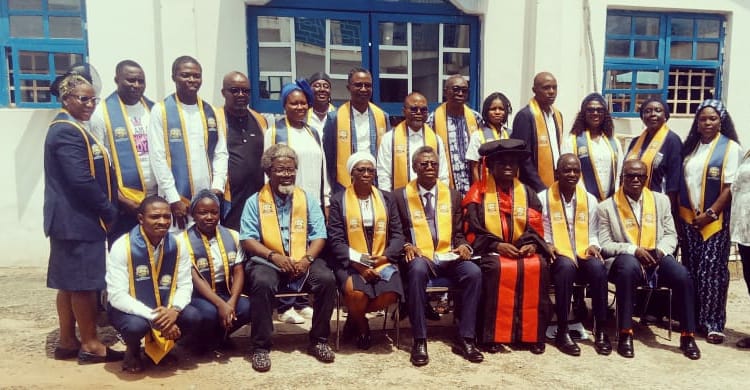
Ogundipe raised the concern during the matriculation ceremony of the institution’s 60 pioneer students, stressing that academic qualifications without moral discipline and upright character could undermine national development.

According to him, Nigeria has many knowledgeable and academically accomplished individuals whose inability to demonstrate integrity has negatively affected their contributions to their families, workplaces and communities.

“We have too many people in this country who are knowledgeable and wise in their own ways, but they do not have character and integrity. That affects their ability to impact their communities,” he said.

The cleric emphasised that education must go beyond the acquisition of certificates to the development of individuals who demonstrate honesty, accountability, faithfulness and commitment to serving humanity.

He explained that true integrity required consistency in personal conduct, whether at home, in the church, at work or within the larger society.

Ogundipe said the college was established not merely to impart biblical knowledge but to raise men and women whose lifestyles reflect Christian values and whose contributions would positively influence society.

He urged Christian leaders to demonstrate their faith through practical actions rather than mere religious declarations.

Speaking on Nigeria’s future, the cleric encouraged citizens to remain hopeful, pray for the country and contribute meaningfully to national peace, unity and development.

Earlier, the Rector of the institution, Pastor Samson Olukayode Aliyu, challenged the matriculating students to prioritise spiritual maturity and moral discipline alongside academic excellence.

Aliyu warned against examination malpractice, plagiarism, dishonesty and other forms of misconduct, stressing that academic certificates could demonstrate knowledge but could not substitute for good character.

“The Church does not only need gifted people; it needs godly people. We need leaders who will choose integrity over compromise, humility over pride, faithfulness over convenience and service over self-interest,” he declared.

He explained that the college offers six-month certificate programmes in theology and one-year diploma programmes in theology, leadership and prophetic studies.

One of the matriculating students, Akeem Omobolanle, who enrolled in the Diploma in Leadership programme, commended the institution’s approach to biblical education and expressed optimism that the training would strengthen his understanding of the Scriptures and prepare him for greater service in Christian ministry.

The ceremony marked the formal admission of the college’s pioneer students into its academic community.

Continue Reading

Economy

Private Capital Critical To Nigeria’s Industrial Future -Omoyele

Published

on

By

By Samson Adeyanju 

Private capital will be critical to Nigeria’s industrial future as the country seeks to address infrastructure gaps, improve energy supply and strengthen economic productivity, Bayonle Omoyele has said.

Omoyele, a PhD student and guest speaker at the Abuja Economic Dialogue organised by the Faculty of Management Sciences, Nile University of Nigeria, Abuja, said the discussion would examine Nigeria’s economic situation and trade outlook in simple, everyday language.

The dialogue, scheduled for October 6, 2026, has as its theme, “Powering the Next Economy: Energy, Infrastructure & the Private Capital Imperative for Nigeria’s Industrial Future.”

Omoyele said the dialogue would also examine why people in the informal sector and at the bottom of the economic pyramid continue to struggle despite various microeconomic and macroeconomic policies.

He said the discussion would interrogate the gap between economic policies and their impact on the daily lives and businesses of ordinary Nigerians.

A major focus will be the role of private investment in addressing energy and infrastructure challenges affecting productive activities and industrial development.

The dialogue is also expected to examine how Nigeria can create conditions that encourage private capital to flow into productive sectors while expanding economic opportunities for businesses and individuals in the informal sector.

The discussion will further consider Nigeria’s trade outlook and the structural issues affecting the country’s prospects for sustainable and inclusive economic growth.

The event is scheduled to hold from 10 a.m. to 12 noon at the Block A, second-floor Conference Hall, Nile University of Nigeria, Abuja.

Continue Reading

Trending