Connect with us

Feature

Nigeria: Fueled by Unemployment, Cybercrime is on the Rise

Published

on

By Samson Adeyanju

In the bustling streets of Lagos, the quiet corners of Abuja, and the cyber cafés of Benin City, a troubling reality unfolds daily—young, energetic Nigerians, unable to secure legitimate jobs, are turning to cybercrime as a means of survival.

Popularly referred to as Yahoo Yahoo, cyber fraud has become a booming underground industry, evolving from crude email scams to sophisticated financial crimes that span continents.

Despite repeated crackdowns by the Economic and Financial Crimes Commission (EFCC), the trend persists, raising pressing questions: Why do so many young Nigerians see cybercrime as their only option? How has unemployment fueled this digital underworld?


The Unemployment Crisis and a Desperate Generation

Nigeria’s unemployment rate remains a ticking time bomb. According to the National Bureau of Statistics (NBS), youth unemployment hovers around alarming levels, leaving millions stranded in uncertainty.

Many graduates, armed with degrees but no opportunities, roam the streets in frustration.

“I spent years in school, did my NYSC, but I have nothing to show for it,” laments Chuka, a 28-year-old graduate from Anambra. “At some point, you start considering other ways to survive.”

For thousands like Chuka, cybercrime offers an escape—a digital hustle that promises quick wealth in a society where hard work and integrity often seem unrewarded.

Social media is flooded with images of young men flaunting luxury cars, designer clothes, and wads of cash, reinforcing the idea that Yahoo Yahoo is a viable shortcut to success.


From ‘Yahoo Yahoo’ to ‘Yahoo Plus’—The Dark Evolution

What started as simple email scams—where fraudsters posed as foreign businessmen or lovers—has morphed into elaborate online heists.

Today, ‘Yahoo Plus’ involves ritualistic practices believed to enhance the scammers’ abilities to deceive victims.

Some even turn to hacking, phishing, and identity theft, targeting businesses and individuals globally.

“I started with basic email scams, but as the game changed, I had to upgrade,” confesses a young fraudster, who declined to give his name.

“Now, it’s more about hacking accounts, manipulating forex platforms, and laundering money through cryptocurrencies.”


The Government’s Struggle and a Society Caught in Between

Law enforcement agencies have intensified efforts to curb cybercrime, leading to numerous arrests.

However, critics argue that tackling the issue requires more than just police raids and EFCC parades. The root cause—rampant unemployment—remains unaddressed.

“Nigeria needs to fix its economic structure,” says Dr. Musa, an economist in Abuja. “If the system offers young people real opportunities, they won’t be lured by cybercrime.”

Meanwhile, the perception of cyber fraud in society is complicated. While many condemn it as outright theft, others see it as an unfortunate survival tactic in a harsh economy.

In some communities, ‘Yahoo boys’ are even celebrated, their wealth admired rather than questioned.


A Way Forward: Beyond Arrests and Name-Shaming

If Nigeria is serious about tackling cybercrime, the approach must go beyond arrests and public shaming.

The government must create sustainable jobs, invest in digital skills training, and foster a business environment where young people can thrive legitimately.

Tech hubs, vocational programs, and entrepreneurship support can provide alternative paths for the youth.

Moreover, a shift in societal values is crucial. The glorification of sudden wealth, often obtained through questionable means, must be replaced with a culture that rewards hard work, creativity, and ethical success.

Until these fundamental issues are addressed, cybercrime will continue to flourish, not just as an act of greed, but as a desperate response to a country struggling to provide for its own.

Abuja Reports

Dutse-Bwari Road Turns Deadly Again as Residents Demand Action

Published

on

By Patrick Idowu

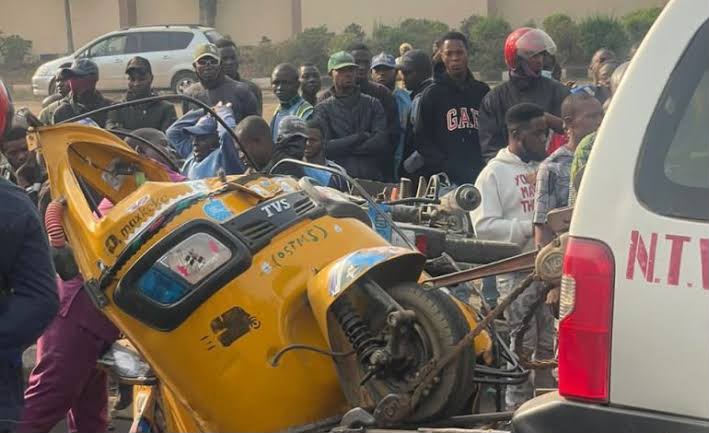
Recurrent road accidents along the Dutse-Bwari Highway have renewed concerns over road safety in the Federal Capital Territory (FCT), following another fatal multiple-vehicle collision at Tipper Garage Junction that reportedly killed four people and injured seven others.

The latest accident occurred at about 5 p.m. on Sunday, November 15, 2026, in Baupma community, involving three heavy-duty trucks, two cars and commercial tricycles.

According to eyewitness accounts, one of the trucks, reportedly descending from the Usuma Dam hill, lost control and rammed into two other trucks at the junction. The impact sent one of the vehicles crashing into the premises of a nearby Shafa filling station, where it struck parked vehicles.

An eyewitness, Anas Muazu, an employee of the Bwari Area Council Revenue Department, said the collision affected several road users and people around the junction.

The incident also raised concerns over the safety of motorists, commercial transport operators, pedestrians and businesses operating around the busy intersection.

Initial reports put the number of people affected at about 18, although subsequent casualty figures were different. A report published by Daily Trust on Tuesday, November 17, put the death toll at four, with seven others injured.

The victims were reportedly taken to Kubwa General Hospital for medical attention, with some requiring further treatment for severe injuries.

A Junction Haunted by Recurring Accidents

Beyond the latest tragedy, residents say Tipper Garage Junction has become a recurring accident hotspot, particularly for vehicles descending from the Usuma Dam and Bwari axes.

Comrade Ose Idasho, a member of the mining workers’ union at a nearby quarry, said accidents occur almost every week at the junction, with heavy-duty vehicles frequently involved.

The latest crash is not the first major tragedy recorded along the corridor this year. In February 2026, a truck reportedly lost control near Tipper Garage Junction, killing its assistant driver and hitting two other vehicles. Another fatal crash was reported at the junction in April 2025, when a trailer reportedly lost control and killed three people.

These incidents have intensified calls for urgent interventions to prevent further loss of lives along the highway.

Residents Appeal to FCT Minister

Following the latest accident, residents have renewed demands for the construction of a flyover at Tipper Garage Junction, alongside other measures to address the recurring crashes.

Idasho appealed to the FCT Minister, Nyesom Wike, to visit the community, engage directly with residents and initiate practical solutions to the persistent safety concerns.

Residents are particularly concerned about the risks posed by heavy-duty vehicles navigating the descending route and the danger to people waiting for commercial transport or conducting business around the junction.

With repeated crashes continuing to raise alarm, residents say the situation requires more than temporary emergency responses, urging the FCT Administration and relevant road safety authorities to prioritise lasting interventions before another tragedy occurs.

Continue Reading

Abuja Reports

UniAbuja Staff, Students Protest Alleged Land Allocation

Published

on

By Patrick Idowu

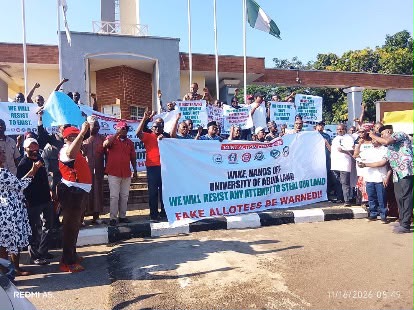
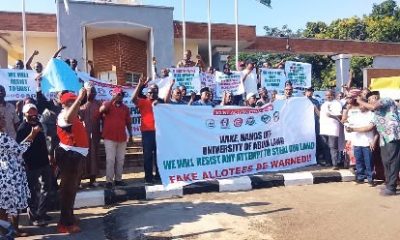
Staff, students and alumni of the University of Abuja have protested the alleged allocation of portions of the institution’s land to private individuals and companies, calling on President Bola Tinubu to intervene and direct FCT Minister Nyesom Wike to reverse the decision.

The protesters, led by ASUU, SSANU, NASU and the Students’ Union Government, accused the FCT Administration of disregarding a subsisting court order restraining encroachment on the disputed land.

The ASUU chairman, Prof. Sylvanus Ugoh, described the alleged allocation as a threat to the university’s future development and warned that the dispute could trigger legal action and industrial unrest.

However, Wike has defended the FCTA’s land recovery plans, arguing that large portions of the university’s allocated land remain undeveloped and lack adequate documentation.

The unions insist that the land is critical to the institution’s academic expansion, while students say the university’s over 55,000 population urgently needs additional hostels and infrastructure.

Continue Reading

Feature

When You Blame Tinubu, Don’t Spear Governors for Nigeria’s Woes

Published

on

By Ade Iyamoye 

Nigeria’s economic hardship has increasingly been laid at the doorstep of President Bola Tinubu. While the pain Nigerians are experiencing is real and undeniable, blaming the President alone ignores a critical fact: Nigeria operates a federal system, and much of what affects citizens daily falls squarely within the powers and responsibilities of state governors.

A factual and balanced assessment shows that Nigeria’s crisis is as much a subnational governance failure as it is a federal challenge.

Nigeria’s Federal Structure: Shared Responsibility, Not Sole Authority

Under the 1999 Constitution (as amended), Nigeria runs a federal system where powers, resources and responsibilities are shared among the federal, state and local governments.


Key areas that directly affect citizens’ welfare, such as:

-Primary and secondary education

-Primary healthcare

-Agriculture and food production

-Local roads and markets

-Rural security and policing support

are largely under the control of state and local governments, not the Presidency.

There are 36 governors and the FCT Minister, each with significant autonomy, budgets and executive powers. It is therefore inaccurate to attribute nationwide underperformance solely to one individual at the centre.


Governors Control Massive Resources

Statistically, Nigerian states are not poor on paper.

-Between FAAC allocations and Internally Generated Revenue (IGR), states collectively receive trillions of naira annually.

–Many states receive over ₦5-10 billion monthly from the Federation Account.

–In addition, states benefit from:

*Budget support facilities

*World Bank and donor-funded programmes

*Security votes running into hundreds of millions monthly

Yet, despite these inflows:

–Civil servants are owed salaries and pensions in some states

–Public schools and hospitals remain dilapidated

–Rural infrastructure is largely absent


This raises a fundamental question: Where is the money going?

Food Inflation: A Governor-Level Failure

One of the biggest drivers of Nigeria’s current hardship is food inflation. But agriculture is constitutionally a residual matter, meaning states have wide latitude to act.


Governors:

–Control vast arable land

–Can establish ranches, farm estates and storage facilities

–Can invest in irrigation, extension services and agro-processing


Yet, many states:

–Depend almost entirely on food transported from a few regions

–Fail to secure farmlands against banditry

–Allocate little of their budgets to agriculture despite its strategic importance

Blaming Tinubu for high food prices while governors leave fertile land idle is economically dishonest.


Security: States Are Not Helpless

While the federal government controls the armed forces, state governments play a decisive role in internal security.


Governors:

–Are Chief Security Officers of their states

–Fund logistics for police and security agencies

–Establish and support outfits like Amotekun, Ebube Agu and local vigilantes

–Control land-use decisions that affect conflict dynamics


In several states, insecurity persists not because Abuja has done nothing, but because:

–Local intelligence is weak

–Security votes lack transparency

–Political will is absent

Security failures cannot be blamed on the President alone when governors sit at the centre of local coordination.


Education and Healthcare: Governors’ Direct Mandate

Public outrage over failing schools and hospitals often targets the federal government, yet:

-Primary healthcare centres are owned and funded by local and state governments

-Basic education is a state responsibility, with UBEC funds often left unaccessed due to counterpart funding failures

Reports have repeatedly shown that billions of naira in UBEC funds remain unutilised because states fail to meet basic requirements.

It is misleading to accuse the President of neglecting education when governors fail to access funds already allocated to them.


Tinubu’s Policies vs. Governors’ Implementation

President Tinubu’s administration has implemented controversial but structural reforms, including:

-Removal of fuel subsidy

-Exchange rate unification

-Fiscal tightening

These policies are painful, but they are macro-level decisions aimed at long-term stability.


What has been largely missing is state-level cushioning:

-Few governors have introduced effective transport subsidies

-Very few states have rolled out large-scale food intervention programmes

-Social safety nets at subnational level are weak or non-existent

Governors cannot support harsh federal reforms rhetorically while failing to mitigate their local impact.

The Political Convenience of Blaming Abuja

Blaming the President has become politically convenient.


Governors:

-Attend FAAC meetings monthly

-Approve state budgets annually

-Control local governments

-Exercise near-total influence within their states

Yet, when hardship bites, they point fingers at Abuja, shielding themselves from accountability.

This culture weakens federalism and robs citizens of the right to demand performance from their closest leaders.


Conclusion

Nigeria’s problems are complex and multi-layered. President Tinubu should be scrutinised, but he should not be scapegoated for failures rooted in poor subnational governance.


If Governors:

-Invest in agriculture

-Improve security coordination

-Prudently manage resources

-Strengthen education and healthcare

-Deploy targeted social interventions the impact of federal economic reforms would be significantly reduced.

In a federation, no single man can ruin or rescue, a nation alone.

If Nigeria must work, governors must work too.

Continue Reading

Trending

taraftarium24Maslak EscortMaslak Escortmarsbahistaraftarium24deneme bonusudeneme bonusudizipaldizipaljustin tvjustin tvjustin tvjustin tvtaraftarium24justin tvdeneme bonusu veren sitelerdizipaljustin tvmarsbahisggrandpashabettGrandpashabet GirişGrandpashabet TwitterGrandpashabet Girişjustin tvtrlisans pinterestgiftcardmall/mygiftdinamobetgrandpashabet girişgrandpashabetdinamobetGrandpashabettaraftarium24dizipalgiftcardmall/mygiftjustin tvGrandpashabetGrandpashabetGrandpashabetGrandpashabetGrandpashabetmarsbahismarsbahistaraftarium24taraftarium24rojadirectajustin tvjojobet girişgrandpashabetgrandpashabetholiganbetholiganbetholiganbetmercurecasinocasibomjojobetibizabet1winmercurecasinocasibomdeneme bonusu veren sitelergüvenilir bahis sitelerijojobet güncel girişjojobetjojobet girişjojobetgameofbetcratosroyalbetradissonbetbahiscasinoonwinonwinamgbahiscasibomjojobetjojobetbetgaranticasinolevantdeneme bonusu veren sitelerimajbetpusulabetpusulabetholiganbetmarsbahismarsbahisgrandpashabet twitterGrandpashabetgrandpashabetgrandpashabetcasibomjojobetcasibomjojobetbetciosuperbetinsahabet