Connect with us

Politics

NASS Members And The Deceit Called State Creation

Published

on

From Taiwo Adisa

In August 2021, the 9th Senate denied that it had recommended the creation of 20 new states. The then-spokesman of the Senate, Senator Ajibola Bashiru, denied media reports that the Red Chamber had recommended the creation of 20 additional states for the federation.


In the statement, issued after an attempt to amend the 1999 Constitution further, Bashiru stated that the Senate would okay the creation of states only if “there is compliance with the provisions of section 8 of the 1999 Constitution of the Federal Republic as amended.”


He said that the constitutional provision on the creation of states, among other things, provides for a referendum by at least two-thirds of the people of the area and approval by a two-thirds majority of members of each House of the National Assembly.


The statement read in part: “Our attention has been drawn to a media report that the Senate Committee on Review of 1999 Constitution has proposed the creation of additional 20 States. The report is a gross misrepresentation of the decision of the committee on the request for the creation of more states. Far from recommending the creation of any state, the Senate Committee, while acknowledging receipts of several Bills proposing the creation of new states, decided that it is not in a position to recommend or propose the creation of any state unless there is compliance with the provisions of Section 8 of the 1999 Constitution of the Federal Republic, as amended.”


Flowing from the clarifications made by Senator Bashiru on behalf of the 9th Senate and several failed state creation efforts in the 6th, 7th, and 8th assemblies, you would expect that lawmakers seeking to champion state creation efforts would have learnt how to follow the due process. But since its inauguration in June 2023, cries of state creation have never ceased in the chambers of the National Assembly. In the House of Representatives, for instance, the bills have been rolling in almost on a weekly basis. One lawmaker would propose the creation of a new state from state X, and within a week or two another from the same or adjoining state would come up with a different geography seeking the creation of a state by another name from the existing state.


There is no doubt that state creation is not just a vexed issue in Nigerian polity, it is a popular path through which a lawmaker can seize the heart of his people and through which a politician can easily get the loudest praise. It promotes ethnic nationalism and ginger the swagger of regional lords. Going by the lopsidedness state creation has witnessed since 1967, the request for the creation of more states is certain to remain on the front burner in this polity.


In recent weeks, therefore, we’ve been forced to read “request for creation of state X passes first reading,” Bill for creation of state Y scales first reading in Reps…” Some of the bills were even reported by some online publications to have scaled the critical second reading. That’s unverifiable, though. I know that experienced reporters in legislative would not join such kangaroo business. There is no big deal to taking a bill through the First Reading. This is because, at that stage, the bill is just for mention, as they say in court. No debate is required, and no question is put for the determination of the chamber. For instance, the presiding officer will just hit the gavel after saying ‘a bill for the creation of XYZ state, first reading taken’. Unlike when a bill is to scale the Second Reading and the critical question has to be put: ‘Those in favour that this bill be read the second time say hi…contrary say nay…’ Remember this was the stage at which the controversial Third Term bill of President Olusegun Obasanjo era died in the Senate.


So when a legislator starts celebrating the mention of a state creation bill just to tell his people that something is being done about their desire and aspiration for a new state, it is either he or she is playing the populist game or merely deceiving the people. Let me tell those who have been making merry on account of such news that nothing really is being done about their desire for a new state. Maybe it would be harsh to say such people are wallowing in fools’ paradise. As far as the Fourth Republic legislature is concerned, the deepest attempts at state creation were undertaken in the 6th and 7th assemblies. During the constitutional amendment exercises of those assemblies, calls were made for the submission of memoranda for the creation of states. Elders from various communities across the country took turns to submit proposals to both the Senate and the House of Representatives, in line with the dictates of Section 8 of the 1999 Constitution. But the exercise didn’t scale through apparently because of the tedious procedure recommended by the constitution and the one-cube-fits-all process applied for the constitution amendment at the time. In those days, the constitutional amendment bill was taken as a single bill, and all issues were only embedded. Once the executive vetoes the bill, all other issues therein die a natural or unnatural death. I am sure it was the experience of that era that got the lawmakers wiser such that these days, the constitution amendment bills are encompassed in different cubes of bills. Whereby, an executive veto won’t just kill the entire process.


In the real sense, there should be nothing like a bill for the creation of a state. It is only a backdoor attempt to fulfill the constitutional provision. Section 8 of the 1999 Constitution which spells out the procedure for state creation, provides for consensus building, not just within the area in need for the new state but across the country. The Constitution states thus: Section 8. (1) An Act of the National Assembly for the purpose of creating a new State shall only be passed if-


(a) a request, supported by at least two-thirds majority of members (representing the area demanding the creation of the new State) in each of the following, namely – (i) the Senate and the House of Representatives, (ii) the House of Assembly in respect of the area, and (iii) the local government councils in respect of the area, is received by the National Assembly; (b) a proposal for the creation of the State is thereafter approved in a referendum by at least two-thirds majority of the people of the area where the demand for creation of the State originated; (c) the result of the referendum is then approved by a simple majority of all the States of the Federation supported by a simple majority of members of the Houses of Assembly; and (d) the proposal is approved by a resolution passed by two-thirds majority of members of each House of the National Assembly.


In all the provisions contained above, nothing tells a lawmaker to submit a bill for the consideration of the Constitution Amendment Committee. So, even if the bills being submitted in their numbers in the House of Representatives pass the second and third reading, they go nowhere as far as they fail to comply with the provisions of Section 8, as reproduced above.


Rather than take the Senate of House chambers as well as their people on a wild goose chase, lawmakers who have been submitting state creation bills need not read the constitution upside down. They will need to embrace lots of consensus building and advocacies in their communities and the chambers, such that they would be in a position to scale the hurdles as contained in the provisions of Section 8 of the 1999 Constitution, as amended.

Continue Reading
Click to comment

Leave a Reply

Your email address will not be published. Required fields are marked *

News

Alia Gets APC Nod for Second Term in Benue

Published

on

By

By Samson Adeyanju

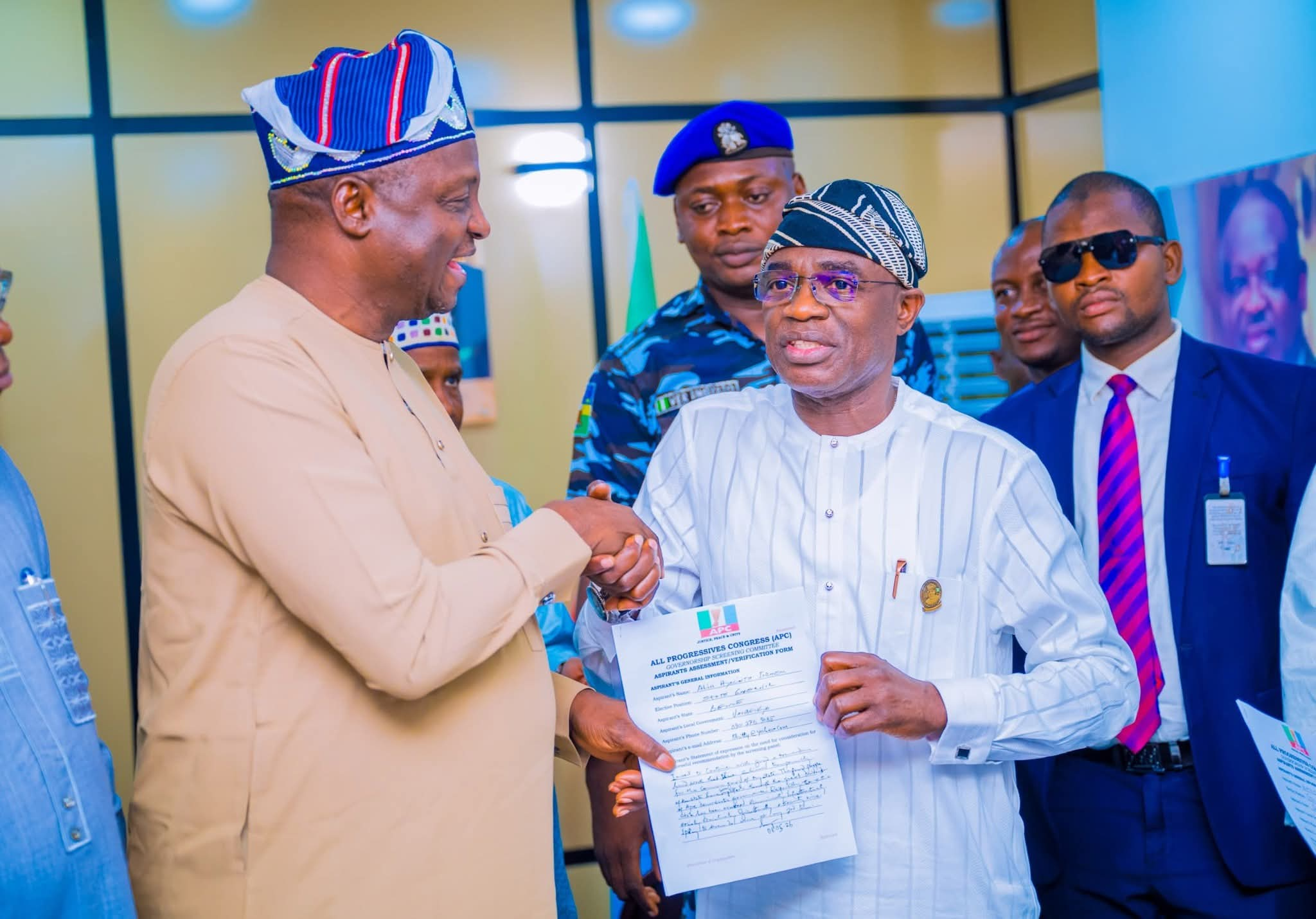
The Governor of Benue State, Hyacinth Alia, has successfully passed the screening exercise of the All Progressives Congress (APC), ahead of the 2027 governorship election and has been officially certified to contest the party’s primaries.

This was contained in the statement issued by his Chief Press Secretary, Sir Tersoo Kula.

The screening exercise was conducted on Sunday at the Plateau State Governor’s Lodge, venue designated for the screening of incumbent governors seeking the party’s ticket for the forthcoming elections.

The screening committee was chaired by the National Chairman of the All Progressives Congress, Nentawe Goshwe, who led the process to assess aspirants seeking to fly the party’s flag in the 2027 gubernatorial elections.

Governor Alia’s Expression of Interest and Nomination forms were procured by the Benue State chapter of the Nigeria Union of Pensioners and the Benue State Motorcycle Association.

Leaders of the two groups attributed their support for the governor to what they described as the remarkable transformation witnessed in the state under his administration, as well as his people-oriented style of governance. They said the governor deserved another term to consolidate ongoing developmental efforts across the state.

Political observers and stakeholders have described the certification as a major boost to Governor Alia’s political standing within the APC, particularly amid ongoing consultations and strategic alignments ahead of the 2027 general elections.

Governor Alia, who was elected in 2023 on the platform of the APC, has consistently highlighted infrastructural development, security improvement, civil service reforms and social welfare programmes as key priorities of his administration.

His successful clearance by the screening committee is also expected to trigger increased political activities within the APC as preparations intensify for the next electoral cycle.

Continue Reading

News

CSN Calls for Inclusive, Just Energy Transition in Nigeria

Published

on

By

By Tony Abah

The Secretary General of the Catholic Secretariat of Nigeria, Rev. Fr. Michael ‘Leke Banjo, has called for a people-centred and morally guided energy transition in Nigeria, warning that development must not continue to benefit a privileged few while leaving vulnerable communities behind.

Speaking at the GreenFaith Nigeria Multifaith and Multisectoral Forum on Nigeria’s Just Energy Transition Plan held on May 7, Fr. Banjo said energy should not be seen merely as an economic issue but as a matter tied to “life, health, education, work, food security, industrial growth, national stability and human dignity.”

Addressing participants at the forum themed, “Faith, Justice, and Power: Advancing an Inclusive Just Energy Transition in Nigeria,” the Catholic priest welcomed members of GreenFaith Africa and other stakeholders, describing the gathering as a shared effort to defend creation and promote justice.

“We gather today not merely as advocates, policy actors or religious leaders, but as stewards,” he said. “We gather to ask a deeper question: what kind of future do we want to leave behind, and who will be allowed to share in it?”

Fr. Banjo stressed that true development should not be measured only by “megawatts, investment figures or economic indicators,” but also by how society treats “those on the margins of energy poverty” and communities already suffering the effects of climate change.

Drawing from Scripture and the 2015 encyclical Laudato Si’, he described creation as “God’s gift entrusted to our responsible care,” insisting that environmental stewardship must go hand in hand with development and innovation.

The cleric lamented the environmental degradation affecting different parts of Nigeria, citing oil pollution and gas flaring in the Niger Delta, desertification in the North, gully erosion in the South-East, and flooding in parts of Kogi State and Benue State.

“In our cities, plastic waste and poor sanitation have turned public spaces into sources of disease and avoidable hardship,” he said. “When we fail to keep the earth, the earth becomes wounded; and when the earth is wounded, human dignity is also wounded.”

Fr. Banjo called on governments at all levels to develop “clear, consistent and just policies” that would protect affected communities, expand access to affordable clean energy, support small businesses and create decent jobs.

He also urged investors and development partners to ensure that renewable energy investments are guided by conscience and accountability.

“The new energy economy must not reproduce old injustices in cleaner language,” he warned, adding that policies should encourage local capacity, community ownership, skill development and transparency.

Beyond government and institutions, Fr. Banjo challenged ordinary citizens to embrace environmentally responsible habits, including proper waste disposal, water conservation, tree planting and keeping public spaces clean.

“We must stop throwing refuse into gutters, streams and open spaces,” he said. “In these simple daily choices, we show whether we truly understand that creation is God’s gift and our common home.”

He commended GreenFaith Nigeria, GreenFaith Africa and The Kukah Centre for promoting climate justice and interfaith collaboration, assuring them of the continued support of the Catholic Secretariat of Nigeria.

“The Catholic Secretariat of Nigeria stands ready to walk with you in this effort to protect creation, uplift the poor, and advance a truly just energy transition for our nation,” he said.

Continue Reading

News

CNND, RNMW to Conduct Due Diligence Ahead of 2027 Elections -Amb Erebuoye

Published

on

By

By Emmanuel Eko

The Concerned Nigerian Network in Diaspora (CNND), and the Rebuild Nigeria Movement Worldwide (RNMW), have announced plans to carry out thorough consultations and assessments before endorsing any political party or candidate for the 2027 general elections.

Speaking on behalf of both organizations, former president and founder, Ambassador James Erebuoye, emphasized the need for caution and strategic decision-making following the experiences of the 2023 elections.

According to Erebuoye, several errors made by platform administrators and coordinators during the last electoral cycle nearly fractured the network, which he noted took over two decades to build across Nigeria and the diaspora.

“We will undertake proper diligence before deciding which political party or candidate to support in 2027, and we will also guide our eligible voters accordingly,” he stated.

He called on coordinators within both organizations to prioritize unity, peace, and discipline among members, warning against the dangers of religious intolerance and tribal divisions.

“This is about our one and only country, Nigeria. We must not allow religious bigotry or tribalism to derail our collective mission,” Erebuoye said.

Looking ahead to the 2027 elections, he described the process as a critical national assignment, urging members at home and abroad to remain committed and organized.

“Our goal is to mobilize not less than 20 million votes for the right presidential candidate we collectively decide to support,” he added.

Erebuoye also stressed the importance of defending Nigeria’s democracy, describing it as a serious responsibility that requires the active involvement of all members. He further called for intensified efforts to combat corruption, which he said has hindered the nation’s development for decades.

Addressing national security concerns, the CNND and RNMW founder urged the Federal Government to take stronger and more decisive action against terrorism and banditry.

“No amount of condolences can bring back those who have lost their lives. The priority of government now must be to secure citizens and put an end to these attacks,” he said.

He outlined a three-point priority for the government: tackling insecurity, eliminating entrenched corruption networks, and then focusing on economic recovery.

Erebuoye noted that improving security would naturally enhance economic growth, attract investment, and boost tourism.

“No foreign investor or tourist will be attracted to a country plagued by insecurity. Fixing the economy will be much easier once the security challenges are addressed,” he concluded.

The statement reflects growing political mobilization among diaspora networks as Nigeria prepares for the 2027 general elections.

Continue Reading

Trending