Connect with us

Business

Nigeria’s Daily Petrol Consumption Drops by 92% Since Tinubu’s Presidency

Published

on

Nigeria has witnessed a dramatic drop in the daily consumption of Premium Motor Spirit (PMS), commonly known as petrol, following President Bola Tinubu’s assumption of office on May 29, 2023. According to data obtained from the Nigerian Midstream and Downstream Petroleum Regulatory Authority (NMDPRA), the country’s daily petrol consumption plummeted by 92% in less than a year.

The NMDPRA’s Daily Truck Out Report for September 2024 shows that as of August 20, 2024, Nigeria’s daily petrol consumption had fallen to 4.5 million liters. This is a stark contrast to the figures recorded in May 2023, when daily consumption was as high as 60 million liters.

The significant drop in fuel consumption follows a series of policy reforms and economic adjustments introduced by the Tinubu administration, aimed at restructuring Nigeria’s energy sector. Chief among these reforms was the removal of the long-standing fuel subsidy, which caused an initial shock to the petroleum market but has since led to more market-driven pricing and consumption behavior.

Further analysis of the report reveals that the Nigerian National Petroleum Company Limited (NNPCL) distributed fuel allocations to only 16 out of Nigeria’s 36 states in the month under review. This left more than half of the country’s states facing fuel scarcity in August 2024, as they received no product allocations during that period.

A breakdown of the allocations shows that Niger State received the highest number of trucks, with 21 trucks delivering approximately 940,000 liters of petrol daily. Lagos followed closely, receiving 12 trucks, amounting to 726,001 liters per day. Kaduna also received 12 trucks, though these amounted to a slightly lower daily delivery of 454,001 liters.

Other notable allocations include:

  • Oyo State: 12 trucks (454,001 liters daily)
  • Kano State: 9 trucks
  • Ondo State: 6 trucks
  • Kwara State: 6 trucks
  • Edo State: 4 trucks
  • Federal Capital Territory (FCT): 4 trucks

States such as Sokoto, Ogun, and Osun received smaller allocations of three to four trucks, while Gombe, Benue, Ekiti, and Kebbi each received only one truck during the period, further intensifying the fuel scarcity in these regions.

The significant reduction in petrol consumption has sparked mixed reactions from analysts and citizens alike. On one hand, the sharp drop is seen as a positive sign of reduced fuel smuggling and more efficient fuel management. For years, Nigeria struggled with fuel smuggling, where subsidized petrol was diverted to neighboring countries, leading to inflated consumption figures and substantial losses for the government.

The Tinubu administration’s removal of the fuel subsidy eliminated the price differentials that made smuggling profitable, contributing to the reduction in consumption. Additionally, the subsequent rise in petrol prices has likely discouraged overuse and encouraged a shift towards alternative energy sources such as diesel, compressed natural gas (CNG), and solar power.

On the other hand, the reduced petrol allocations across several states have led to growing concerns over accessibility and affordability of fuel. Many regions are grappling with supply shortages, forcing residents to endure long lines at petrol stations or pay inflated prices on the black market.

Business

OPEC+ Output Dips as Nigeria, Libya, Venezuela Miss Targets

Published

on

By

By Onyeanya Ebere Immaculata


Crude oil production in Nigeria, Libya, and Venezuela fell in October, slowing overall OPEC+ output and undermining the group’s monthly targets.

Reuters reported that OPEC+ added only 30,000 barrels per day (bpd), in October, down sharply from September’s 330,000 bpd increase. Nigeria’s output, which briefly reached 1.5 million bpd in July, slipped back to 1.3 million bpd in September.

NNPCL CEO Bayo Ojulari attributed the decline to industrial disputes involving Dangote Refinery and petroleum unions NUPENG and PENGASSAN.

Oil prices fell amid global market weakness and a stronger U.S. dollar. Brent crude dropped 6 cents to $64.38 per barrel, WTI lost 10 cents to $60.46, and the OPEC Basket fell 0.26 cents to $66.72.

Analysts noted that rising U.S. crude inventories and negative risk sentiment pressured the market.

OPEC+ plans to raise output by 137,000 bpd in December but will pause increases in early 2026, a move analysts say is unlikely to boost prices in the near term.

Continue Reading

Business

Onafowokan Unveils Africa’s Largest Fibre-Optic Cable Plant in Ogun

Published

on

By

By Samson Adeyanju


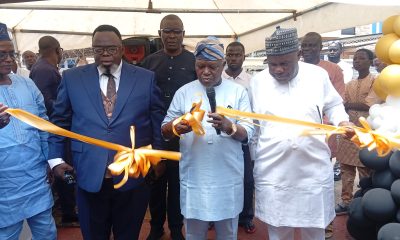
Chairman of Coleman Technical Industries, Asiwaju Solomon Onafowokan, has inaugurated Africa’s largest fibre-optic cable factory in Sagamu, Ogun State, to boost Nigeria’s digital infrastructure and reduce reliance on imports.

The launch, which marked Coleman’s 50th anniversary, drew senior government officials and telecom executives.

The 350,000-square-metre facility can produce 9 million kilometres of fibre-optic cable yearly, alongside smelting units for aluminium and copper.

Onafowokan said the project reinforces Coleman’s commitment to local manufacturing and supports the government’s digital economy agenda, targeting ₦15 trillion in domestic and export revenue.

President Bola Tinubu, represented at the event, lauded the project as a milestone for industrial diversification and broadband expansion.

The Minister of Communications, Dr. Bosun Tijani, also announced a $500 million World Bank-backed partnership to deploy 90,000 kilometres of fibre nationwide.

Continue Reading

Business

Private Sector Key to Africa’s Growth Under AfCFTA -Randle

Published

on

By

By Omoniyi David


Chairman of the NEPAD Business Group Nigeria (NBGN), Bashorun J. K. Randle, has emphasized the vital role of the private sector in driving Africa’s economic growth under the African Continental Free Trade Area (AfCFTA).

Randle made the remark ahead of a high-level business forum scheduled for October 30, 2025, at Eko Hotels & Suites, Lagos, themed “Mobilising Africa’s Private Sector for AfCFTA towards Africa’s Economic Development Amid Global Uncertainty.”

He said Africa’s economic transformation depends on the active participation of private enterprises, noting that the forum seeks to develop strategies to boost intra-African trade, industrial competitiveness, and inclusive prosperity.

According to NBGN, the event will promote partnerships and dialogue on policy alignment, trade facilitation, investment promotion, and value-chain development among African economies.

Participants are expected from government agencies, financial institutions, business associations, and regional economic communities across the continent.

Continue Reading

Trending