News
Former Presidential Aide Blasts Govs for Sabotaging EFCC
Published
2 years agoon
By
editor
Former presidential aide, Laolu Akande, has issued a strong rebuke against 16 state governments involved in legal actions aimed at weakening Nigeria’s anti-corruption system, specifically targeting the Economic and Financial Crimes Commission (EFCC). Speaking on Sunday during the “My Take” segment of Inside Sources on Channels Television, Akande criticized these states’ efforts to curtail the powers of the EFCC, calling their actions “anti-people” and questioning their motives.
Akande began by expressing his disappointment at the states’ decision to challenge the authority of the EFCC, particularly at a time when Nigeria is grappling with rampant corruption that threatens the very fabric of society. “At a time when corrosive corruption is tearing away the fabric of our society, we can see how 16 state governments and some lawyers are mounting an assault on the existence of the EFCC,” Akande said.
He commended the remaining 20 states and the Federal Capital Territory (FCT) for choosing not to participate in the legal battle. “Thankfully, there are 20 more states and the FCT who have stayed out of this needless legal drama. Those 20 states and the FCT have acted in the best interest of the Nigerian people,” he added.
The legal dispute, currently before the Supreme Court, questions the constitutional legitimacy of the EFCC in exercising authority over state governments. The plaintiffs argue that the anti-corruption agency oversteps its jurisdiction in handling matters within the purview of state governments.
However, Akande was quick to point out that the Supreme Court has already ruled on this issue in the past, affirming the EFCC’s authority. Referring to the landmark case of Attorney-General of Ondo State vs Attorney-General of the Federation in 2002, he emphasized that the court has ruled twice in favor of the EFCC’s constitutional mandate. “This is a matter the Supreme Court, the highest court in the land, has expressed a firm opinion on at least twice,” Akande said.
Akande expressed frustration that 16 state governments are investing resources in fighting the EFCC instead of focusing on more pressing issues such as education and healthcare. He pointed to the fact that several of the litigating states have failed to access over N45 billion in Universal Basic Education Commission (UBEC) matching grants between 2020 and 2023, funds meant to improve public education.
“It’s quite disturbing that we have 16 state governments who can’t seem to figure out a more beneficial matter to take to the Supreme Court,” Akande said. “In many of the states, students lie on their bellies to study. Some lie on their backs. No classrooms. No good buildings. Where you have buildings, they’re old, dilapidated structures all over this country.”
The former presidential aide also highlighted the deplorable state of healthcare in many of the states involved in the legal challenge, pointing out that both education and healthcare fall under the concurrent list of responsibilities shared between state and federal governments. “Rather than addressing these fundamental issues, these state governments are busy engaging in a legal battle to shield themselves from accountability,” he added.
Akande didn’t mince words when it came to the motivations behind the legal actions. He accused the governors involved of seeking to protect themselves from future prosecution, suggesting that their primary concern is evading EFCC scrutiny once they lose the immunity that comes with being in office.
“Those governors are more concerned about how their governors will possibly be free of EFCC once they lose their immunity status. Is that a compelling reason for the other 15 states to join Kogi in this truly anti-people case?” Akande asked rhetorically.
He reserved particularly harsh criticism for Kogi State, which has been at the forefront of the legal challenge. Describing the actions of Kogi’s immediate past governor, Yahaya Bello, as a “drama of the absurd,” Akande accused Bello of attempting to dismantle the EFCC for personal gain.
Rather than weakening the anti-corruption agency, Akande advocated for reforms aimed at strengthening the EFCC’s capacity to operate more professionally and with respect for human rights. He stressed that any reforms should focus on eliminating internal corruption, improving its operations, and ensuring the agency’s adherence to human rights standards, particularly in its treatment of suspects.
“If we need to do anything to EFCC, we must strengthen its professional capacity to be free of inducement, corruption, and respect people’s fundamental rights, especially the suspects. This attempt to kill EFCC with this legal case must fail,” he declared.
Akande concluded by commending the 20 states and the Federal Capital Territory (FCT) that have stayed out of the legal challenge. He praised them for acting in the best interest of Nigerians, calling their stance a reflection of true leadership.
You may like
Abuja Reports
Caritas Nigeria Urges Ecological Conversion, Climate Action
Published
1 day agoon
June 11, 2026By
Editor
By Samson Adeyanju
Caritas Nigeria has called on Nigerians to embrace what Pope Francis describes as “ecological conversion,” urging citizens, institutions and governments to move beyond environmental rhetoric and take concrete action against climate change and environmental degradation.
The call was made during the commemoration of World Environment Day 2026 at the Catholic Secretariat of Nigeria (CSN) Training Hall, Abuja, under the theme: “Inspired by Nature. For Climate. For Our Future.”
Delivering an address on behalf of the Catholic Secretariat of Nigeria, the Deputy Secretary, Rev. Fr. Augustine Okochi, described care for the environment as a moral, spiritual and ethical responsibility rooted in Christian faith.
“Our concern for the environment is not a passing trend. It is part of our moral duty, our Christian witness, and our responsibility to future generations,” he said.
Fr. Okochi noted that climate change is already affecting communities through flooding, land degradation, water pollution, rising temperatures and declining livelihoods, with the poor, women, children and displaced persons bearing the greatest burden.
He commended Caritas Nigeria’s efforts in environmental awareness, tree planting, climate-smart agriculture and support for vulnerable communities, while urging families, schools, parishes and institutions to cultivate a culture of environmental stewardship.
Speaking at the event, Caritas Nigeria’s Environmental Focus President, Dr. Pascal Onu, stressed the importance of educating young people on environmental protection through debate and quiz competitions.
“We believe it is important to catch them young. When we imbibe the right environmental culture in our children, it goes a long way in protecting the environment,” he said.
Dr. Onu identified inadequate infrastructure, poor waste management systems and limited funding as major obstacles to environmental sustainability despite increasing public awareness of climate issues.
Also speaking, Director of the Department of Climate Change at the Federal Ministry of Environment, Dr. Iniobong Abiola-Awe, reaffirmed Nigeria’s commitment to climate action through initiatives such as the National Adaptation Plan, Nationally Determined Contributions (NDCs), the Just Transition Action Plan and the National Clean Cooking Policy.
She emphasized the role of young people in advancing climate solutions through programmes such as the Eco-Schools Initiative and the Youth Climate Innovation Hub.
In a goodwill message, the Abuja Environmental Protection Board (AEPB), represented by Chief Environmental Health Officer Omenta Rachael Chinenye, urged Nigerians to draw inspiration from nature in addressing environmental challenges and commended the active participation of students in climate debates.
Students at the event said the programme deepened their understanding of environmental protection, forest conservation and sustainable living, pledging to promote environmental responsibility in their schools and communities.
The event brought together religious leaders, government officials, environmental experts, students and development partners who renewed their commitment to building a cleaner, greener and more climate-resilient Nigeria.
2027 General Elections
Catholic Church Warns Against Fake Identities, Urges Responsible Journalism
Published
4 weeks agoon
May 17, 2026By
Editor
By Samson Adeyanju
The Catholic Church in Nigeria has warned against the growing spread of fake identities, misinformation and digital disconnection in the media space, calling on journalists and social media users to embrace truth, responsibility and respect for human dignity in communication.
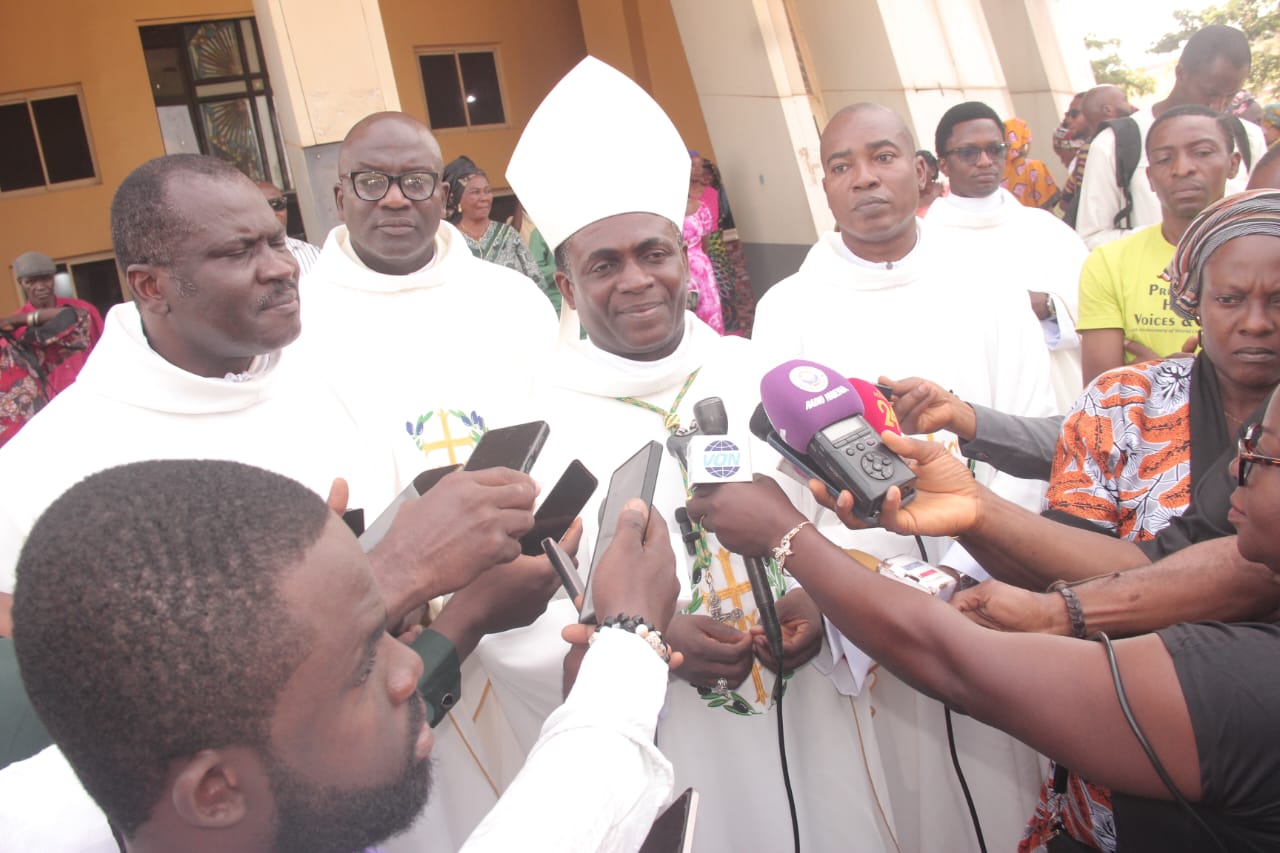
The warning was issued by the Chairman of the Department of Communications of the Catholic Bishops’ Conference of Nigeria and Bishop of the Catholic Diocese of Katsina, Most Rev. Gerald Mamman Musa, during his homily and press conference at the 2026 World Communications Day celebration held at the Catholic Secretariat of Nigeria, Abuja.
Bishop Musa, who reflected on the theme “Preserving Human Voices and Faces,” said modern society is increasingly “digitally connected but personally and spiritually disconnected,” despite advances in communication technology.
He stressed that communication remains central to human existence, noting that “to live is to communicate,” whether through speech, writing, or digital platforms.
According to him, the Church sets aside World Communications Day annually to reflect on the responsibility that comes with communication, especially in an era dominated by social media and digital interactions.
Prayer and spiritual grounding in communication
Drawing from the liturgical readings, Bishop Musa emphasised the importance of prayer, describing it as the “master key” to perseverance, strength and spiritual revival.
He recalled the apostles who, after the ascension of Jesus Christ, gathered in the upper room in fear but turned their anxiety into prayer while awaiting the Holy Spirit.
“The upper room is a place of communion with God, revival and spiritual renewal,” he said, urging Christians to remain rooted in prayer amid modern-day pressures.
He added that prayer does not remove suffering but gives believers the strength to endure challenges with hope and joy.
Warning against fake identities and online abuse
Bishop Musa warned that social media platforms have become spaces where individuals hide behind fake names, anonymous accounts and false identities to spread hatred, lies, blackmail and cybercrime.
“When we come with unreal names and masks on social media, we are acknowledging that we are doing something wrong,” he said.
He compared such behaviour to criminals who conceal their identities while committing evil acts, adding that truth thrives in openness while wrongdoing hides in anonymity.
He also cautioned against treating people as statistics or objects, drawing from the philosophy of Martin Buber, which emphasises human dignity and mutual respect.
The bishop further highlighted how Jesus Christ consistently gave voice to the marginalised, including the Samaritan woman, the woman caught in adultery and the blind Bartimaeus, stressing that society must not silence vulnerable voices.
According to him, preserving human voices means allowing people to speak from their lived experiences rather than speaking over them.
Bishop Musa urged media practitioners and social media users to use communication tools responsibly in promoting truth, evangelisation and human dignity.
“Speaking the truth in love is not only about projecting our voices, but doing so with charity and responsibility,” he said.
CSN Scribe urges responsible journalism ahead of elections
The Secretary-General of the Catholic Secretariat of Nigeria, Fr. Michael Banjo, also called on journalists to uphold responsible journalism and defend truth as Nigeria approaches another election cycle.
Fr. Banjo warned that communication must not become “a weapon of injury” in a country already facing insecurity, economic hardship and political tension.
He stressed that preserving human voices and faces requires verifying information before publication to prevent misinformation from damaging reputations or destabilising communities.
According to him, journalists must avoid hate speech, sensationalism and divisive narratives that reduce citizens to ethnic, religious or political labels.
“The answer to misinformation is responsible journalism; the answer to propaganda is truth,” he said.
Fr. Banjo also called for transparency in the electoral process, especially in the electronic transmission of results, insisting that every vote must count and reflect the true will of the people.
He urged journalists not only to highlight challenges but also to report positive developments that strengthen national unity and hope.
The CSN scribe thanked the media for their continued partnership with the Church in promoting justice, peace and accountability.
He concluded by urging Nigerians to “speak truth without hatred, listen without prejudice, and use every platform in service of the common good.”
Fr Umoh celebrates birthday, reflects on six-year tenure
The National Director of Social Communications of the Catholic Secretariat of Nigeria, Rev. Fr. Michael Nsikak Umoh, also used the occasion to reflect on his six-year tenure as he addressed journalists at the same event, which marked the 2026 World Communications Day and the closing of the 5th Nigeria Catholic Communications Week (ComWEEK).
Fr. Umoh described the event as a “double celebration,” noting both the global communications observance and the conclusion of a nationwide media literacy programme carried out across Catholic parishes and chaplaincies.
He expressed gratitude to the media for their collaboration with the Church, describing journalists as key partners in amplifying the Church’s voice and strengthening public discourse.
According to him, the media and the Church share a “sacred duty to be the conscience of the nation,” especially in challenging socio-economic times.
He also paid tribute to the immediate past Chairman of the CSN Communications Department, Most Rev. David Ajang of the Catholic Diocese of Lafia, commending his leadership in establishing key reforms, including the Nigeria Catholic Network (NCN) and the institutionalisation of ComWEEK.
Fr. Umoh introduced the new Chairman of the CSN Department of Social Communications, Most Rev. Gerald Mamman Musa, describing him as a “communications scholar and seasoned shepherd,” and expressed confidence in his leadership.
Reflecting on his tenure since 2020, he said his administration worked to strengthen the Church’s digital presence and unify communication structures, while acknowledging that further work remains.
He thanked the Catholic Bishops’ Conference of Nigeria (CBCN), his Archbishop Most Rev. Alfred Adewale Martins, and the media for their support throughout his service.
In a personal note, Fr. Umoh revealed that the celebration coincided with his 58th birthday, calling it a “providential coincidence” and a meaningful milestone in his ministry.
The event ended with prayers for the media, the Church and Nigeria, and the formal closure of ComWEEK 2026.
By Samson Adeyanju
The Governor of Benue State, Hyacinth Alia, has successfully passed the screening exercise of the All Progressives Congress (APC), ahead of the 2027 governorship election and has been officially certified to contest the party’s primaries.
This was contained in the statement issued by his Chief Press Secretary, Sir Tersoo Kula.
The screening exercise was conducted on Sunday at the Plateau State Governor’s Lodge, venue designated for the screening of incumbent governors seeking the party’s ticket for the forthcoming elections.
The screening committee was chaired by the National Chairman of the All Progressives Congress, Nentawe Goshwe, who led the process to assess aspirants seeking to fly the party’s flag in the 2027 gubernatorial elections.
Governor Alia’s Expression of Interest and Nomination forms were procured by the Benue State chapter of the Nigeria Union of Pensioners and the Benue State Motorcycle Association.
Leaders of the two groups attributed their support for the governor to what they described as the remarkable transformation witnessed in the state under his administration, as well as his people-oriented style of governance. They said the governor deserved another term to consolidate ongoing developmental efforts across the state.
Political observers and stakeholders have described the certification as a major boost to Governor Alia’s political standing within the APC, particularly amid ongoing consultations and strategic alignments ahead of the 2027 general elections.
Governor Alia, who was elected in 2023 on the platform of the APC, has consistently highlighted infrastructural development, security improvement, civil service reforms and social welfare programmes as key priorities of his administration.
His successful clearance by the screening committee is also expected to trigger increased political activities within the APC as preparations intensify for the next electoral cycle.
Caritas Nigeria Urges Ecological Conversion, Climate Action
Democracy Day: Foundation to engage youths through 21km marathon