Connect with us

News

Pope Francis Calls for Religious Unity to Combat Extremism on Historic Visit to Indonesia

Published

on

Pope Francis on Wednesday called for religious unity to combat extremism and intolerance as the 87-year-old’s longest tour began in Muslim-majority Indonesia.

On the first full day of his four-nation journey to Asia-Pacific, the Pope focused on the role that all faiths may play in resolving hotly contested security concerns.

“The Church aims to enhance interreligious dialogue to promote peace and harmony.”

“(Extremists) attempt to impose their views through the distortion of religion by using deception and violence,” the pope said in a speech after meeting President Joko Widodo.

The pope also stated that self-interest was hindering the religious unity he had advocated for and was fueling wars around the world, without naming any specific ones.

“In various regions, we see the emergence of violent conflicts, which are often the results… of the intolerant desire to let one’s interests, one’s position or one’s historical narrative prevail at all costs,” he told me.

Widodo repeated the pope’s comments.

“Freedom and tolerance is what Indonesia, together with the Vatican want, to spread… amid an increasingly turbulent world,” according to him.

Indonesia, the world’s largest Muslim-majority country, has long contended with Islamist extremism.

The 2002 bombings on the tourist island of Bali killed 202 people, making them the bloodiest in Indonesian history and prompting a crackdown on militancy.

Catholics account up less than 3% of Indonesia’s population – approximately eight million individuals — compared to 87 percent, or 242 million Muslims.

However, they are one of six officially recognized religions or denominations in the purportedly secular republic, with Protestantism, Buddhism, Hinduism, and Confucianism.

The pope’s visit to Indonesia is the third in history, and the first since John Paul II in 1989.


– Fragile health-

The pope’s delicate health will be challenged during the tour, which also includes stops in Papua New Guinea, East Timor, and Singapore.

He hadn’t traveled abroad since visiting Marseille, France, in September of last year.

His doctor and two nurses are accompanying him to Indonesia, but Vatican spokesperson Matteo Bruni explained that this was routine protocol.

The pontiff appeared invigorated when he landed in Jakarta from Rome on Tuesday, and again when he met Widodo on Wednesday morning for the first big event of his tour.

He arrived in a civilian Toyota sedan, sitting in the front passenger seat before exiting on a wheelchair to welcome the crowd.

Hundreds of children in traditional costumes screamed “Welcome Pope” and waved flags.

Widodo welcomed him, as did Defence Minister Prabowo Subianto, the country’s president-elect, who will take office next month.

The pontiff used a cane to get out of his wheelchair and speak with the Indonesian leader.

As he drove away from the palace, dozens of people rushed to follow him.

The pope was subsequently slated to meet privately with members of the Society of Jesus, a Jesuit order to which he belongs, at the Holy See’s Jakarta mission.


– Meeting with the devout.-

Interfaith links are important to his Indonesia leg.

He is scheduled to host a meeting Thursday with representatives from all six religions in the Istiqlal Mosque, Southeast Asia’s largest and a symbol of religious coexistence.

According to the Indonesian bishops’ conference, he will sign a joint declaration with the mosque’s grand imam on “dehumanisation” caused by the rise of conflict and environmental devastation.

The pope will hold a mass on Thursday at the country’s 80,000-seat national football stadium, which is likely to be packed with Catholics.

In a show of solidarity, the religious affairs ministry has asked TV stations to stop airing daily Muslim dusk prayer recordings during mass and instead utilize text reminders.

Before that, the pope will address the local Catholic faithful on Wednesday afternoon at Jakarta’s cathedral, which is located across the street from the mosque.

The church, which is connected to the mosque by a “tunnel of friendship,” was restored after a fire at the end of the nineteenth century, and Christians have recently taken pictures with a life-sized pope cutout there.

The pope will conclude his day by meeting with young people who are members of a global network of schools focused at assisting impoverished youngsters that he founded in 2013.

Continue Reading
Click to comment

Leave a Reply

Your email address will not be published. Required fields are marked *

Abuja Reports

20 Finalists Begin Final Stage of National Essay Competition

Published

on

By

By Samson Adeyanju

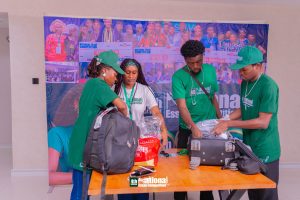
Twenty finalists from across Nigeria have begun the final stage of the fourth edition of the National Essay Competition in Abuja, following an orientation session designed to prepare them for the decisive examination.

The finalists arrived in the Federal Capital Territory for a four-day, all-expenses-paid programme featuring the essay examination, institutional tours and opportunities for learning and networking.

The competition, the brainchild of Mr Foluso Ojo, is sponsored by the Nigeria Revenue Service (NRS).

Ahead of the examination, the finalists participated in an orientation session led by Professor Omotosho Borisade of Ekiti State University, who serves as the competition’s umpire.

The session familiarised participants with the competition’s rules and regulations, examination guidelines and assessment criteria, helping them understand the requirements of the final stage.

The essay examination is scheduled to begin today at 9 a.m., after which the finalists are expected to embark on institutional tours around Abuja.

The programme is designed to extend beyond the contest itself, exposing the finalists to new learning opportunities, professional connections and experiences in the nation’s capital.

The competition brings together young Nigerians to demonstrate their writing ability, knowledge, creativity and critical-thinking skills as they compete for the top honours.

With the finalists prepared for the examination, attention now turns to their performance and the eventual emergence of the competition’s champion.


Continue Reading

News

Pastor Ogundipe Decries Lack of Integrity Among Educated Nigerians

Published

on

By

By Samson Adeyanju

Pastor Alex Ogundipe, Chairman of the Governing Board of Christian Heritage International Bible College, Kubwa, Abuja, has expressed concern over the growing number of educated Nigerians who lack the character and integrity required to make meaningful contributions to society.

Ogundipe raised the concern during the matriculation ceremony of the institution’s 60 pioneer students, stressing that academic qualifications without moral discipline and upright character could undermine national development.

According to him, Nigeria has many knowledgeable and academically accomplished individuals whose inability to demonstrate integrity has negatively affected their contributions to their families, workplaces and communities.

“We have too many people in this country who are knowledgeable and wise in their own ways, but they do not have character and integrity. That affects their ability to impact their communities,” he said.

The cleric emphasised that education must go beyond the acquisition of certificates to the development of individuals who demonstrate honesty, accountability, faithfulness and commitment to serving humanity.

He explained that true integrity required consistency in personal conduct, whether at home, in the church, at work or within the larger society.

Ogundipe said the college was established not merely to impart biblical knowledge but to raise men and women whose lifestyles reflect Christian values and whose contributions would positively influence society.

He urged Christian leaders to demonstrate their faith through practical actions rather than mere religious declarations.

Speaking on Nigeria’s future, the cleric encouraged citizens to remain hopeful, pray for the country and contribute meaningfully to national peace, unity and development.

Earlier, the Rector of the institution, Pastor Samson Olukayode Aliyu, challenged the matriculating students to prioritise spiritual maturity and moral discipline alongside academic excellence.

Aliyu warned against examination malpractice, plagiarism, dishonesty and other forms of misconduct, stressing that academic certificates could demonstrate knowledge but could not substitute for good character.

“The Church does not only need gifted people; it needs godly people. We need leaders who will choose integrity over compromise, humility over pride, faithfulness over convenience and service over self-interest,” he declared.

He explained that the college offers six-month certificate programmes in theology and one-year diploma programmes in theology, leadership and prophetic studies.

One of the matriculating students, Akeem Omobolanle, who enrolled in the Diploma in Leadership programme, commended the institution’s approach to biblical education and expressed optimism that the training would strengthen his understanding of the Scriptures and prepare him for greater service in Christian ministry.

The ceremony marked the formal admission of the college’s pioneer students into its academic community.

Continue Reading

Economy

Private Capital Critical To Nigeria’s Industrial Future -Omoyele

Published

on

By

By Samson Adeyanju 

Private capital will be critical to Nigeria’s industrial future as the country seeks to address infrastructure gaps, improve energy supply and strengthen economic productivity, Bayonle Omoyele has said.

Omoyele, a PhD student and guest speaker at the Abuja Economic Dialogue organised by the Faculty of Management Sciences, Nile University of Nigeria, Abuja, said the discussion would examine Nigeria’s economic situation and trade outlook in simple, everyday language.

The dialogue, scheduled for October 6, 2026, has as its theme, “Powering the Next Economy: Energy, Infrastructure & the Private Capital Imperative for Nigeria’s Industrial Future.”

Omoyele said the dialogue would also examine why people in the informal sector and at the bottom of the economic pyramid continue to struggle despite various microeconomic and macroeconomic policies.

He said the discussion would interrogate the gap between economic policies and their impact on the daily lives and businesses of ordinary Nigerians.

A major focus will be the role of private investment in addressing energy and infrastructure challenges affecting productive activities and industrial development.

The dialogue is also expected to examine how Nigeria can create conditions that encourage private capital to flow into productive sectors while expanding economic opportunities for businesses and individuals in the informal sector.

The discussion will further consider Nigeria’s trade outlook and the structural issues affecting the country’s prospects for sustainable and inclusive economic growth.

The event is scheduled to hold from 10 a.m. to 12 noon at the Block A, second-floor Conference Hall, Nile University of Nigeria, Abuja.

Continue Reading

Trending