Connect with us

News

New National Anthem: Is Tinubu Quietly Implementing 2014 CONFAB?

Published

on

As President Bola Tinubu’s administration unfolds, a significant question arises: Is his presidency quietly implementing the recommendations of the 2014 National Conference (CONFAB)? Convened under former President Goodluck Jonathan, the CONFAB proposed extensive reforms across various sectors. With the recent passage of a bill to revert to Nigeria’s old national anthem, “Nigeria, We Hail Thee,” it appears that some of these recommendations are being considered.

The decision to revert to the old national anthem, which was dropped by the General Olusegun Obasanjo-led military government in 1978, has sparked both praise and criticism. Some Nigerians expressed outrage over the change, citing a lack of consultation. Despite this, President Tinubu signed the bill into law on Wednesday, marking a significant nod to the 2014 CONFAB’s recommendations.

The newly re-adopted anthem, “Nigeria, We Hail Thee,” written by Lillian Jean Williams in 1959 and composed by Frances Berda, is seen by Tinubu as a symbol of Nigeria’s diversity. Speaking on his first anniversary in office, Tinubu emphasized the anthem’s role in uniting the nation. Meanwhile, prominent lawyer and fierce Tinubu critic, Chief Mike Ozekhome, welcomed the reversion, stating it was in the spirit of the 2014 CONFAB.

In this piece, we take a look at some of the key recommendations of the CONFAB and analyze whether the Tinubu administration is adopting any of them.

Qualification to Contest for President: The CONFAB recommended that any presidential aspirant must hold a degree. This proposal aimed to ensure that the nation’s leader possesses a minimum level of education. While this has not yet been codified into law under Tinubu’s administration, discussions around educational qualifications for political candidates continue to be relevant.

Rotation of Presidency: The CONFAB suggested rotating the presidency between the North and South and governorship among the senatorial districts of each state. Tinubu’s presidency, following Muhammadu Buhari from the North, aligns with this recommendation. However, formalizing this rotation into the constitution remains unaddressed.

Decamping (Cross-Carpeting): To curb political instability, the CONFAB recommended that any elected official who changes parties forfeits their seat. Although several analysts have expressed concerns over political decamping, concrete legislative action on this recommendation is yet to be seen. According to Section 68 (1) (g) the 1999 Constitution, for a member of the Legislature (Senate, House of Representatives or House of Assembly) to leave his party under which he was elected, he has to lose his seat. The exception is that the party is fictionalized or merged with another.

Mineral Exploration: The use of excess revenue for exploring mineral resources nationwide was proposed to diversify the economy. The Tinubu administration has shown interest in economic diversification, but specific policies reflecting this recommendation are still in development.

Acting President: The CONFAB advised that in the event of the President’s incapacity, the Vice President should act for 90 days, after which a new election should be held. This clear succession plan remains a crucial issue but hasn’t been legislatively enacted under Tinubu. This became a huge problem during President Umaru Yar’Adua who refused to hand over to his deputy while he was away on medical leave for several months in 2010. The lacuna created by the Constitution is yet to be addressed.

Rotation of Presidency (Post-Vacancy): If a president leaves office prematurely, a new president from the same zone should be elected. This idea supports continuity and regional balance but has not been formalized.

Open Grazing: Phasing out cattle routes and grazing reserves in favor of ranching was recommended to reduce conflicts. Tinubu’s government has continued to encourage modern ranching practices, aligning with this recommendation.

New State for South East: The CONFAB proposed creating an additional state in the South-East to balance state distribution. This significant constitutional change has not been addressed by Tinubu’s administration yet.

Creation of New States: Creating 18 new states to balance regional representation was another recommendation. This ambitious restructuring remains untouched under Tinubu’s leadership.

Fiscal Sharing Formula: The conference proposed a new revenue sharing formula among federal, state, and local governments. Adjusting the fiscal distribution is a complex task, and while discussions persist, no changes have been implemented.

Form of Government: A modified presidential system combining elements of presidential and parliamentary systems was recommended. This hybrid system remains theoretical, with no steps taken toward its implementation.

Appointment of Ministers: Limiting the number of ministers and selecting a majority from the legislature aimed to reduce governance costs. Tinubu’s appointments so far do not fully reflect this recommendation.

Legislature: The CONFAB suggested a part-time bicameral legislature. This change has not been pursued under Tinubu.

Local Government Autonomy: The recommendation to remove local government as a tier of government and allow states to create local governments freely has not been adopted. Local government autonomy remains a contentious issue. It was as a result of this that the Attorney-General of the Federation Mr. Lateef Fagbemi, SAN has taken the 36 Governors to the Supreme Court over the funding of the third tier of government.

Removing Immunity: Removing immunity for officials facing criminal charges was proposed to enhance accountability. Tinubu’s administration has not yet pursued this reform.

Independent Candidacy: Allowing independent candidates to run for office was aimed at broadening political participation. This has not been legislated under Tinubu.

Anti-Corruption: The CONFAB proposed treating accused individuals as guilty until proven innocent and abolishing plea bargains. Such drastic changes to the justice system are controversial and remain unimplemented.

State Police: Allowing states to establish their own police forces was recommended to improve security. Tinubu has shown interest in this but has yet to push for its enactment.

National Anthem: Reverting to the old national anthem, “Nigeria, We Hail Thee,” was recently legislated, marking a significant nod to the CONFAB’s recommendations.

Religion Taxes and Pilgrimages: Taxing religious institutions and abolishing government-sponsored pilgrimages were recommended for economic reasons. These reforms have not been actively pursued.

Mission Schools: Returning public schools to their original religious missions was proposed to improve education standards. This recommendation has seen some discussion but limited action.

While some of the 2014 CONFAB recommendations resonate with current policy discussions, substantial implementation remains absent. The recent decision to revert to the old national anthem indicates a willingness to consider the CONFAB’s proposals. As President Tinubu’s term progresses, the extent to which these recommendations will be integrated into Nigeria’s governance structure remains to be seen. The focus on economic diversification, security, and political stability suggests potential alignment with some CONFAB goals, but concrete legislative actions will ultimately determine the extent of their adoption.

Economy

Private Capital Critical To Nigeria’s Industrial Future -Omoyele

Published

on

By

By Samson Adeyanju 

Private capital will be critical to Nigeria’s industrial future as the country seeks to address infrastructure gaps, improve energy supply and strengthen economic productivity, Bayonle Omoyele has said.

Omoyele, a PhD student and guest speaker at the Abuja Economic Dialogue organised by the Faculty of Management Sciences, Nile University of Nigeria, Abuja, said the discussion would examine Nigeria’s economic situation and trade outlook in simple, everyday language.

The dialogue, scheduled for October 6, 2026, has as its theme, “Powering the Next Economy: Energy, Infrastructure & the Private Capital Imperative for Nigeria’s Industrial Future.”

Omoyele said the dialogue would also examine why people in the informal sector and at the bottom of the economic pyramid continue to struggle despite various microeconomic and macroeconomic policies.

He said the discussion would interrogate the gap between economic policies and their impact on the daily lives and businesses of ordinary Nigerians.

A major focus will be the role of private investment in addressing energy and infrastructure challenges affecting productive activities and industrial development.

The dialogue is also expected to examine how Nigeria can create conditions that encourage private capital to flow into productive sectors while expanding economic opportunities for businesses and individuals in the informal sector.

The discussion will further consider Nigeria’s trade outlook and the structural issues affecting the country’s prospects for sustainable and inclusive economic growth.

The event is scheduled to hold from 10 a.m. to 12 noon at the Block A, second-floor Conference Hall, Nile University of Nigeria, Abuja.

Continue Reading

Judiciary

Chamber Commissioning: Every Empire Will Expire, Akintola Tells Nigerian Leaders

Published

on

By

By Samson Adeyanju

A Senior Advocate of Nigeria, Chief Adeniyi Akintola, has cautioned Nigerian leaders and public office holders against abusing power, stressing that no position of authority or political influence is permanent.

Akintola gave the warning at the commissioning of Dayo Ajibola & Associates, also known as SBA Chambers, where he urged those in positions of authority to remain humble, remember their roots and prepare for life after office.

“Every empire will expire. Let those who are holding public office get this into their heads. Every empire will expire. Every person in a position of authority will come to a time when he will no longer be relevant,” he said.

The legal practitioner also warned politicians against sacrificing people for political interests, urging professionals who interact with political leaders to be cautious and maintain clear boundaries between their principles and political relationships.

He said money should not be allowed to determine a person’s values or professional decisions, urging young lawyers to resist the temptation of seeking immediate financial rewards.

According to him, younger lawyers should focus on building credibility, relationships and professional competence rather than demanding large fees from every client.

“The younger generation lawyers are making the mistake of wanting that money now, now, now. It doesn’t work that way,” Akintola said.

He advised lawyers to carefully assess the clients they represent and avoid fraudulent individuals and activities.

“We have a standard in our office. No room for 419,” he said, stressing that professional reputation remained more valuable than short term financial gains.

Akintola further urged young professionals not to live beyond their means, saying proper financial planning was necessary for sustainable careers and businesses.

He explained that his law office makes provisions for the maintenance and replacement of office equipment, noting that professionals must plan for unforeseen expenses instead of spending all their earnings.

“If you take good care of your job, your job will take good care of you,” he said.

The Senior Advocate also emphasised discipline and commitment to legal practice, particularly punctuality and diligence in handling clients’ briefs.

“The court will not wait for you. You should be in court latest by 8:30. The client that gives you a brief is not waiting for stories. He wants results,” he said.

Akintola urged senior lawyers to continue mentoring younger practitioners and advised employees to remain loyal and committed to their employers.

He also encouraged the new generation to remain prayerful, disciplined and patient, saying genuine professional success is built over time.

Speaking at the occasion, Senator Abdulfatai Buhari, representing Oyo North Senatorial District, commended Akintola for his commitment to mentoring younger professionals.

Buhari, who said he had adjusted his international travel plans to attend the event, congratulated Dayo Ajibola on the commissioning of the chambers.

He said the presence of senior practitioners and other distinguished personalities at the event demonstrated the respect Akintola had earned through his character and professional relationships.

Buhari urged Akintola to remain focused despite betrayal, blackmail and disappointment, saying the growth of people he had mentored should give him satisfaction.

“People will still continue to betray. People will continue to blackmail. People will continue to misbehave, but just be happy that the people you are training are coming up, and you are seeing them growing,” he said.

In his vote of thanks, Barrister Dayo Ajibola, principal of the newly commissioned chambers, expressed appreciation to Akintola, senior lawyers, public officials, friends and other guests for honouring the occasion.

Ajibola, who became emotional while recounting some of the challenges he had overcome, attributed his survival and progress in life to God’s protection, prayers and the support of family, mentors and friends.

He disclosed that he had obtained bachelor’s and master’s degrees before returning to study law, describing his journey into the legal profession as one marked by several challenges and near tragedies.

Ajibola thanked Akintola for his mentorship and described his presence at the commissioning as a significant honour.

He also expressed appreciation to the senior members of the legal profession who attended the ceremony, saying their support had encouraged him to continue building the new law firm.

The commissioning marked a significant milestone for Dayo Ajibola & Associates and brought together members of the legal profession, political figures, friends and associates.

Continue Reading

News

Church Leader at 50, Renews Commitment to Humanitarian Service, Family Values

Published

on

By

By Samson Adeyanju

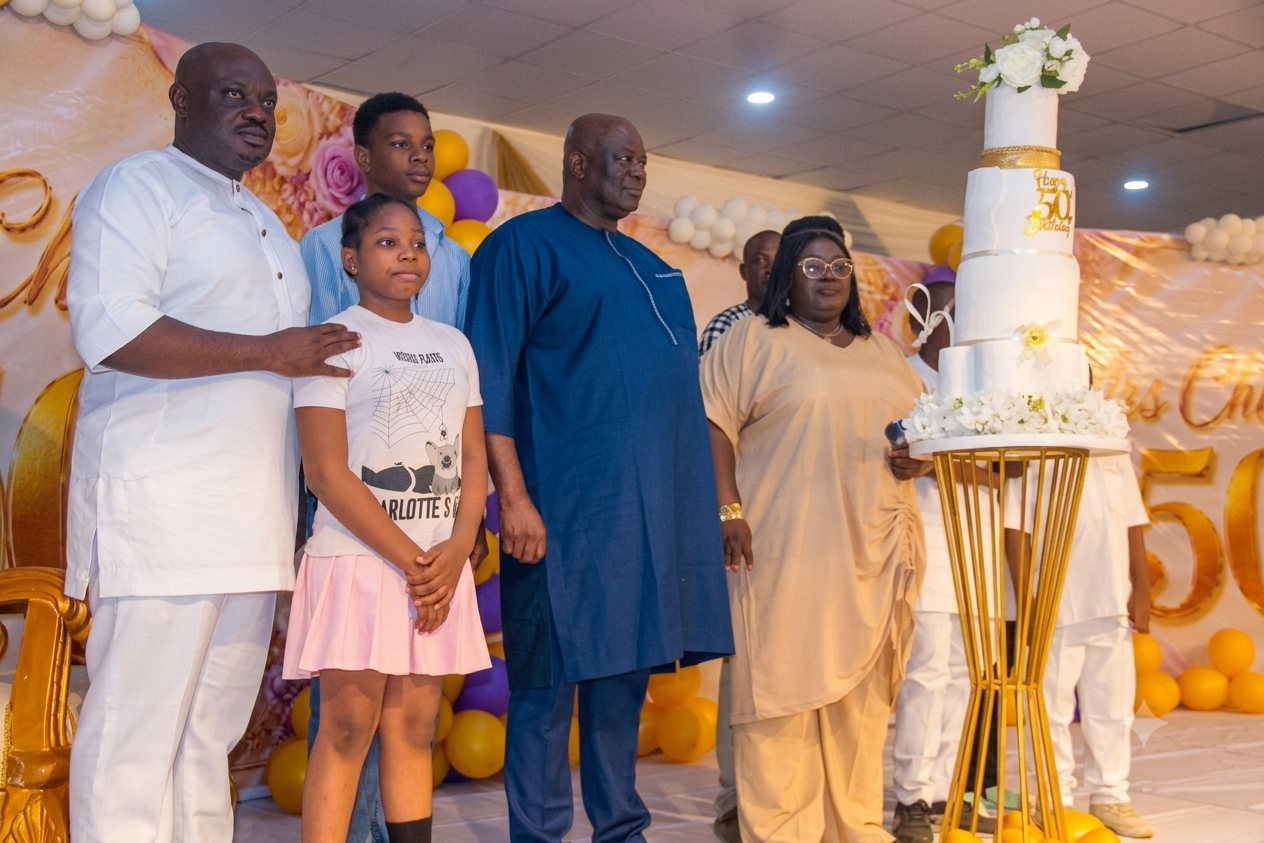
The President of the Laity Council of St. Luke’s Catholic Parish, Kubwa, Abuja, Mrs. Chizoba Okonkwo, has marked her 50th birthday with a renewed commitment to humanitarian service, particularly the welfare of vulnerable children, while urging Nigerian families to strengthen their faith in God and protect the sanctity of marriage.

The thanksgiving celebration, which began with a Holy Mass at St. Luke’s Catholic Parish, Kubwa, and culminated in a grand reception at the NYSC Orientation Camp, Kubwa, drew family members, church leaders, professional colleagues, community associations and well-wishers from across the country.

Speaking at the reception, her husband, Engr. Ikenna Okonkwo, a Fellow of the Nigerian Society of Engineers (FNSE), credited his wife’s unwavering support and selflessness as the foundation of his charitable engagements and professional accomplishments over their 21 years of marriage.

According to him, many beneficiaries of his philanthropic activities are unaware that his wife’s encouragement and sacrifices have sustained his commitment to serving others.

“There is something behind every good thing people see, and that is the woman we are celebrating today. Without a supportive wife, you cannot sustain this level of commitment to serving people,” he said.

He described Mrs. Okonkwo as a humble and contented woman whose passion for service outweighs material possessions, noting that despite travelling widely, including two visits to the Vatican, she remains modest and focused on impacting lives.

Recalling discussions ahead of her golden jubilee, Engr. Okonkwo said he offered to replace her 13-year-old vehicle or sponsor another overseas vacation, but she rejected both proposals.

“The only thing she requested was that we should feed people. That is why everyone here is sharing in this celebration. Her joy is in serving others,” he added.

In her remarks, Mrs. Okonkwo thanked God for preserving her life and appreciated her husband, family, friends and associates for their unwavering support.

“I thank the Almighty God for my life. I thank my lovely husband, my family and everyone who came to celebrate with me. May God bless you all, protect your families and grant your heart’s desires,” she prayed.

Speaking with journalists after the event, the celebrant described attaining the age of 50 as a testimony to God’s faithfulness and said her next phase of life would be devoted to expanding her humanitarian efforts.

“My greatest wish is to help small children. I keep praying that God will give me the strength and opportunity to do more for them,” she said.

She also advised Nigerian women to build their homes on faith, love and mutual understanding, warning against allowing third-party interference to undermine marriages.

“Always put God first in everything you do. Love your family, especially your husband. Every marriage has challenges, but don’t allow third parties to destroy your home. Pray together and trust God,” she advised.

Born on July 5, 1976, in Enugu State, Mrs. Okonkwo hails from Ubaha Umunze in Orumba South Local Government Area of Anambra State. She holds a National Certificate in Education in Mathematics/Economics and a degree in Economics from Nnamdi Azikiwe University, Awka.

Since joining the Daughters of Charity Hospital, Kubwa, Abuja, in 2006, she has risen through the ranks from receptionist to Head of the Front Desk Unit, reflecting two decades of dedicated service.

Beyond her professional career, Mrs. Okonkwo has distinguished herself in church and community leadership, serving in numerous capacities within the Catholic Church and socio-cultural organisations.

She is currently the President of the Laity Council of St. Luke’s Catholic Parish, Kubwa, having previously served as President of the Catholic Women Organisation (CWO), Treasurer of the Laity Council, two-time member of the Parish Pastoral Council and matron of several parish groups.

Her tenure as CWO President was marked by the empowerment of more than 30 women through vocational skills acquisition and trade support, earning her recognition as a champion of community development and women’s empowerment.

A devoted Catholic, Mrs. Okonkwo continues to play active roles in parish development, humanitarian initiatives and grassroots community service.

Tributes from church leaders, associates and family members described her as a compassionate leader, dedicated church worker and advocate of selfless service whose life of faith, humility and generosity continues to inspire many Nigerians.

Continue Reading

Trending