Connect with us

Business

Naira gain against Dollar Amid CBN and BDC Decision to help stabilize the Currency

Published

on

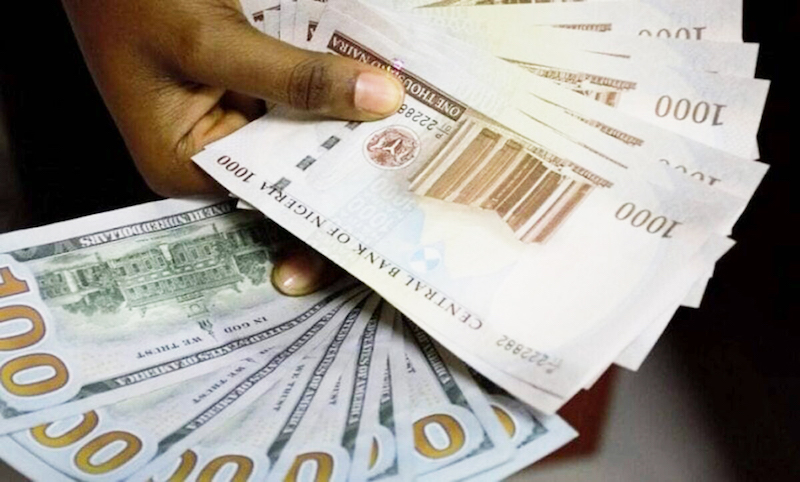
The market reacted positively yesterday to the recent reforms by the Central Bank of Nigeria (CBN), with the Naira appreciating by 13.3 per cent on the parallel market to close at N1,350 to the Dollar compared to N1,530/$ on Wednesday.

The naira pared some of its recent losses against the dollar on Thursday as markets digested the latest policy decisions from the Central Bank of Nigeria (CBN) to prop up the country’s embattled currency.

On Wednesday, the CBN ordered banks to reduce their excessive foreign exchange exposure by February 1 (Thursday) in a bid to shore up dollar supply. It said the net open position limit of banks’ overall foreign currency assets and liabilities both on and off-balance sheet should not exceed 20 percent short or zero percent long of shareholders’ funds unimpaired by losses, using the gross aggregate method.

The apex bank also removed the cap on exchange rates quoted by International Money Transfer Operators (IMTOs), allowing them to quote exchange rates for naira payout to beneficiaries using the prevailing market rates on a willing seller, willing buyer basis.

Previously, IMTOs were required to quote rates within an allowable limit of -2.5 percent to +2.5 percent around the previous day’s closing rate of the Nigerian foreign exchange market.

The naira appreciated to 1,400 per dollar on Thursday from a record low of 1,520/$ on Wednesday at the parallel market, commonly called black market, data collated from different street traders show.

“The reason for the removal of the cap is to incentivise the IMTOs to transparently transfer their receipt into the country,” Aminu Gwadabe, president of Association of Bureau De Change Operators of Nigeria (ABCON), said.

He said the IMTOs were hitherto not remitting the actual remittance proceeds into the official market but mostly kept it in the jurisdictions of receipts at parallel market rates.

“It is hoped with the removal of the cap on IMTOs proceeds, the diversion from the official markets of the proceeds will be reduced drastically or eliminated. The likely impacts will be an increase in liquidity in the market which will influence exchange rate and stability positively,” he said.

“Already, we have started seeing the local currency appreciating against the dollar in the parallel market by about 6 percent from N1,520 yesterday to N1,420/$ this afternoon in the market.”

The ABCON boss called on the management of the apex bank to sustain the tempo. “There is the urgent need in the immediate time to consider the effective transmission mechanism roles of the BDCs through their inclusion as the third leg of the market,” he said.

Nigeria’s currency today is the cheapest and best value of any in Africa, or any of the emerging or frontier markets, according to FIM Partners’ currency model.

“Globally, only the Japanese yen is cheaper (and that’s a pretty unique story). The model doesn’t have Lebanon/Venezuela/Zimbabwe,” said Charlie Robertson, head of macro-strategy at FIM Partners.

Following the CBN’s directives to banks, the volume of dollar transactions by willing buyers and willing sellers, consisting of banks, exporters and investors, increased by 85.36 percent in the Nigerian Autonomous Foreign Exchange Market.

The daily FX market turnover increased to $134.07 million on Wednesday from $72.33 million on Tuesday at the official market.

The naira appreciated to 1,455.59 from 1,482.57 on Tuesday, data from FMDQ Group shows

Analysts at CSL Stockbrokers said the FX market may not witness a significant influx of liquidity despite CBN’s directive for banks to sell down significant net long FX positions running into billions of dollars in 24 hours.

“Many of these dollar assets are not in cash. Firstly, we believe that many banks will require CBN to grant a forbearance and will find other ways besides throwing liquidity into the market to comply such as negotiating the conversion of foreign currency loans to naira loans, a conversion that many customers would likely require, given the devaluation of the naira,” they said.

They said banks with swap positions with the CBN may likely take on the naira equivalent of such positions.

“We do not believe many banks will be in the market to sell dollars, so we do not expect a significant influx of liquidity into the FX market,” they added.

They pointed out that banks that decide to sell their dollar assets at current exchange rates would make significant realised gains which would boost their 2024 earnings.

According to them, banks with more FX liabilities may suffer revaluation losses when there is a devaluation of the naira, although banks will likely avoid such a position if the currency points to a devaluation.

The analysts said the loss of revaluation gains may weaken banks’ capital adequacy ratio (CAR), and impact banks’ ability to boost capital.

“The new CBN directives imply these windfall gains from long FX positions will no longer be available to boost capital following a devaluation, which may imply a weakening of the Capital Adequacy Ratio (CAR),” they said.

The directive may also negatively impact customers’ ability to access foreign currency loans, according to them.

“We also believe these new directives will likely reduce banks’ appetite for foreign currency assets, which earn less than local currency assets and may have negative consequences for the supply of foreign currency loans to support needed projects.”


Analysts at SBG Securities expect CBN’s policy changes on banks’ FX exposures to have mixed effects on the Nigerian economy.

“We anticipate a positive impact on foreign currency liquidity in the interim, as banks move to achieve the new regulatory limit set by the central bank. We estimate a range of USD4 billion – USD6 billion of liquidity that could potentially enter the market as banks attempt to sell down the excess above the new regulatory limit of 0 percent long,” they said.

They however said some banks might have the long position on their balance sheet but without the liquidity in the immediate and may need forbearance from the CBN as they might not be able to meet “the very tight deadline”.

“We anticipate the market reacting negatively to this information in the interim, as the impact of the policy on bank earnings in the short-term is assessed. However, as the Central Bank continues to take steps to address the FX liquidity situation, we think that market expectations for green shoots appearing over the medium to longer term might not be out of reach,” they added.

Continue Reading
Click to comment

Leave a Reply

Your email address will not be published. Required fields are marked *

Business

Nigerian Banks Expand Lending as Loan Demand Surges

Published

on

By Ifunanya Stephanie

Nigerian banks increased credit supply to households and businesses in the third quarter of 2026, following stronger demand for secured, unsecured and corporate loans, according to the Central Bank of Nigeria (CBN).

The development was accompanied by improved loan approval rates and declining default rates across major lending categories, although borrowing costs remained relatively high in some segments.

The findings are contained in the CBN’s Q3 2026 Credit Conditions Survey, which assessed lending trends, loan demand, approval rates and repayment performance across the banking sector.

In the secured lending segment, the loan demand index stood at 25.6, with consumer lending to households recording the strongest demand at 42.9, followed by credit for house purchases at 28.0. Mortgage and remortgage lending recorded 12.0, while lending to small businesses by households declined to -19.7.

Demand for unsecured credit also strengthened, with an overall index of 7.2. Overdrafts and personal loans to households recorded 24.7, while credit card lending contracted to -20.0.

Corporate lending recorded a demand index of 18.9, reflecting increased borrowing interest among small businesses, medium-sized private non-financial corporations and large companies, which posted indices of 22.6, 18.3 and 20.7, respectively. However, demand from other financial corporations weakened, recording -16.2.

According to the survey, banks attributed the increased demand for corporate credit largely to inventory financing, balance sheet restructuring and capital investments, which recorded indices of 18.6, 2.5 and 0.7, respectively.

The CBN also identified changing economic outlook, liquidity positions and market share objectives as major factors influencing banks’ decisions to expand secured lending. For unsecured credit, market share objectives, economic outlook and the cost and availability of funds were among the key considerations.

Meanwhile, the proportion of loan applications approved increased across secured, unsecured and corporate lending categories compared with the preceding quarter.

Despite the improved access to credit, borrowing costs remained a concern, as the spread between lending rates and the Monetary Policy Rate widened across several lending categories.

The spread for secured lending widened to -14.5 index points, while corporate lending spreads stood at -13.6 index points for medium-sized private non-financial corporations, -12.2 for other financial corporations, -11.0 for small businesses and -10.3 for large private non-financial corporations.


The latest findings suggest an improvement in credit availability across Nigeria’s banking sector, although the widening interest rate spreads indicate that stronger loan supply and approval rates have yet to translate into proportionately cheaper borrowing for businesses and households.

Continue Reading

Business

CBN Restores BDC Access to FX Market, Caps Weekly Purchases at $150,000

Published

on

By Huldah Shado

The Central Bank of Nigeria (CBN), has approved the participation of licensed Bureau De Change (BDC), operators in the Nigerian Foreign Exchange Market (NFEM), allowing each BDC to purchase up to $150,000 weekly.

The approval was contained in a circular dated February 10, 2026, signed by the Director of the Trade and Exchange Department, Dr. Musa Nakorji, and addressed to authorised dealer banks and the general public.

The CBN said the move is aimed at improving foreign exchange liquidity in the retail segment of the market and meeting the legitimate needs of end users, amid a widening gap between the official and parallel market exchange rates.

Under the new arrangement, licensed BDCs can access foreign exchange from the NFEM through any authorised dealer bank of their choice at the prevailing exchange rate.

The apex bank directed banks to carry out full Know-Your-Customer (KYC), and due diligence checks on BDC clients before selling foreign exchange to them.

It also imposed reporting and transparency requirements, mandating BDCs to submit returns electronically to the CBN.

In addition, the bank prohibited third-party transactions and limited cash settlement to a maximum of 25 per cent of each transaction.

Continue Reading

Abuja Reports

Ultraviolet MFB MD Visits Equity Circle, Eyes Strategic Partnership

Published

on

By Samson Adeyanju 

The Managing Director and Chief Executive Officer of Ultraviolet Microfinance Bank, Bayonle Omoyele, has paid a working visit to Equity Circle, one of Abuja’s fast-growing real estate companies, as part of efforts to strengthen strategic partnerships within Nigeria’s real estate sector.

During the visit, Equity Circle’s Co-Founder and Chief Marketing Officer, Fabian George, conducted Omoyele on a tour of the company’s facilities and outlined its growth trajectory.

He disclosed that the firm recorded significant milestones over the past four years, culminating in an ₦8 billion revenue in the 2025 financial year.

Discussions between both parties focused on establishing a strategic credit relationship, with proposed areas of collaboration including invoice discounting, structured credit solutions, and cash-flow management support to help Equity Circle sustain and scale its operations.

Addressing Equity Circle staff during an interactive session, Omoyele emphasised the importance of strong marketing fundamentals, highlighting the 4Ps of marketing-Product, Price, Place, and Promotion, as key drivers of long-term competitiveness and brand leadership.

He also urged the team to adopt a long-term growth mindset, remain focused, and ensure that every unit contributes meaningfully to the organisation’s strategic goals, noting that disciplined execution is critical in Nigeria’s evolving real estate market.

The visit underscores Ultraviolet Microfinance Bank’s commitment to supporting high-growth enterprises through tailored financial solutions and partnerships that promote sustainable economic development.

Continue Reading

Trending

taraftarium24Maslak EscortMaslak Escortmarsbahisdeneme bonusudizipaldizipaljustin tvjustin tvjustin tvjustin tvtaraftarium24justin tvdeneme bonusu veren sitelerdizipaljustin tvmarsbahisggrandpashabettGrandpashabet GirişGrandpashabet Girişmarsbahisjustin tvtrlisans pinterestgiftcardmall/mygiftdinamobetgrandpashabet girişgrandpashabetdinamobetGrandpashabettaraftarium24dizipalgiftcardmall/mygiftjustin tvGrandpashabetGrandpashabetGrandpashabetGrandpashabetCasibommarsbahiskavbettaraftarium24taraftarium24rojadirectajustin tvbahiscomibizabetnesinecasinowbahisbetgarantitambetbetbeyesbetsahabetonwinnatobetsuperbetinsonbahisdeneme bonusu veren sitelergüvenilir bahis sitelerijojobet güncel girişjojobetjojobet girişjojobetamgbahismercurecasinobetplaycasinomilyoncasinoroyalpalacebetamgbahisbetsalvadorcasinolevantcasinolevantcasinolevantcasinolevantcasinolevantmatbetsekabetpusulabetvdcasinomarsbahisholiganbetmatbetimajbetholiganbetmarsbahistipobetjojobetcashwincasinolevantcasinolevantbetciosuperbetinsahabetgrandpashabet