Connect with us

Education

Stakeholders in Tertiary Education Sector Rejects Autonomy for Universities

Published

on

The Federal Government’s plans to avail universities financial autonomy are viewed from another prism by academics, who maintain that the government may be trying to shirk its constitutional and moral responsibilities of funding universities. They said while funding and academics form an integral part of tertiary education, the Federal Government must also desist from appointing politicians as pro-chancellors as most of them are only interested in contract awards, and with no idea of how a university system works.

In unison, stakeholders in the tertiary education sub-sector have rejected the planned financial autonomy for universities, insisting that the Federal Government cannot shirk the responsibility of funding education.

Curiously, the stakeholders are also urging the government to give institutions the free hand to run their affairs, saying that appointing pro-chancellors and council members, who have no idea of how the university system works, could be counter-productive.

Education Minister, Tahir Mamman, had during an education conference in Abuja, announced that the Federal Government would grant full autonomy to public universities in the country.

Mamman said the move would enable public universities to source for funding through various means, in a bid to meet their financial obligations.

But for the Academic Staff Union of Universities (ASUU), former Vice Chancellors of the University of Ibadan (UI), Prof. Idowu Olayinka, and Federal University, Oye (FUOYE) counterpart, Prof. Kayode Soremekun, and Bells University, Ota, Prof Adebayo Adeyemi, ceding the funding of universities established by the government primarily to these institutions means that the government is abdicating its responsibility, which is unacceptable.

ASUU National President, Prof. Emmanuel Osodeke, said that there is no way that the government can stop funding university education according to Section 18 of the constitution.

Osodeke noted that the autonomy law enacted in 2003 is still in force, and if followed without interference from bureaucrats, universities will be better off.

According to him, up to 95 per cent of the budgetary allocation for federal universities goes into paying salaries at rates that academics have repeatedly lamented as inadequate and globally uncompetitive.

An inadequate one per cent covers overheads, leaving public institutions struggling to fund their day-to-day costs.

Osodeke noted that the main financial inflow available for capital projects in public universities comes from the Tertiary Education Trust Fund (TETFund), which is serviced from a two per cent education tax paid from the assessable profit of companies registered in Nigeria.

Osodeke addressed sentiments about the irony of ASUU advocating for administrative autonomy for public universities while objecting to financial autonomy, saying “Are there no other autonomous bodies in this country? Are they funding themselves? Take the judiciary and the national assembly. Are they funding themselves?

“The Federal Government is talking about financial autonomy, where is it happening in the world? Do you know how much the U.S. government spends in terms of scholarships and grants? Do you know the budgetary allocation to universities?

“By proposing financial autonomy, the government is trying to privatise federal universities. Is that what we want and what taxpayers are saying? Nigeria’s finance belongs to Nigerians.

“If you check the ratio of Nigeria’s education budget to our Gross Domestic Product (GDP), we have the lowest in the world at 0.5,” he said.

Osodeke said allocating up to N12 billion in the budget for overhead costs at federal universities will guarantee the proper running of these institutions.

“If the University of Nigeria (UNN), UI, and Ahmadu Bello University (ABU) get about N12 billion yearly to run universities, won’t that solve a problem? Funding is a critical issue. The second is academics.

“The bulk of academics are leaving the country today because of what professors are being paid. A professor is paid about N400,000 and he spends more than N100,000 on fuel to get to his office. How will he survive?”

Prof. Olayinka on his part said that there is a need for the government to be more explanatory concerning the planned financial autonomy.

He said while there are three streams of funding universities, there is no way the Federal Government can detach itself from funding public institutions.

Continue Reading
Click to comment

Leave a Reply

Your email address will not be published. Required fields are marked *

Abuja Reports

Atoyebi Adewumi Wins 4th National Essay Competition, Beats 2,000 Contestants

Published

on

By

By Samson Adeyanju

Atoyebi Adewumi has emerged winner of the fourth edition of the National Essay Competition, beating more than 2,000 contestants in an intellectual contest aimed at promoting academic excellence, critical thinking and creative writing among young Nigerians.

The competition, which focused on the relevance of taxation to national development, challenged participants to examine the role of tax revenue in financing public services, stimulating economic growth and strengthening the relationship between government and citizens.

The initiative provided a platform for young Nigerians to demonstrate their writing skills, articulate informed perspectives on national issues and contribute ideas towards building a more responsible and progressive society.

Speaking after being declared winner, an elated Adewumi expressed gratitude to the convener, Foluso Sylvanus Ojo, and the organising team for providing young Nigerians with an opportunity to showcase their intellectual abilities.

“I am so glad, very, very glad, to have this privilege of emerging as the winner. I am grateful to the convener and the entire team, as well as everyone who supported this vision,” Adewumi said.

In his remarks, Ojo expressed concern over the tendency to criticise the attitudes and lifestyles of younger generations without providing adequate opportunities to nurture their talents and channel their energies towards productive pursuits.

He called on the government, corporate organisations and nongovernmental organisations to invest more in educational initiatives that promote intellectual excellence, creativity and responsible citizenship.

According to him, sustained investment in academic competitions and youth development programmes would encourage discipline, innovation and a stronger commitment to national development.

Drawing a comparison with the substantial cash prizes awarded in some reality television competitions in Nigeria, Ojo argued that students and intellectually gifted young Nigerians deserved greater recognition, financial support and encouragement.

“I believe the government should support initiatives like this because individuals need supportive hands, especially from the government. When they receive such support, they become more confident and motivated to continue their good work,” he said.

Ojo maintained that society could not continue to complain about the attitudes and lifestyles of young people without deliberately investing in programmes that encourage positive values and productive engagement.

The fourth edition of the competition also underscored the importance of tax awareness among young Nigerians, highlighting how effective taxation, transparency and accountable governance could contribute to improved infrastructure, education, healthcare and other essential public services.

Beyond celebrating the winner, the competition reinforced the need to identify, encourage and empower emerging intellectual talents capable of contributing meaningfully to Nigeria’s development.

Winner of the 5,000,000 naira

Winner of 3,000,000 naira

Winner of 2,000,000
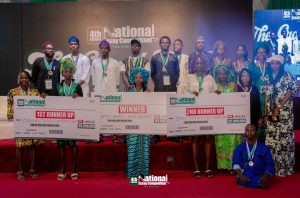
All the participants 

Continue Reading

Abuja Reports

20 Finalists Begin Final Stage of National Essay Competition

Published

on

By

By Samson Adeyanju

Twenty finalists from across Nigeria have begun the final stage of the fourth edition of the National Essay Competition in Abuja, following an orientation session designed to prepare them for the decisive examination.

The finalists arrived in the Federal Capital Territory for a four-day, all-expenses-paid programme featuring the essay examination, institutional tours and opportunities for learning and networking.

The competition, the brainchild of Mr Foluso Ojo, is sponsored by the Nigeria Revenue Service (NRS).

Ahead of the examination, the finalists participated in an orientation session led by Professor Omotosho Borisade of Ekiti State University, who serves as the competition’s umpire.

The session familiarised participants with the competition’s rules and regulations, examination guidelines and assessment criteria, helping them understand the requirements of the final stage.

The essay examination is scheduled to begin today at 9 a.m., after which the finalists are expected to embark on institutional tours around Abuja.

The programme is designed to extend beyond the contest itself, exposing the finalists to new learning opportunities, professional connections and experiences in the nation’s capital.

The competition brings together young Nigerians to demonstrate their writing ability, knowledge, creativity and critical-thinking skills as they compete for the top honours.

With the finalists prepared for the examination, attention now turns to their performance and the eventual emergence of the competition’s champion.


Continue Reading

Education

Oyelami Named Acting CEO of National Mathematical Centre

Published

on

By

By Omoniyi David

The Federal Government has appointed Professor Oyelami as Acting Chief Executive Officer of the National Mathematical Centre with immediate effect.

The appointment was announced in a statement by the centre’s Controller of Information and Public Relations, Onyekachi Njoku. He said the decision followed the elevation of the former CEO, Promise Mebine, as Vice-Chancellor of the Federal University Otuoke.

Njoku disclosed that the approval was conveyed in a letter signed by Rakiya Ilyasu, Director of University Education at the Federal Ministry of Education.

Professor Oyelami, a mathematician who joined the centre over two decades ago from Abubakar Tafawa Balewa University, previously served as Coordinator of the Mathematics and Theoretical Physics programmes and as Deputy Director/Academic Planning Coordinator.

An alumnus of the University of Jos and Abubakar Tafawa Balewa University, he holds a Second-Class Upper degree, MSc and PhD in Mathematics and has published widely in local and international journals.

The centre said his appointment would strengthen its mandate to promote research, innovation and capacity building in mathematical sciences.

Continue Reading

Trending