Feature
Benue’s New IDP Policy: A Roadmap of Hope and Dignity for Displaced Persons

By Bridget Tikyaa
One of the key campaign pledges of Rev. Father Hyacinth Iormem Alia on his way to becoming the Governor of Benue State was addressing the security challenges of the state and helping internally displaced persons (IDPs), return to their feet and ancestral homes.
This promise was anchored on the realities of the debilitating conditions faced by displaced persons, people battered by insecurity, driven into penury, and trapped in abject poverty. Their lives were turned upside down by displacement, the horrors of “war,” and the hopelessness of not knowing where or how to begin again.
According to a report by the International Organization for Migration (IOM), the population of IDPs affected by attacks from armed criminals, including herdsmen and local militias, has risen to over 500,182 in the state. In June 2025, the Benue State Emergency Management Agency (BSEMA), announced the registration of an additional 18,592 IDPs in Gwer West Local Government Area. So far, records indicate that over 200,000 IDPs have returned home following state government initiatives.
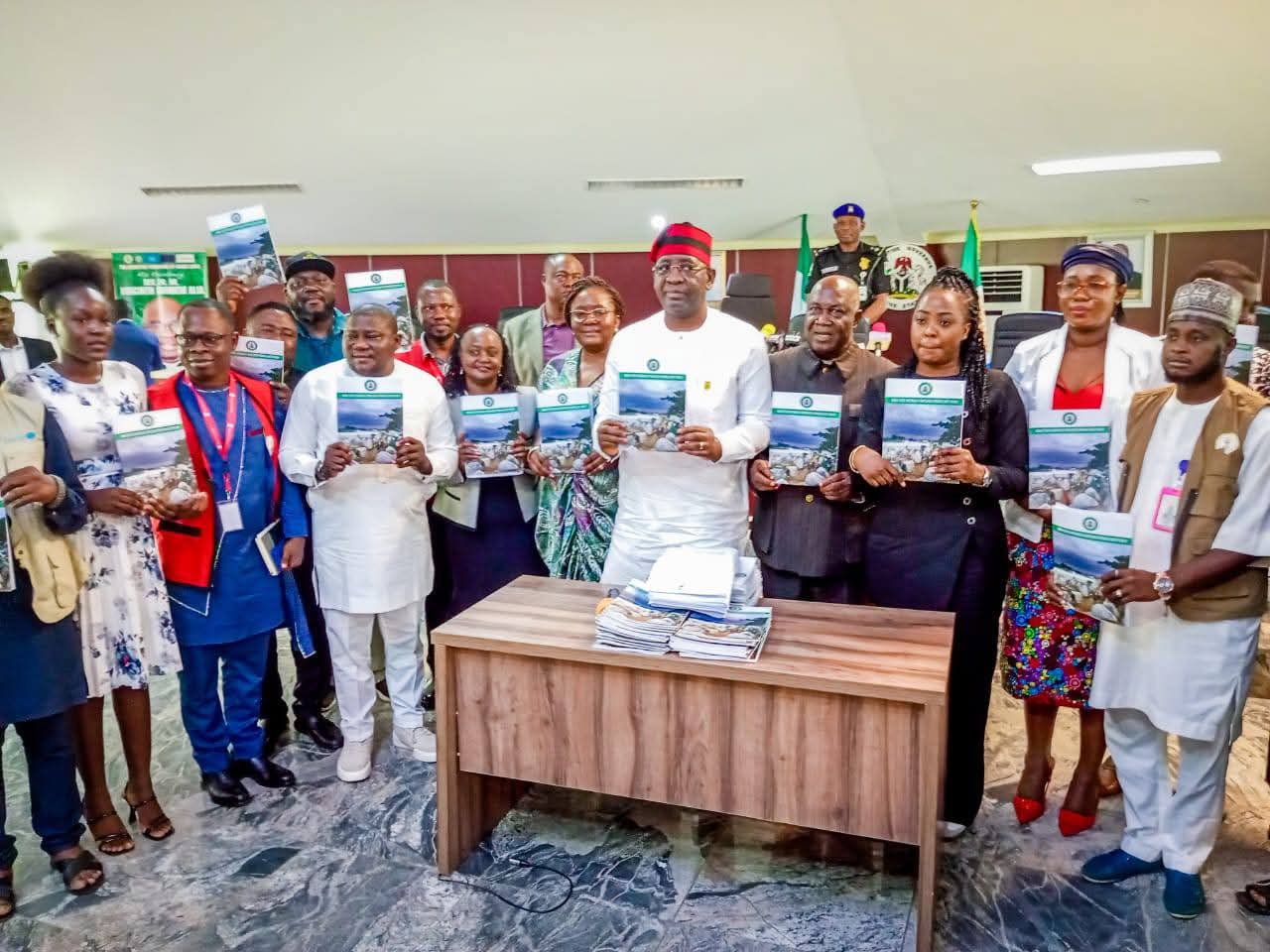
It was therefore a significant milestone when, on September 30, 2025, the Benue State IDP Policy was unveiled by the Governor, fulfilling his pledge to resettle IDPs and address the humanitarian challenges confronting the state’s displaced population.
The policy was developed by the Benue State Government in partnership with Save the Children International. It builds on Governor Alia’s earlier efforts, which include launching a programme to facilitate the safe return of IDPs to their ancestral homes through a three-pronged approach: Return, Integration, and Resettlement.
The governor has also provided IDPs with access to land, subsidized farm inputs, and improved seedlings to boost agricultural productivity. He initiated the formation of 210 farmers’ cooperatives across all camps, benefiting more than 4,200 IDPs.
In addition, the government is constructing 3,000 housing units to shelter at least 16,000 IDPs and has completed a transit camp in Guma Local Government Area, which accommodates over 4,000 IDPs in dignified emergency shelters.
The government has also launched economic empowerment programmes for IDPs aimed at guaranteeing market access, stabilizing prices, and integrating beneficiaries into the wider value chain. The Benue Investment and Property Company (BIPC), has initiated entrepreneurship programmes designed to empower IDPs and refugees, targeting over 50,000 direct jobs and impacting more than 80,000 families.
Furthermore, the administration has promoted peacebuilding and community dialogues to foster reconciliation and encourage land donations from traditional rulers for farming and resettlement.
These efforts form part of the governor’s broader strategy to restore normalcy to conflict-affected areas and improve the living conditions of displaced persons across Benue State.
The launch of the IDP Policy anchored on constitutional obligations and international human rights frameworks, represents a renewed commitment to collective action involving government, partners, and displaced communities.
The Principal Special Assistant to the Governor on Legal Matters, Barr. Seember Wayo, described the new policy as a social contract and a roadmap of hope anchored on both national and international legal instruments, including the UN Guiding Principles on Internal Displacement and the Kampala Convention.
“For decades, the people of Benue have borne the brunt of violent conflicts, farmer–herder crises, natural disasters, and other displacements that have torn families apart and placed immense pressure on host communities,” she said. “The launch of this policy is not just a formal event, but a profound statement of our government’s determination to protect the dignity, rights, and future of every displaced Benue citizen.”

The official unveiling of the policy by Governor Alia, represented by his Deputy, Barr. Dr. Sam Ode, reaffirmed the administration’s commitment to enabling displaced families to return home, rebuild their lives, and thrive. To achieve this, ministries, agencies, civil society, private sector actors, and community leaders are expected to work together through the Ministry of Humanitarian Affairs, the Durable Solutions Taskforce, and the SDGs Directorate to move the policy from words to action.
Barr. Wayo emphasized that the launch must mark a shift from policy intent to practical implementation. “It calls on all of us: government, partners, communities, and citizens to turn compassion into coordinated action, ensuring displacement in Benue never becomes a permanent condition, but a challenge we are united in overcoming,” she said.
This call was echoed by Save the Children International Deputy Country Director, Jane Mutua, and representatives of other humanitarian agencies, civil society groups, and displaced communities present at the event. They agreed that the new policy represents a major step in addressing the humanitarian challenges facing displaced populations in the state.
Mutua stressed the importance of ensuring that the policy moves beyond paper into action through full implementation, adequate funding, and continuous monitoring to achieve tangible results that directly impact displaced children and families.
The Commissioner for Humanitarian Affairs and Disaster Management, Aondowase Kunde, and the Executive Secretary of BSEMA, Dr. James Iorpuu, also commended Save the Children International for its consistent support. They emphasized the need for stronger collaboration between government and development partners to restore dignity and hope to thousands of IDPs across the state.
As the Benue State Government executes this social contract that places displaced persons at the centre of all interventions, all stakeholders and citizens must strengthen collaboration to restore dignity and hope to thousands of IDPs across the state.
Bridget Tikyaa is the Principal Special Assistant to the Governor on Media, Publicity, and Communication Strategy.


By Bridget Tikyaa
The Tiv people are one of Nigeria’s largest ethnic groups. They are mainly located in Benue State, with a noticeable presence in Taraba and Nasarawa states. With an estimated population of over 6.5 million, the Tiv people have very strong presence in Tarkaa, Makurdi, Gwer East, Gwer West, Ukum, Logo, Konshisha, Gboko, Kwande, Vandeikya, Katsina Ala, Guma, Buruku, and Ushongo Local Government Areas of Benue State. So also in
Bali, Donga, Ibi, Gassol, Takum, Gashaka, Kurmi, and Wukari Local Government Areas of Taraba State, and in Doma, Lafia, Obi, Keana, and Awe Local Government Areas, Nasarawa State. There are also about 20,000 of them in Manyu Division in the Republic of Cameroon.
So, when on December 13, 2025, the Tiv nation decided to converge on Gboko to role out the drums in celebration of their culture and tradition, it was to highlight the identity of a people who have been making solid contributions to the growth and development of not just their communities and states, but Nigeria and the global community as a whole.
Invariably, the 2025 Tiv Day celebration, which actually began in 1977, was a decisive attempt to revive the Tiv nation, engineer unity and cohesion, and bring out the best of its sons and daughters, tradition and customs.
The Tiv Day is a vibrant celebration typically marked with traditional dances, music, and performances, family and friends get-together to strengthen bonds and share experiences while savouring traditional
cuisine. It is also a time for the display of traditional attire, artefacts, and crafts.
There are also speeches and reflections from leaders who share insights on Tiv history, culture, and contributions. This was what the paramount leader of the Tiv people did.
The Tor Tiv, His Royal Majesty, Professor James Ortese Ayatse, highlighted the significance of the celebration in his speech at the opening of the grand ceremony, which apart from the cultural displays, is meant to ensure cultural reforms, empowering women, eliminating practices that hinder progress, promoting development of the Tiv language, and supporting youth education through initiatives such as the Tiv Scholarship Trust Fund, “Ayatutu Ka Se” Foundation, and “Kasev Tiv Bam”.
For all Tiv sons and daughters, it was an opportunity to shine, waltz, and merry. Embrace unity, heal political and social divisions, and work collectively for the future of the Tiv nation.
The event didn’t stop at the dance steps, traditions and cultural displays, it was also an opportunity to publicly honour outstanding Tiv sons, daughters and friends within and outside Nigeria, who have set examples worthy of emulation. These were people recognised by the Tiv Area Traditional Council and conferred with chieftaincy titles. Distinguished Tiv sons, daughters, and friends in recognition of their contributions to the Tiv Nation and Nigeria.
Among those honoured were Governor Hyacinth Alia (Asôrtar-u-Tiv), APC National Chairman, Engr. Prof. Nentawe Goshwe Yilwada (Zegebar-u-Tiv), and former Benue State Governor, Senator Dr. Gabriel Torwua Suswam (Vande-u-Tiv). Other are Engr. Slyvanus Ghasarah (Orwasen Tar-u-Tiv); Mr. Terry Atiba (Anôngo Tar-u-Tiv); Prince Michael Kaase Aondoakaa (Ivangeyange-u-Tiv); Prof. Sebastine Hon (Semawan-u-Tiv); Air Commodore Titus Terhemba Agbacha (Rtd.) (Garyō-u-Tiv); Hon. B.T. Ashaver (Yarasuwa-u-Tiv); Prince Solomon Wombo (Imenger-i-Tiv); Rt. Hon. Barr. Emmanuel Jime (Shagbawan-u-Tiv); Prof. Okurga Malu (Akinde-u-Tiv); Prof. Eugene Aliegba (Ibughashe-i-Tiv); Dr. Steven Hwande (Jime Nor-u-Tiv); Hon. Mrs. Dorathy Mato (Pendatyo-u-Tiv); Barr. Samuel Paul Edeh (Wandor-u-Dedoo-u-Tiv); Mr. Isaac Akinkunmi (Vanya-u-Dedoo-u-Tiv); and Chief David Sabi Kente (Zege Igba-u-Tiv). Eight others are to be conferred with their titles at a later date.

As expected, the event attracted a huge presence of people, tourists, and leaders, including Benue State Governor, Rev. Fr. Dr. Hyacinth Iormem Alia, and the Secretary to the Government of the Federation, George Akume, who wore two caps at the event – representative of President Bola Ahmed Tinubu and as a distinguished son of the soil.
President Tinubu minced no words in hailing the Tiv language and its people, saying the Tiv nation has an enduring cultural heritage and is making invaluable contributions to Nigeria’s unity and progress.
He went into history, saying that the Tiv Cultural Day Celebration, which began in 1977, has remained a vital platform for promoting unity and preserving cultural identity among the Tiv people, a development which the president said is worthy of emulation by other ethnic groups in the country.
The Presidential eulogy acknowledged the sacrifices made by the Tiv nation to the preservation of Nigeria’s corporate unity and the promotion of national development, as can be seen in the quality of persons serving meritoriously in key positions in the Tinubu administration.
Highlighting the priorities of the Renewed Hope Agenda being assiduously pursued, said through SGF Akume that the government has demonstrated commitment to strengthening fundamental freedoms, civil liberties and good governance as evidenced in improvements in the quality of education, digitalisation of the economy, public service welfare, and the ease of doing business, which is attracting direct foreign investment in quantum leaps.
The Presidential Envoy to the occasion also pointed to the construction of new dams and major bridges across the country, including the one at River Buruku, the intensification of the war against insurgents and terrorists to achieve enhanced national security, as well as the establishment of the North Central Development Commission, which was noted as of strategic benefit to the Tiv nation and that peoples of North-Central Nigeria.
“May I commend specially once more the contribution of the Tiv people during the Nigerian Civil War to preserve the unity and territorial integrity of this country, even as I extend my continual goodwill and prayers for long life and prosperity to His Royal Majesty, the Tor Tiv, the Tiv Area Traditional Council, and the entire Tiv nation”, President Tinubu said.
For Governor Alia, the Tiv Day celebration is a new chapter in the history of the Tiv people, highlighting their numerical strength and spread across several states of Nigeria, and remaining one of Nigeria’s most identifiable ethnic group.
For him and all Tiv sons and daughters, that should be a source of pride, not just because of who they are but also for their uniqueness.
He admonished all to remain peaceful and united and work collectively for the progress of the Tiv Nation.
The governor, who was conferred with the traditional title of Asortar U Tiv, said everyone should commit to providing responsible services for the overall development of Benue State.
One key event at the ceremony was the launch of the Tiv-English Dictionary, a great milestone in the preservation and revival of Tiv language and culture.
Former Governor of Benue State, Senator Gabriel Suswam, who was among those honoured, urged Tiv sons and daughters to rise above political differences and support the government in power to advance development across Tiv land and Benue State.
The President General of Mzough-u-Tiv Worldwide, CP Iorbee Ihagh (Rtd.), described the 2025 Tiv Day celebration as a call for deeper reflection and action to promote unity and peace, which are the foundations for development.
He also had a message to the federal government to intensify efforts to end insecurity and enable displaced Tiv people to return to their ancestral homes and farms.
In his response on behalf of the honourees, the National Chairman of the All Progressives Congress, Engr. Prof. Nentawe Goshwe Yilwada expressed gratitude to the Tiv Nation for the honour and appealed for unity and reconciliation, stressing that peace within is necessary to confront external challenges.


Nigeria Through Foreign Lens: Why We Must Stop Being Our Own Worst Critics

Church Leader at 50, Renews Commitment to Humanitarian Service, Family Values

34 Young Leaders Join PELF 2026 Cohort in Plateau