Connect with us

News

Report: Ajuri Ngelale Did Not Resign Due to ‘Vexatious Medical Situation’. He Was Fired

Published

on

Ajuri Ngelale, the broadcast journalist who made a name for himself with his eloquence and sonorous voice, did not resign as special adviser to the president on media and publicity to tend to a “vexatious medical situation” in his family as he claimed

He was fired by the presidency and only allowed to publicly resign after his repeated pleas for a soft landing.

Ngelale, who was also the special presidential envoy on climate action, stunned Nigerians on Saturday morning when he announced his abrupt exit from office, citing “medical matters presently affecting my immediate, nuclear family”.

“On Friday, I submitted a memo to the Chief of Staff to the President informing my office that I am proceeding on an indefinite leave of absence to frontally deal with medical matters presently affecting my immediate, nuclear family,” Ngelale wrote.

“While I fully appreciate that the ship of state waits for no man, this agonising decision — entailing a pause of my functions as the Special Adviser to the President on Media & Publicity and Official Spokesperson of the President; Special Presidential Envoy on Climate Action, and Chairman, Presidential Steering Committee on Project Evergreen — was taken after significant consultations with my family over the past several days as a vexatious medical situation has worsened at home.”

He said he looked “forward to returning to full-time national service when time, healing, and fate permit”, and respectfully asked “for some privacy for my family and I [sic] during this time”.

But multiple highly-placed sources in and around the presidency told FIJ on Saturday afternoon that Ngelale’s exit was not triggered by a family health emergency, but rather his loss in a power tussle with Bayo Onanuga, the Special Adviser on Information and Strategy.

It was understands that following the election of Bola Tinubu as Nigeria’s president in 2023, Ngelale did not exactly hit it off with Onanuga, largely because having been in government before Onanuga — President Muhammadu Buhari appointed Ngelale his senior special adviser on public affairs in 2019 and he served in this position until the end of Buhari’s tenure — he considered himself Onanuga’s boss.

Ngelale, 38, began his career with the Africa Independent Television (AIT) in the 2000s, while Onanuga, 67, a former Managing Director of the News Agency of NJigeria (NAN), began his career in the 1980s. There was one problem, though: while Ngelale was special adviser on media and publicity, Onanuga was the special adviser on information and strategy.

It was believed that civil servants found the roles confusing. This was nothing like in the Buhari administration when Femi Adesina was the special adviser on media and publicity and Garba Shehu the senior special assistant on media publicity. In the latter case, everyone knew Adesina, as SA, was senior, while Shehu, as SSA, was subordinate.

Ngelale and Onanuga both had special adviser roles; and the profolios seemed similar. However, by design, the civil service structure of the villa reported to the SA media, and that was Ngelale.

“Ngelale considered himself untouchable because he had the backing of the president’s son Seyi and Femi Gbajabiamila, the president’s chief of staff,” one source who asked not to be named for fear of retribution told FIJ.

“He was fired; I became aware of this on Tuesday, but I won’t rule out the possibility that it happened earlier. When he got the letter, he started to plead to be allowed to resign as a soft landing. He was eventually given a soft landing, which is understandable. News of his sacking in public would have thoroughly embarrassed not just Ngelale but the presidency too.”

Although this source expressed regrets that things eventually got to a head, they conceded that there was no other way out, given Ngelale’s unwillingness to discuss his long-drawn-out feud with Onanuga when the opportunities were presented to him.

“The Ngelale-Onanuga feud was no secret in the villa, so several top appointees and cabinet members attempted to intervene at separate times; and while Onanuga was open to peace talks, Ngelale wasn’t,” the source continued.

“For example, Mohammed Idris Malagi, the minister of information and national orientation, called for talks four times. Onanuga was willing to attend but Ngelale snubbed them all, always claiming he was busy.”

Civil servants who asked not to be named, as well as a source familiar with presidency happenings, said that Onanuga, despite being formally appointed in October 2023 “was a squatter in the presidency and did not have an office of his own until just a few months ago”.

“When Onanuga was appointed, he had no office. He was squatting in Tunde Rahman’s office,” said one of the sources. “It was just recently that he eventually got an office that belonged to either Wale Edun or Zacheus Adedeji when they were still advisers.

Rahman, the senior special assistant to the president on media and publicity, was appointed in July 2023 — three months earlier than Onanuga’s appointment. Meanwhile, Zacheus Adedeji was appointed special adviser on revenue while and Wale Edun was appointed special adviser on monetary policy in June 2023.

While Adedeji has since become the executive chairman, Federal Inland Revenue Service (FIRS), Edun has since become minister of finance and coordinating minister of the economy. Notably, all three appointments came months ahead of Onanuga’s.

These were people who had been with Tinubu for decades, unlike Ngelale, so how did Ngelale become so powerful that he got appointed earlier, blocked Onanuga from having an office to himself and all the aforementioned appointees could not fix Onanuga an office?

As written earlier, Ngelale had the backing of Seyi Tinubu and Gbajabiamila, but a third source took it even further, saying: “It was about how he got the job.”

“During the 2023 presidential electioneering, Jumoke Oduwole, the special adviser on Presidential Enabling Business Environment Council (PEBEC), introduced Ngelale to Gbajabiamila,” said the source.

“When Ngelale got there, he met Seyi. He told Seyi he would facilitate a CNN interview during which Tinubu’s presidential ambition would be discussed. Seyi thought it was impossible, but Ngelale did it. He secured the interview on CNN. He then told Seyi the time and date it would air. Seyi promised Ngelale that Tinubu would phone him if he pulled it off. Immediately after the interview was aired, Tinubu called Ngelale.

“When Tinubu won the election, Ngelale was abroad. People told him to return home but he said no; he insisted he would get his own appointment once he arrived in the country. And that was exactly what happened: Ngelale’s appointment by Tinubu was announced days after his return to Nigeria.

“Conversely, Gbajabiamila delayed the announcement of Onanuga’s appointment for at least two months. It required Chief Bisi Akande, who originally made the case for Onanuga’s appointment, to return to Tinubu for follow-up conversations. That was when Tinubu ordered that Onanuga’s appointment should be made, and that was how Onanuga came to the villa.”

It was believed that villa staff and civil servants whose work related to the president’s communication strategy noticed the tension between Ngelale and Onanuga and thought if they worked with one, then the other thought they were against him.

“This meant thework of publicising the president’s progressive policies was derailed,” said the source.

“By the way, Ngelale instructed civil servants that no statement from Onanuga could go out if he had not personally cleared it. If you speak with sources across divides, they would tell you Onanuga was the more peace-seeking of the duo. But this particular order from Ngelale to civil servants annoyed Onanuga.”

Ngelale’s standing with Tinubu started to plummet once it was easy to pitch to the president how Ngelale’s unharmonious relationship not just with Onanuga but with the media was hindering good publicity for the president.

“He did not have a good relationship with journalists. Ask the reporters; ask the state house correspondents. And also ask editors,” added the source.

“Many people consider him disrespectful and arrogant, even the editors.

Continue Reading
Click to comment

Leave a Reply

Your email address will not be published. Required fields are marked *

Abuja Reports

Atoyebi Adewumi Wins 4th National Essay Competition, Beats 2,000 Contestants

Published

on

By

By Samson Adeyanju

Atoyebi Adewumi has emerged winner of the fourth edition of the National Essay Competition, beating more than 2,000 contestants in an intellectual contest aimed at promoting academic excellence, critical thinking and creative writing among young Nigerians.

The competition, which focused on the relevance of taxation to national development, challenged participants to examine the role of tax revenue in financing public services, stimulating economic growth and strengthening the relationship between government and citizens.

The initiative provided a platform for young Nigerians to demonstrate their writing skills, articulate informed perspectives on national issues and contribute ideas towards building a more responsible and progressive society.

Speaking after being declared winner, an elated Adewumi expressed gratitude to the convener, Foluso Sylvanus Ojo, and the organising team for providing young Nigerians with an opportunity to showcase their intellectual abilities.

“I am so glad, very, very glad, to have this privilege of emerging as the winner. I am grateful to the convener and the entire team, as well as everyone who supported this vision,” Adewumi said.

In his remarks, Ojo expressed concern over the tendency to criticise the attitudes and lifestyles of younger generations without providing adequate opportunities to nurture their talents and channel their energies towards productive pursuits.

He called on the government, corporate organisations and nongovernmental organisations to invest more in educational initiatives that promote intellectual excellence, creativity and responsible citizenship.

According to him, sustained investment in academic competitions and youth development programmes would encourage discipline, innovation and a stronger commitment to national development.

Drawing a comparison with the substantial cash prizes awarded in some reality television competitions in Nigeria, Ojo argued that students and intellectually gifted young Nigerians deserved greater recognition, financial support and encouragement.

“I believe the government should support initiatives like this because individuals need supportive hands, especially from the government. When they receive such support, they become more confident and motivated to continue their good work,” he said.

Ojo maintained that society could not continue to complain about the attitudes and lifestyles of young people without deliberately investing in programmes that encourage positive values and productive engagement.

The fourth edition of the competition also underscored the importance of tax awareness among young Nigerians, highlighting how effective taxation, transparency and accountable governance could contribute to improved infrastructure, education, healthcare and other essential public services.

Beyond celebrating the winner, the competition reinforced the need to identify, encourage and empower emerging intellectual talents capable of contributing meaningfully to Nigeria’s development.

Winner of the 5,000,000 naira

Winner of 3,000,000 naira

Winner of 2,000,000
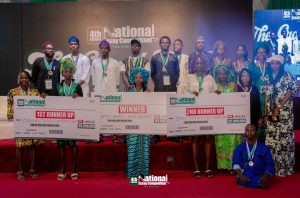
All the participants 

Continue Reading

Abuja Reports

20 Finalists Begin Final Stage of National Essay Competition

Published

on

By

By Samson Adeyanju

Twenty finalists from across Nigeria have begun the final stage of the fourth edition of the National Essay Competition in Abuja, following an orientation session designed to prepare them for the decisive examination.

The finalists arrived in the Federal Capital Territory for a four-day, all-expenses-paid programme featuring the essay examination, institutional tours and opportunities for learning and networking.

The competition, the brainchild of Mr Foluso Ojo, is sponsored by the Nigeria Revenue Service (NRS).

Ahead of the examination, the finalists participated in an orientation session led by Professor Omotosho Borisade of Ekiti State University, who serves as the competition’s umpire.

The session familiarised participants with the competition’s rules and regulations, examination guidelines and assessment criteria, helping them understand the requirements of the final stage.

The essay examination is scheduled to begin today at 9 a.m., after which the finalists are expected to embark on institutional tours around Abuja.

The programme is designed to extend beyond the contest itself, exposing the finalists to new learning opportunities, professional connections and experiences in the nation’s capital.

The competition brings together young Nigerians to demonstrate their writing ability, knowledge, creativity and critical-thinking skills as they compete for the top honours.

With the finalists prepared for the examination, attention now turns to their performance and the eventual emergence of the competition’s champion.


Continue Reading

News

Pastor Ogundipe Decries Lack of Integrity Among Educated Nigerians

Published

on

By

By Samson Adeyanju

Pastor Alex Ogundipe, Chairman of the Governing Board of Christian Heritage International Bible College, Kubwa, Abuja, has expressed concern over the growing number of educated Nigerians who lack the character and integrity required to make meaningful contributions to society.

Ogundipe raised the concern during the matriculation ceremony of the institution’s 60 pioneer students, stressing that academic qualifications without moral discipline and upright character could undermine national development.

According to him, Nigeria has many knowledgeable and academically accomplished individuals whose inability to demonstrate integrity has negatively affected their contributions to their families, workplaces and communities.

“We have too many people in this country who are knowledgeable and wise in their own ways, but they do not have character and integrity. That affects their ability to impact their communities,” he said.

The cleric emphasised that education must go beyond the acquisition of certificates to the development of individuals who demonstrate honesty, accountability, faithfulness and commitment to serving humanity.

He explained that true integrity required consistency in personal conduct, whether at home, in the church, at work or within the larger society.

Ogundipe said the college was established not merely to impart biblical knowledge but to raise men and women whose lifestyles reflect Christian values and whose contributions would positively influence society.

He urged Christian leaders to demonstrate their faith through practical actions rather than mere religious declarations.

Speaking on Nigeria’s future, the cleric encouraged citizens to remain hopeful, pray for the country and contribute meaningfully to national peace, unity and development.

Earlier, the Rector of the institution, Pastor Samson Olukayode Aliyu, challenged the matriculating students to prioritise spiritual maturity and moral discipline alongside academic excellence.

Aliyu warned against examination malpractice, plagiarism, dishonesty and other forms of misconduct, stressing that academic certificates could demonstrate knowledge but could not substitute for good character.

“The Church does not only need gifted people; it needs godly people. We need leaders who will choose integrity over compromise, humility over pride, faithfulness over convenience and service over self-interest,” he declared.

He explained that the college offers six-month certificate programmes in theology and one-year diploma programmes in theology, leadership and prophetic studies.

One of the matriculating students, Akeem Omobolanle, who enrolled in the Diploma in Leadership programme, commended the institution’s approach to biblical education and expressed optimism that the training would strengthen his understanding of the Scriptures and prepare him for greater service in Christian ministry.

The ceremony marked the formal admission of the college’s pioneer students into its academic community.

Continue Reading

Trending