News
President Tinubu fell; so what?


The uproar that greeted the slip of President Bola Ahmed Tinubu on June 12, 2024, as the nation marked its Democracy Day, goes a long way to describe a people yet to find truce to setting their priorities right.
In the wake of lingering economic woes and the attendant anguish that has been the lot of majority of Nigerians, one would expect that, rather than looking for trivialities that add nothing to our present precarious situation, a citizen clamoring for leeway to stardom should rather roll up sleeves in readiness to team up with government to salvage Nigeria.
Yes, things are rough and our leaders seems to have been at a cross road as to proffering a foolproof way out of the present economic quagmire, but it is an Hobson’s choice that we keep hope alive, believing that we shall breakthrough at last.
Back to the presidential slide, it is on record that prominent leaders across the globe have fell down at public glare, hence President Tinubu’s fall should not be a surprise, since he is also human. As human, there are bound to be occasions like that and life goes on.
So, President Bola Tinubu who stumbled and fell as he climbed into the back of a parade vehicle at Eagle Square on Wednesday, now making headlines around the world is no news. He is far from the only world leader or political icon, who has taken a highly visible fall.
From Chinese leader Xi Jinping (whose 2019 slip commentators dubbed the “great fall of China”) to Gerald Ford (whose fall while disembarking Air Force One in 1975 was the subject of late-night comedy skits) and other politicians around the world, trips and tumbles are fodder for laughs, cringes — and hot takes.
Though when the mighty fall, we just can’t look away.
“It breaks the image of infallibility of powerful figures,” Bart Cammaerts, a professor of politics and communication at the London School of Economics, told The Washington Post. Projecting the right image is serious business for politicians.
Joe Biden of USA
In Biden’s case, his critics immediately used it as an opportunity to highlight the oldest U.S. president’s age and question his fitness for office. But there is also something captivating about politicians appearing more human. “Think of slapstick comedy, breaking the seriousness and ceremonial aspect of the event,” Cammaerts said.
“With people in power, there is so much effort to control the public image — body language, speech, facial expressions — that seeing all those things fall away all at once, in a total loss of control, is particularly gripping,” said Dan Stevens, professor of political behavior in the United States and Britain at Exeter University.

Here are other memorable political falls or trips.
1. Hillary Clinton — 2016
A media frenzy ensued when Hillary Clinton, as Democratic presidential nominee, buckled and stumbled in 2016 after becoming sick during a 9/11 memorial service in New York.While Clinton was diagnosed with pneumonia, and her doctor said she became overheated and dehydrated at the event, the incident became a hot button in a highly charged campaign —when her rival, Bonald Trump had repeatedly questioned her “stamina” for office and accused her of being “exhausted,” The Post reported at the time.

2. Donald Trump — 2020
Trump, as president, looked unsteady on his feet at the U.S. Military Academy at West Point in 2020. His slow, unsteady walk while descending a ramp led his critics to use the hashtag #TrumpIsNotWell. As The Post reported at the time, Trump is “exceptionally attuned” to his public image and keen on being seen as strong — and his critics were quick to compare the incident with videos of his rival Biden jogging. Trump tweeted that the ramp was “very long & steep, had no handrail and, most importantly, was very slippery” and insisted that the “last thing I was going to do is ‘fall’ for the Fake News to have fun with.”He also made headlines in the United Kingdom when he clutched the hand of Prime Minister Theresa May in 2017 during her visit to the White House. Trump appeared to grab her hand as he walked down a ramp, before patting it and letting go. The incident came as a “surprise” to May, her advisers later reportedly said.

3. Gerald Ford — 1975
Stumbles, especially from older politicians, are often framed as part of a narrative about fitness for office, Stevens said, also citing the example of Bob Dole who at age 73 ran against Bill Clinton in 1996 and fell off a stage at a campaign event.Exactly 48 years ago to the day of Biden’s June 1 tumble, President Gerald Ford was also captured falling down by the media. The embarrassing incident occurred overseas as he was disembarking Air Force One in the rainy Austrian city of Salzburg.
Accompanied by his wife, Ford, 61, walked tentatively down the wet plane steps before seeming to lose his balance and skidding down the remaining stairs, ending up in a heap on the tarmac as officials clambered to get him back on his feet. He apparently later quipped: “Thank you for your gracious welcome to Salzburg, and I am sorry I tumbled in.”The incident was caught on camera and beamed globally. It was also used in late-night comedy shows at the time portrahing the president as bumbling and clumsy.

4. Xi Jinping — 2019
China’s leader Xi Jinping caused a commotion when he nearly slipped off a stage in Russia during the St. Petersburg International Economic Forum in 2019. On a crowded platform, surrounded by U.N. Secretary General António Guterres and other world leaders, Xi appeared to get close to the crowd, bending and waving before almost falling toward them.He swiftly regained his footing, although he looked a little sheepish, before coolly walking away and waving. Commentators labeled it the “great fall of China” and mused about the implications for his image in a country that goes to extreme lengths to portray Xi as a strong leader and avoids any public criticism.

5. Robert Mugabe — 2015
Zimbabwe’s late leader, Robert Mugabe, went flying down red-carpeted steps in the capital Harare in 2015.An immediate government denial followed, and some members of the press were forced to delete their photographs by security officials. “Nobody has shown any evidence of the president having fallen down because that did not happen,” Information Minister Jonathan Moyo told the state-owned Zimbabwe Herald, labeling speculators “malcontents.” He then blamed poor carpeting. “To be honest with you, even Jesus, let alone you, would have also tripped in that kind of situation,” he added.The authoritarian leader appeared to struggle with the stairs and then miss one, falling down as he headed for his car. His critics pointed to his age – 90 – and saw it as another reason for him to walk away after more than three decades in power in the southern African country

6. Vladimir Putin — 2019
But in 2019 the world saw him floored during another pursuit: playing ice hockey at Sochi’s Bolshoy Ice Dome. After winning the game, Putin glides around the rink in a victory lap clapping and waving at fans. The Russian leader then slammed into the floor l before being helped up and skating off.Russia’s President Vladimir Putin is known for carefully curating his image, releasing photographs of him bare-chested riding a horse or swimming in a freezing Siberian lake or practicing judo in apparent displays of his strength and manliness.

7. Boris Johnson — 2015
“In the current era of promotional politics, a politician’s ‘brand’ — or public persona — is as critical for gaining public acceptance as their policies,” said Lee Edwards, professor of strategic communication and public engagement at LSE.Another male leader said to care about his image — Britain’s former prime minister Boris Johnson — also makes the epic falls list. Johnson, often appearing with his hair uncombed and shirts untucked, has been perceived by some British media as a curated image of his nonchalant approach to government.In 2015, the then-mayor of London made tabloid headlines when heslipped during a charity tug-of-war game at a World War I commemoration event with Britain’s armed forces. Clenching his teeth and grimacing, Johnson pulled hard in the game taking place along the River Thames. He was heard exclaiming “oh bugger,” before ultimately losing his footing and falling on the muddy grass before regaining his composure.
All public appearances are therefore scrutinized and “where weaknesses emerge, they are highly visible and up for discussion,” she said. Memes and social media commentary “perpetuate the story, along with the embarrassment, for much longer than used to be the case.”

8. Helle Thorning-Schmidt — 2015
Danish Prime Minister Helle Thorning-Schmidt fell down steps in Paris in 2015, landing her on her hands and knees. She was exiting France’s Elysee Palace wearing high heel shoes before she wobbled and her ankles appeared to give way, causing her to tumble and let out a scream. She quickly dusted herself off and proceeded to take questions from nearby reporters

9. Margaret Thatcher — 1982
British Prime Minister Margaret Thatcher fell down after politically fraught meetings in Beijing in 1982, in which she was negotiating the future of the British colonial territory of Hong Kong.As she left the Great Hall of the People, she stumbled down the steps — a moment captured on camera. At the time, her fall was perceived by many in Hong Kong as a sign that negotiations were not going well for the British — some described it as an embarrassing or ominous moment in the negotiations, or a moment that symbolised how Britain’s power was waning at a time when China was adopting an increasingly bullish position on Hong Kong


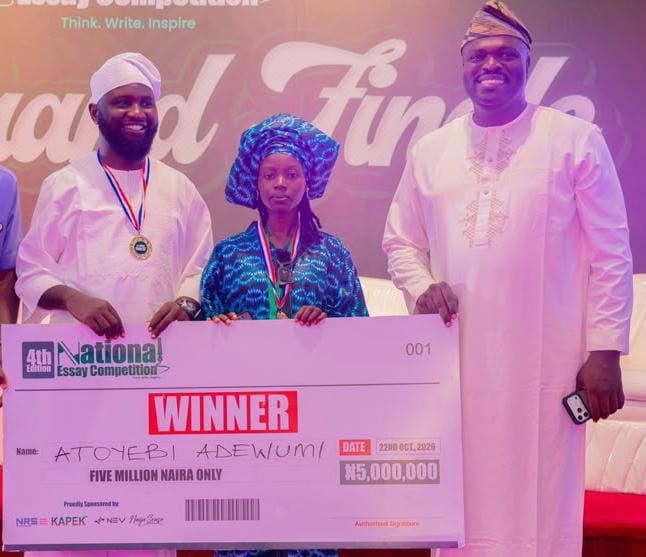
By Samson Adeyanju
Atoyebi Adewumi has emerged winner of the fourth edition of the National Essay Competition, beating more than 2,000 contestants in an intellectual contest aimed at promoting academic excellence, critical thinking and creative writing among young Nigerians.
The competition, which focused on the relevance of taxation to national development, challenged participants to examine the role of tax revenue in financing public services, stimulating economic growth and strengthening the relationship between government and citizens.
The initiative provided a platform for young Nigerians to demonstrate their writing skills, articulate informed perspectives on national issues and contribute ideas towards building a more responsible and progressive society.
Speaking after being declared winner, an elated Adewumi expressed gratitude to the convener, Foluso Sylvanus Ojo, and the organising team for providing young Nigerians with an opportunity to showcase their intellectual abilities.
“I am so glad, very, very glad, to have this privilege of emerging as the winner. I am grateful to the convener and the entire team, as well as everyone who supported this vision,” Adewumi said.
In his remarks, Ojo expressed concern over the tendency to criticise the attitudes and lifestyles of younger generations without providing adequate opportunities to nurture their talents and channel their energies towards productive pursuits.
He called on the government, corporate organisations and nongovernmental organisations to invest more in educational initiatives that promote intellectual excellence, creativity and responsible citizenship.
According to him, sustained investment in academic competitions and youth development programmes would encourage discipline, innovation and a stronger commitment to national development.
Drawing a comparison with the substantial cash prizes awarded in some reality television competitions in Nigeria, Ojo argued that students and intellectually gifted young Nigerians deserved greater recognition, financial support and encouragement.
“I believe the government should support initiatives like this because individuals need supportive hands, especially from the government. When they receive such support, they become more confident and motivated to continue their good work,” he said.
Ojo maintained that society could not continue to complain about the attitudes and lifestyles of young people without deliberately investing in programmes that encourage positive values and productive engagement.
The fourth edition of the competition also underscored the importance of tax awareness among young Nigerians, highlighting how effective taxation, transparency and accountable governance could contribute to improved infrastructure, education, healthcare and other essential public services.
Beyond celebrating the winner, the competition reinforced the need to identify, encourage and empower emerging intellectual talents capable of contributing meaningfully to Nigeria’s development.

Winner of the 5,000,000 naira 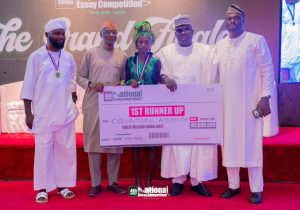
Winner of 3,000,000 naira 
Winner of 2,000,000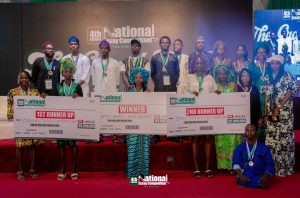
All the participants


By Samson Adeyanju
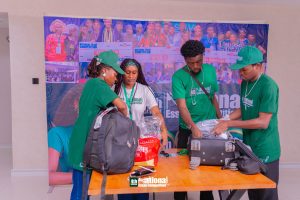
Twenty finalists from across Nigeria have begun the final stage of the fourth edition of the National Essay Competition in Abuja, following an orientation session designed to prepare them for the decisive examination.
The finalists arrived in the Federal Capital Territory for a four-day, all-expenses-paid programme featuring the essay examination, institutional tours and opportunities for learning and networking.
The competition, the brainchild of Mr Foluso Ojo, is sponsored by the Nigeria Revenue Service (NRS).
Ahead of the examination, the finalists participated in an orientation session led by Professor Omotosho Borisade of Ekiti State University, who serves as the competition’s umpire.
The session familiarised participants with the competition’s rules and regulations, examination guidelines and assessment criteria, helping them understand the requirements of the final stage.
The essay examination is scheduled to begin today at 9 a.m., after which the finalists are expected to embark on institutional tours around Abuja.
The programme is designed to extend beyond the contest itself, exposing the finalists to new learning opportunities, professional connections and experiences in the nation’s capital.
The competition brings together young Nigerians to demonstrate their writing ability, knowledge, creativity and critical-thinking skills as they compete for the top honours.
With the finalists prepared for the examination, attention now turns to their performance and the eventual emergence of the competition’s champion.




Atoyebi Adewumi Wins 4th National Essay Competition, Beats 2,000 Contestants

20 Finalists Begin Final Stage of National Essay Competition

Pastor Ogundipe Decries Lack of Integrity Among Educated Nigerians