Abuja Reports
FCTA Arrests Two Land Racketeers, Says no Compensation for Victims


The Federal Capital Territory Administration (FCTA) on Thursday arrested two suspected land racketeers for selling plots of land illegally to unsuspecting residents of Ungwan Zaki, in Jahi District, Abuja.
Mr Mukhtar Galadima, Director of Development Control, FCTA, who stated this in Abuja, during the demolition of illegal structures in Jahi community said there would be no compensation for the victims.
Galadima said the suspects, one Mr Yusuf Ibrahim, popularly known as Baban Kalifa, and Prophet Emmanuel Ayisa, would be prosecuted according to the law.
“I am not surprised because these are the antics of criminals, but we have warned the residents and citizens about this kind of ugly situation.
“We have warned people to beware because every land in Abuja has been planned for something. We equally warned residents not to buy land from local chiefs. You have to go to the appropriate authority.
“Even if you want to buy land from somebody, you have to conduct a due diligence search. It is unfortunate that these are victims of circumstances,” he said.
He stressed that the authority would not give them compensation for their loss and advised people to consult appropriate authorities to search for whatever property they want to buy.
The director said, “I feel their pain, but whatever it is, it is illegal and that is why we are removing it.
“It is a continuous process of cleaning and sanitising the city. Obviously, this place is like a criminal den, because when we came in, we saw a lot of characters,” he said.
The Deputy Director and Head of Enforcement, Mr Hassan Ogbole, said that the area was reserved for a road corridor between Kado and Jahi Districts.
Ogbole said that the enforcement team visited the area five times, adding that the people often return and rebuild after every demolition.
“I believe that with this extensive removal of the trees, it will be difficult for them to come back,” he said.
Also, Mr Peter Olumuji, Secretary, Command and Control, FCTA, explained that the arrest was based on intelligence reports by security agencies who gathered that people were contributing money to bribe the enforcement team.
Olumoji explained that the security operatives were able to identify the culprit and arrest was made, adding that the Commissioner of Police, FCT Command had ordered thorough investigation and prosecution of the fraudsters.

One of the victims, Ms Florence Emedo, said that she bought the land about two years ago, and was assured that the area would not be demolished and that she could stay there for 10 years.
“We were told that the traditional leader of the area, called Zaki of Kado, was fully aware of the land, which was initially being sold for N75,000.
“Baban Kalifa assured us that nothing will happen, adding that they have an insider in FCTA and assured us that nothing will happen but from time to time we will just contribute money and give them.
“They asked us to gather money and they will go to the office, and we contributed N10,000 each,” she said.
Another victim, Ms Owadia Valentina, said that she bought the plot for N450,000 while some bought between N100,000 and N200,000.
“He assured us that we can stay for 10 years and that there is already an agreement on the land.
“I moved in October last year, and I just painted two months ago,” she said.
However, the suspect denied the allegation, claiming that they have not sold land to anyone in the area.
Yusuf Ibrahim specifically said that he did not collect any money from anybody for the purpose of enriching himself.
He, however, acknowledged collecting money from the residents, but said it was for compensation to the Gbagyi people who owned the cashew plantation where the lands were sold.
Similarly, Prophet Ayisa, agreed that he and Baban Khalifa held a meeting after which they collected money from the victims of the demolished structures, but not to appease the officials of the FCTA against demolition of their area.







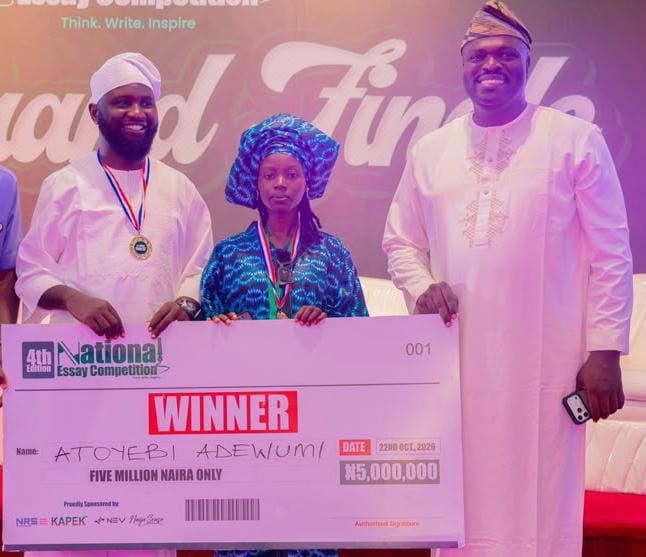
By Samson Adeyanju
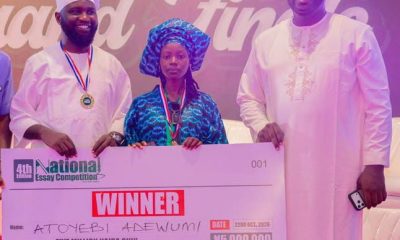
Atoyebi Adewumi has emerged winner of the fourth edition of the National Essay Competition, beating more than 2,000 contestants in an intellectual contest aimed at promoting academic excellence, critical thinking and creative writing among young Nigerians.
The competition, which focused on the relevance of taxation to national development, challenged participants to examine the role of tax revenue in financing public services, stimulating economic growth and strengthening the relationship between government and citizens.
The initiative provided a platform for young Nigerians to demonstrate their writing skills, articulate informed perspectives on national issues and contribute ideas towards building a more responsible and progressive society.
Speaking after being declared winner, an elated Adewumi expressed gratitude to the convener, Foluso Sylvanus Ojo, and the organising team for providing young Nigerians with an opportunity to showcase their intellectual abilities.
“I am so glad, very, very glad, to have this privilege of emerging as the winner. I am grateful to the convener and the entire team, as well as everyone who supported this vision,” Adewumi said.
In his remarks, Ojo expressed concern over the tendency to criticise the attitudes and lifestyles of younger generations without providing adequate opportunities to nurture their talents and channel their energies towards productive pursuits.
He called on the government, corporate organisations and nongovernmental organisations to invest more in educational initiatives that promote intellectual excellence, creativity and responsible citizenship.
According to him, sustained investment in academic competitions and youth development programmes would encourage discipline, innovation and a stronger commitment to national development.
Drawing a comparison with the substantial cash prizes awarded in some reality television competitions in Nigeria, Ojo argued that students and intellectually gifted young Nigerians deserved greater recognition, financial support and encouragement.
“I believe the government should support initiatives like this because individuals need supportive hands, especially from the government. When they receive such support, they become more confident and motivated to continue their good work,” he said.
Ojo maintained that society could not continue to complain about the attitudes and lifestyles of young people without deliberately investing in programmes that encourage positive values and productive engagement.
The fourth edition of the competition also underscored the importance of tax awareness among young Nigerians, highlighting how effective taxation, transparency and accountable governance could contribute to improved infrastructure, education, healthcare and other essential public services.
Beyond celebrating the winner, the competition reinforced the need to identify, encourage and empower emerging intellectual talents capable of contributing meaningfully to Nigeria’s development.

Winner of the 5,000,000 naira 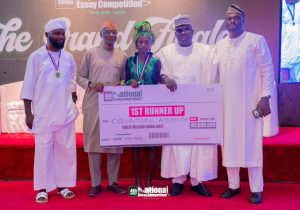
Winner of 3,000,000 naira 
Winner of 2,000,000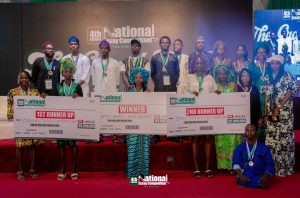
All the participants


By Samson Adeyanju
Twenty finalists from across Nigeria have begun the final stage of the fourth edition of the National Essay Competition in Abuja, following an orientation session designed to prepare them for the decisive examination.
The finalists arrived in the Federal Capital Territory for a four-day, all-expenses-paid programme featuring the essay examination, institutional tours and opportunities for learning and networking.
The competition, the brainchild of Mr Foluso Ojo, is sponsored by the Nigeria Revenue Service (NRS).
Ahead of the examination, the finalists participated in an orientation session led by Professor Omotosho Borisade of Ekiti State University, who serves as the competition’s umpire.
The session familiarised participants with the competition’s rules and regulations, examination guidelines and assessment criteria, helping them understand the requirements of the final stage.
The essay examination is scheduled to begin today at 9 a.m., after which the finalists are expected to embark on institutional tours around Abuja.
The programme is designed to extend beyond the contest itself, exposing the finalists to new learning opportunities, professional connections and experiences in the nation’s capital.
The competition brings together young Nigerians to demonstrate their writing ability, knowledge, creativity and critical-thinking skills as they compete for the top honours.
With the finalists prepared for the examination, attention now turns to their performance and the eventual emergence of the competition’s champion.







Atoyebi Adewumi Wins 4th National Essay Competition, Beats 2,000 Contestants

20 Finalists Begin Final Stage of National Essay Competition

Pastor Ogundipe Decries Lack of Integrity Among Educated Nigerians