Connect with us

Energy

‘We Can’t Afford Gas Anymore’: FCT Residents Beg FG Over Soaring Prices

Published

on

By Samuel Adeola


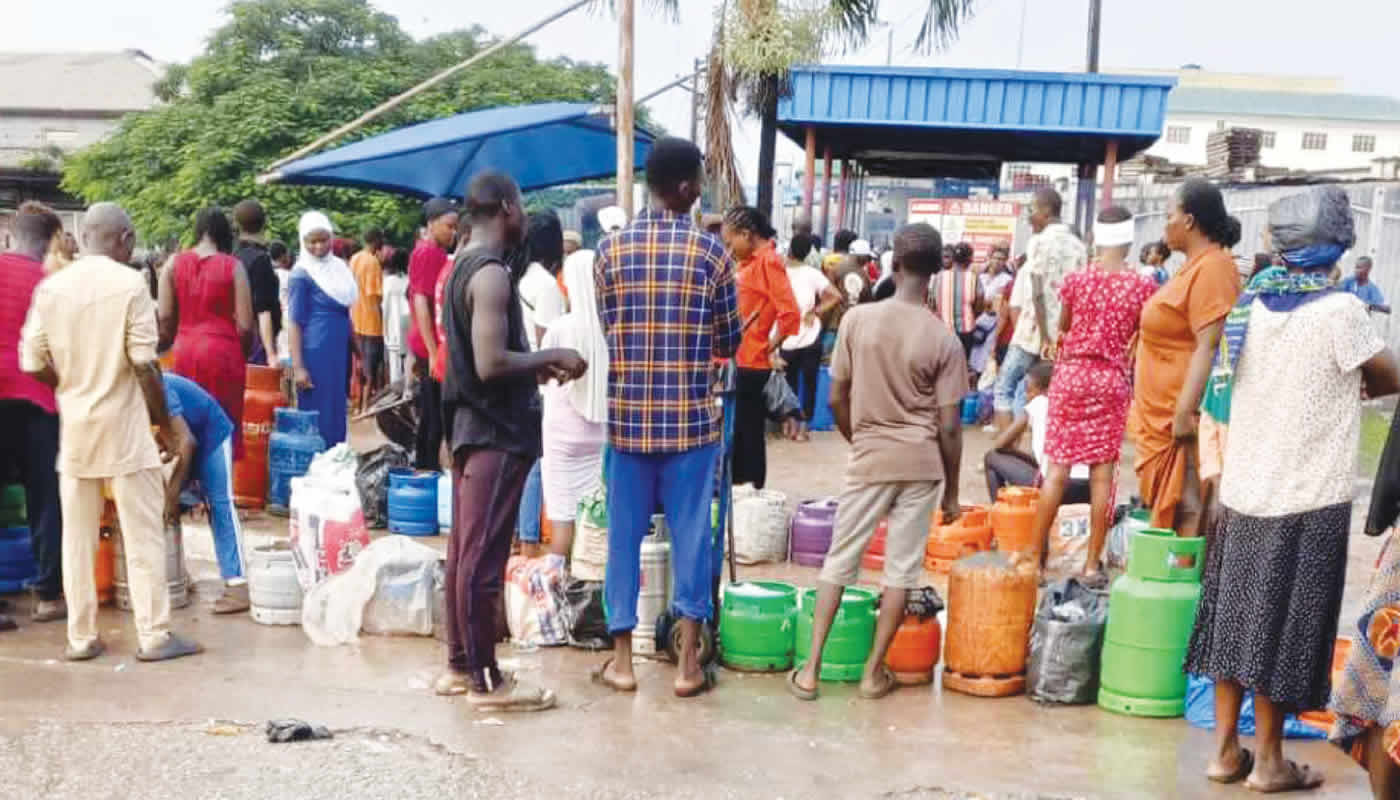
Residents of the Federal Capital Territory (FCT) have expressed frustration over the sharp rise in the price of Liquefied Petroleum Gas (LPG), commonly called cooking gas, urging the Federal Government to take urgent action.

Checks by the News Agency of Nigeria (NAN) revealed that the price of cooking gas jumped from about N1,100 to N1,800 per kilogram following the recent strike by the Petroleum and Natural Gas Senior Staff Association of Nigeria (PENGASSAN).

Mrs. Tina Okojie, a businesswoman, said she refilled her 12.5kg cylinder for N18,125, up from N15,000. “We are already struggling to pay other bills. I hope the government can address whatever the issues are because many Nigerians rely on cooking gas,” she said.

Mr. Nura Idris, a security guard, said he could no longer afford to fill his 5kg cylinder. “I now buy just 3kg at N4,800. We are going through a lot of hardship; let the government find a solution to this high cost,” he pleaded.

A tailor, Mrs. Bose Ajibade, noted that she could not afford to refill her 12.5kg cylinder, which now costs N21,000. “The difference is too much. I only bought what N14,000 could give me. The government should come to our aid,” she said.

Also, Mrs. Beatrice John, a civil servant, said she now resorts to charcoal as an alternative. “It’s not convenient, but what can one do? The government must find a lasting solution,” she added.

However, another resident, Mrs. Ese Okoro, said she managed to get gas at a cheaper rate from NIPCO at N1,120 per kg. “I filled my 12.5kg cylinder for N14,000 after queueing for hours, but the situation seems to be easing,” she noted, urging the government to ensure product availability.

Reacting to the price hike, the Minister of State for Petroleum Resources (Gas), Dr. Ekperikpe Ekpo, said the surge was due to the PENGASSAN strike at Dangote Refinery and maintenance at the Nigeria LNG Train Four facility, which reduced domestic supply.

He assured that operations have resumed at the Dangote Refinery and Nigeria LNG, adding that “the situation is temporary and will normalise soon.”

The Federal Government has also directed the Nigerian Midstream and Downstream Petroleum Regulatory Authority (NMDPRA) to intensify monitoring of LPG depots to prevent hoarding.

Continue Reading
Click to comment

Leave a Reply

Your email address will not be published. Required fields are marked *

Economy

Tinubu Woos World’s Largest Busmaker to Nigeria, Targets 40% Cut in Transport Fares

Published

on

President Bola Tinubu has welcomed plans by Chinese automotive manufacturer Yutong to establish a Compressed Natural Gas (CNG) bus assembly plant in Nigeria as part of efforts to reduce transportation costs and expand affordable mass transit across the country.

The proposed investment follows an invitation by the President to the company, described as the world’s largest bus manufacturer, to support the expansion of affordable transportation in Nigeria.

Under an agreement with the Presidential Initiative on Compressed Natural Gas and Electric Vehicles (Pi-CNG & EV), Yutong is expected to supply an initial 300 CNG-powered buses, with the first 100 scheduled to arrive in Lagos by the end of December 2026.

The remaining buses will be assembled locally through YP Automobiles Bus Assembly at the former Leyland Automotive plant in Ibadan, Oyo State.

According to a statement issued on Thursday by the President’s Special Adviser on Information and Strategy, Bayo Onanuga, the investment is expected to revive local industrial capacity, reduce dependence on imported vehicles and create employment opportunities for Nigerian engineers, technicians and other workers.

The initiative is part of the National Affordable CNG Transit Programme (NACTP), which is targeting a reduction of approximately 40 per cent in transport fares on participating routes in collaboration with state governments.

The programme aligns with the transportation component of the Tinubu administration’s Renewed Hope Agenda 2.0 for 2027–2031.

Onanuga said the President maintained that the primary objective of the investment was to reduce the daily transportation expenses of Nigerians, particularly workers, traders and families who depend on commercial vehicles.

Tinubu stressed that the lower operating costs of CNG-powered vehicles should translate into reduced fares for passengers, enabling households to save more of their income for essential needs.

The statement added that the expansion of CNG transportation would be supported by investments in refuelling infrastructure through Pi-CNG & EV, the Midstream and Downstream Gas Infrastructure Fund (MDGIF) and private sector operators.

These efforts include the deployment of Mobile Refuelling Units and a presidential directive for the provision of 2,000 additional CNG refuelling infrastructure units nationwide.

Yutong, which reportedly sold 49,518 buses globally in 2025, has experience in mass transit manufacturing and local assembly operations across several international markets.

The President also welcomed the company’s decision to establish local assembly capacity, describing it as an opportunity to promote technology transfer, develop skilled manpower and strengthen Nigeria’s automotive industry.

He reiterated that the success of the CNG programme would ultimately be measured by the savings it delivers to Nigerians through reduced transportation costs.

The agreement between Yutong and the Pi-CNG & EV initiative is scheduled to be signed in Lagos on Thursday, November 19, 2026.

Continue Reading

Energy

Interior Ministry, Pi-CNG Plan Working Group to Drive CNG Adoption

Published

on

By Omoniyi David

The Federal Ministry of Interior and the Presidential Initiative on Compressed Natural Gas (Pi-CNG) have proposed a high-level working group to accelerate adoption of Compressed Natural Gas across agencies under the ministry.

The decision followed a meeting in Abuja between Interior Minister, Olubunmi Tunji-Ojo, and Pi-CNG Executive Chairman, Barr. Ismaeel Ahmed.

Tunji-Ojo said the initiative aligns with the ministry’s mandate, which covers 264 correctional centres, the Nigeria Immigration Service, Civil Defence formations and over 4,000 kilometres of national borders.

He noted that CNG adoption would promote cleaner energy, improve operational efficiency and reduce costs.

He directed the immediate constitution of a working group, led by the ministry’s Director of Joint Services, with representatives from relevant agencies to focus on fleet conversion, credit facilities and capacity building.

Ahmed commended the minister’s commitment and expressed optimism about advancing sustainable energy use across the ministry’s operations.

Continue Reading

Abuja Reports

Aso Rock Solar Project Signals No Confidence in National Grid -Fr Umoh

Published

on

By Samson Adeyanju 

The National Communications Director, Catholic Secretariat of Nigeria and public affairs commentator, Rev. Fr Michael Nsikak Umoh, has described the Federal Government’s plan to power the Aso Rock Presidential Villa with a N17 billion solar mini-grid as a “vote of no confidence” in Nigeria’s national electricity grid.

In a write-up titled “A Vote of No Confidence: The Villa’s Exit as Nigeria’s Power Sector’s Ultimate Indictment,” Fr Umoh argued that the decision of the seat of power to disconnect from the national grid by March 2026 carries deeper political meaning beyond the official explanation of cost savings and energy transition.

He likened the development to a landlord abandoning a crumbling estate to retreat into a privately fortified penthouse, while tenants remain under a leaking roof, insisting that the move symbolises a government retreat from reform in a sector it regulates and supervises.

Fr Umoh recalled President Bola Ahmed Tinubu’s campaign promise of December 22, 2022, in which he pledged to deliver constant electricity within four years and urged Nigerians not to vote for him again if he failed to do so.

According to him, the plan to “exit” the national grid three years into a four-year mandate weakens public confidence in the administration’s ability to deliver the promised expansion of electricity generation capacity to 15,000 megawatts.

He noted that Nigeria’s grid supply still fluctuates between 3,000 and 5,000 megawatts, describing it as a familiar range that has long represented the country’s energy stagnation.

Fr Umoh said the financial implications of the project also raise questions, especially as citizens continue to face increased tariffs under the Band A regime approved by the Nigerian Electricity Regulatory Commission.

He argued that it would be difficult to persuade Nigerians to accept market-reflective pricing in the name of reform, while the Presidency prepares to withdraw from the same system it expects citizens to fund and endure.

The commentator further linked the development to the electricity sector’s liquidity crisis, recalling that in February 2024, Abuja Electricity Distribution Company issued a disconnection notice over unpaid obligations attributed to the Presidential Villa.

He said the shift to independent solar power appears less like environmental leadership and more like “structural secession,” warning that it risks reinforcing the long-standing “generator mentality” where elites self-provide electricity while the wider public remains trapped in unreliable supply.

While acknowledging that decentralised renewable energy systems are vital to Nigeria’s future, Umoh maintained that such models gain legitimacy when scaled inclusively, not when reserved for the political elite.

He cited the embedded generation model in Aba, driven by Geometric Power, as an example of how localised initiatives can improve electricity stability when backed by targeted reforms and proper management.

Fr Umoh also referenced estimates that Nigeria loses about $28 billion annually due to unreliable power supply, arguing that the scale of the problem requires systemic reform rather than insulation by government leaders.

“As 2027 approaches, memory will matter,” he warned, adding that disconnecting Aso Rock from the national grid before the administration’s electricity promise matures could become a lasting symbol of failure.

He said the solarisation of the Presidential Villa could still be reframed as a pilot for nationwide decentralisation if accompanied by transparent and accelerated reforms that improve supply for ordinary Nigerians, manufacturers and businesses.

However, he stressed that without such reforms, the project may be remembered as a moment the state appeared to “vote against its own promise.”

Continue Reading

Trending

extrabetseo ajansıseo ajansıcasino siteleritrlisans pinterestgiftcardmall/mygiftgrandpashabet girişgrandpashabet güncel girişgrandpashabetgrandpashabet girişgrandpashabettaraftarium24dizipalgiftcardmall/mygiftjustin tvGrandpashabetGrandpashabetGrandpashabetcasino siteleriRadissonbetsweet bonanzacasino siteleriultrabettaraftarium24taraftarium24rojadirectajustin tvcasinolevantjojobetjojobetjojobetcasibomholiganbet xcasinolevantcasinolevantjojobetjojobetholiganbetholiganbetholiganbetholiganbetjojobetgrandpashabetmatadorbetonwinsahabetgrandpashabetmarsbahis xmarsbahiscasinolevantcasinolevantcasinolevantgrandpashabetjojobetjojobetgrandpashabetsekabetmatbetimajbetcasibompusulabetvdcasinosuperbetincratosroyalbetcasibomholiganbetholiganbet girişholiganbetmarsbahiscasinolevantjojobetcasinolevantgrandpashabetgrandpashabetnesinecasino xwbahis xbetgaranti xgrandpashabet girişGrandpashabetjojobet