Connect with us

News

Address Soaring Fuel Prices or Face Mass Revolt – NASU Warns FG

Published

on

The Non-Academic Staff Union of Educational and Associated Institutions (NASU) has sounded a stark warning to the Federal Government, urging immediate action to curb the rising petrol prices and the continued devaluation of the naira to avert a potential mass revolt. This call came from NASU’s President, Dr. Makolo Hassan, during the union’s National Executive Council (NEC) meeting in Abuja over the weekend.

Dr. Hassan expressed deep concern over the worsening economic situation in Nigeria, pointing out that the escalating cost of fuel has a far-reaching impact on the economy. “The surge in petrol prices has caused an upward spiral in transportation and production costs, creating a ripple effect that is further exacerbating inflation,” he noted. This inflationary pressure has made life increasingly difficult for ordinary Nigerians, whose purchasing power is eroded by rising costs.

He also criticized Nigeria’s over-dependence on crude oil, which has made the economy highly vulnerable to global market fluctuations. “Nigeria’s abundant crude oil, which should have been a blessing, has instead made the nation’s economy highly vulnerable to global oil price fluctuations. Rather than fostering sustainable growth, this over-reliance has left the country exposed to external shocks, often resulting in economic instability,” Dr. Hassan lamented.

Despite years of rhetoric about diversifying the economy, NASU’s president observed that little progress has been made in shifting away from oil dependency. “The much-talked-about diversification remains a mirage,” he said, emphasizing the lack of sufficient investments and policies to genuinely boost sectors like agriculture, manufacturing, and technology. “Without real action, Nigeria’s economy remains stuck in a boom-and-bust cycle dictated by volatile global oil markets.”

Dr. Hassan also highlighted the ongoing challenge posed by Nigeria’s non-functional government-owned refineries, which have left the country heavily reliant on imported fuel. “Despite being a major oil producer, Nigeria lacks sufficient domestic refining capacity. This forces the government and private marketers to import refined petroleum products at international prices, which are subject to global market fluctuations,” he explained. This situation has placed a heavy burden on both the economy and consumers, and it has further politicized the contentious issue of petrol subsidies.

NASU also addressed the Dangote Refinery, which had been expected to alleviate some of these issues. Dr. Hassan noted that while the refinery holds promise for reducing Nigeria’s reliance on fuel imports in the long run, it still faces challenges within Nigeria’s regulatory and petroleum landscape. “The complexities of navigating Nigeria’s regulatory and petroleum cabal landscape have slowed down the expected relief the Dangote Refinery was meant to provide,” he said. “The absence of functional government refineries continues to exacerbate the current high cost of petroleum products, and price increases have become a daily affair.”

The Nigerian National Petroleum Corporation Limited (NNPCL) came under heavy criticism during the NASU meeting. Dr. Hassan called out the NNPCL for failing to revive and maintain government-owned refineries, despite years of promises and significant investments. “The NNPCL has brought significant embarrassment to the nation by allowing these refineries to remain largely non-operational,” he said. “Instead of focusing on restoring these vital assets to reduce Nigeria’s reliance on imported petroleum products, the NNPCL has diverted its efforts towards positioning itself as a monopolistic player in the distribution of petrol from the Dangote Refinery.”

He condemned this shift in focus, accusing the NNPCL of prioritizing market control over its core mandate of ensuring domestic refining capacity. “The irony of a state-owned enterprise neglecting its own refineries while competing for control over private-sector output underscores its inefficiencies and has deepened public frustration over Nigeria’s ongoing energy crisis,” Dr. Hassan added. NASU called on the government to take decisive action to address the inefficiencies of the NNPCL and restore public confidence in the state-owned enterprise.

The economic strain caused by rising inflation, coupled with the continuous devaluation of the naira and increasing fuel prices, has led to a severe cost-of-living crisis in the country. Dr. Hassan stressed that the situation is plunging many Nigerians into deeper poverty, as the prices of basic goods and services continue to soar. “As fuel prices rise, transportation and production costs follow, which has created a ripple effect that worsens inflation. This has increased financial hardship for households across the nation, with many struggling to afford daily necessities,” he said.

The NASU president warned that if the current trajectory continues unchecked, the country may face widespread social unrest. “The escalating cost of living, compounded by high unemployment and underemployment, is putting enormous pressure on the Nigerian populace. If the government does not take immediate steps to address the fuel price hikes and stabilize the naira, a mass revolt could be imminent.”

In its call for action, NASU urged the Federal Government to prioritize addressing the inefficiencies within NNPCL and revamping domestic refining capacity. The union also advocated for a more aggressive approach to economic diversification, emphasizing that the over-reliance on crude oil must be ended if Nigeria is to achieve sustainable economic growth. “Diversifying into sectors like agriculture, manufacturing, and technology is the only way to shield the economy from global oil price volatility and create a more stable future for Nigeria,” Dr. Hassan concluded.

Foreign News

Journalist Kemi Olunloyo’s Son Wanted in US Over Abduction, Shooting Allegations

Published

on

By Erica May

Police in Philadelphia, United States, are searching for Olunkayode J. Taiwo, identified in Nigerian media reports as the son of journalist Kemi Olunloyo, over allegations that he abducted a woman at gunpoint and later fired shots in her direction.

The Philadelphia Police Department said Taiwo is wanted in connection with two incidents involving the same woman, which allegedly occurred on November 2 and November 15, 2026.

According to police, the first incident happened at about 10 p.m. on November 2 along the 1500 block of West Seybert Street in North Philadelphia, where Taiwo allegedly abducted the woman while armed with a gun.

Investigators said that on November 15, he allegedly fired two shots in the direction of the same woman and her residence on the 7600 block of Rugby Street in Philadelphia.

Police have not disclosed the victim’s condition or provided details about the circumstances surrounding the alleged incidents.

Authorities believe Taiwo may be driving a silver or grey 2026 Honda Accord bearing Pennsylvania registration number H900330.

The Philadelphia Police Department’s Special Victims Unit is investigating the case and has appealed to members of the public with information about his whereabouts to contact the authorities.

Anyone with relevant information can reach the Special Victims Unit on 215-685-3251 or submit an anonymous tip by calling or texting 215-686-TIPS (8477).

Reports by US media outlets indicate that an arrest warrant has been issued, but Taiwo remains at large.

Although Nigerian media reports have identified him as Kemi Olunloyo’s son, the police reports reviewed do not independently establish the relationship.

Taiwo has not been reported arrested or convicted in connection with the allegations. The accusations remain unproven, and he is entitled to the presumption of innocence.

Continue Reading

Abuja Reports

UniAbuja Protest Enters Third Day as Land Dispute Deepens

Published

on

By Erica May

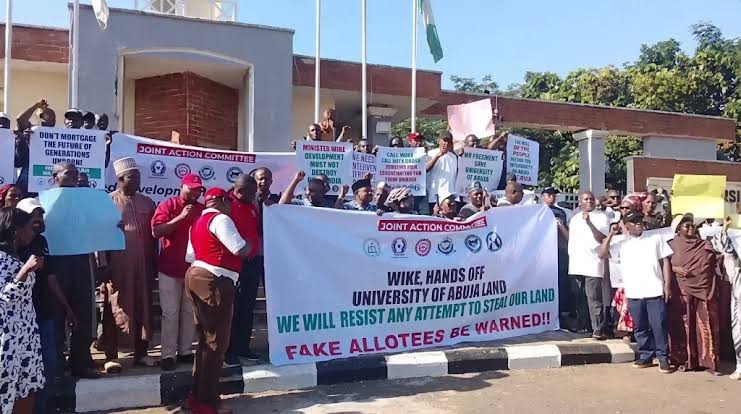
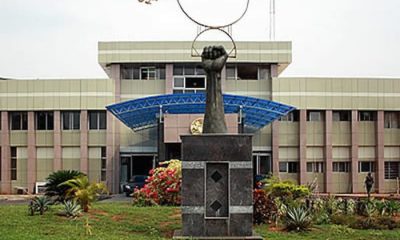
Students, lecturers, non-academic staff and alumni of the University of Abuja have sustained their protest over the disputed reduction and alleged reallocation of portions of the institution’s land, with the demonstration entering its third day on Wednesday, November 18.

The protest, which began on Monday at the university’s main campus in Gwagwalada, has disrupted academic activities, as demonstrators continue to block the institution’s main entrance and call on President Bola Tinubu to intervene in the dispute involving the Federal Capital Territory Administration (FCTA).

The action is being coordinated by the university community, including the Academic Staff Union of Universities (ASUU), Senior Staff Association of Nigerian Universities (SSANU), Non-Academic Staff Union (NASU), National Association of Academic Technologists (NAAT) and the Students’ Union Government (SUG).

The protesters are demanding that the FCTA halt further dealings involving the disputed land and reverse allocations they allege were made to private individuals and companies. They argue that the land is essential to the university’s long-term development, including the provision of hostels, research facilities, classrooms and other infrastructure.

The SUG President, Eyamu Oghenenyerovwo Peculiar, has highlighted the institution’s growing student population, said to be above 55,000, arguing that the university needs more land and facilities to accommodate its expanding academic community.

The protesters have also asked Tinubu, who is the university’s visitor, to prevail on FCT Minister Nyesom Wike to halt further action on the disputed property.

At the centre of the disagreement is the university’s land allocation, which the FCTA says is being reduced from approximately 11,824 hectares to 4,685 hectares.

The administration has defended the decision, maintaining that Wike implemented recommendations from a joint committee established by the FCTA and the university in 2016 and approved by his predecessor, former FCT Minister Mohammed Musa Bello.

The FCTA has described the protest as misplaced, arguing that the university does not require the entire land area originally associated with the institution. It has also maintained that the current administration acted on an earlier approval rather than independently initiating the reduction.

However, the university’s labour unions have rejected the administration’s account, saying the institution was neither adequately involved in the committee’s deliberations nor consulted on the contents of the report being relied upon.

The unions have consequently demanded that the FCTA make available the committee’s meeting minutes, members’ signatures and official documents authorising the disputed land decision.

On Wednesday, ASUU’s UniAbuja chapter chairman, Professor Sylvanus Ugoh, warned that the unions could escalate their action if the administration failed to halt the disputed allocations and address their concerns.

With the university entrance still blocked and academic activities affected, the dispute has developed into a major standoff between the institution’s community and the FCTA, with both sides maintaining opposing positions on the land reduction.

The protesters say they will sustain their action until the matter is addressed, while the administration continues to defend the decision as the implementation of an earlier recommendation.

Continue Reading

2027 General Elections

Jonathan Warns of Post-2027 Crisis Amid Rising Campaign Violence

Published

on

By Edisemi Andrew

Former President Goodluck Jonathan has warned that Nigeria could face a serious post-election crisis after the 2027 general elections if rising political intolerance, thuggery, ethnic rivalry and declining public confidence in democratic institutions are not urgently addressed.

Jonathan gave the warning on Tuesday at the 2026 Goodluck Jonathan Foundation Peace Conference in Abuja, where he expressed concern that political parties and campaign organisations were increasingly being run like rival cult groups, with opponents treated as enemies rather than competitors.

He said he had received calls from Nigerians at home and friends of the country abroad expressing concern about the direction of the nation and the possibility of unrest after the elections.

The former President also raised concerns about the judiciary, citing conflicting court decisions on similar matters and growing perceptions that litigants could seek favourable judgments from different courts.

He warned that declining public confidence in the courts could encourage citizens to resort to self-help, with potentially dangerous consequences. He also cautioned politicians against exploiting ethnic divisions for electoral advantage.

Drawing an analogy with football, Jonathan described the Independent National Electoral Commission (INEC) as the referee, the judiciary as the Video Assistant Referee (VAR), and the electorate as the fans, stressing that every stakeholder had a responsibility to protect the integrity of the democratic process.

He urged religious leaders, traditional rulers and other influential figures to promote tolerance and discourage political violence.

Jonathan’s warning comes amid a series of reported attacks, protests and confrontations involving political parties and their supporters ahead of the 2027 elections.

INEC Chairman, Prof. Joash Amupitan, acknowledged that the 2023 general elections left a significant trust deficit, while condemning attacks on campaign convoys and party supporters.

He warned that individuals who sponsor or participate in political violence would face the law, adding that the Commission would work with security agencies to prevent further incidents.

In his keynote address, former President of the ECOWAS Commission, Dr Omar Alieu Touray, identified public trust, consensus on democratic principles, responsible political competition, early-warning systems, inclusive development and responses to misinformation as essential elements of peaceful elections.

Touray also cited Jonathan’s decision to concede defeat in the 2015 presidential election as an example of leadership that placed national stability above personal ambition.

The conference, now in its third edition, followed earlier editions in 2019 and 2022.


APC, ADC Trade Accusations

Meanwhile, the ruling All Progressives Congress (APC) and opposition African Democratic Congress (ADC) have exchanged accusations over alleged attempts to sponsor violence and disrupt political activities.

In a statement issued on Tuesday, APC Presidential Campaign Council spokesperson Dele Alake accused the ADC and the Nigeria Democratic Congress (NDC) of recruiting young people to disrupt its campaign activities, spread misinformation and create tension ahead of the 2027 elections.

Alake alleged that opposition elements were deploying deepfakes, artificial intelligence-generated images, fake news and sponsored protests to manipulate public opinion against President Bola Tinubu and the APC.

He cited the November 13 incident near the Shehu Shagari Central Mosque in Abuja, where protesters reportedly confronted the President’s motorcade after Friday prayers, alleging that individuals mobilised by the opposition threw stones at the convoy.

The APC spokesperson also alleged that some of the party’s members in the South-East had been threatened and labelled saboteurs for refusing to support Peter Obi, the NDC presidential candidate.

However, the campaign council did not publicly provide evidence establishing the ADC’s or NDC’s involvement in the alleged sponsorship of the Abuja incident.

The ADC Presidential Campaign Council rejected the allegations in a statement by its Director of Strategic Communication, Phrank Shaibu, challenging the APC to produce evidence or withdraw its claims.

The opposition council argued that public dissatisfaction with the Tinubu administration should not be dismissed as an opposition-sponsored campaign, pointing to the rising cost of food, fuel and other essential commodities.

It also questioned what it described as conflicting accounts from the Presidency and the APC over the Abuja incident, asking why those reportedly arrested were released if authorities had evidence linking them to opposition-sponsored violence.

The ADC denied sponsoring attacks or recruiting young people to confront political opponents, while calling for impartial investigations into all reported incidents.


ADC Challenges Kaduna Government Over Rally Venue

Separately, the ADC condemned the Kaduna State Government’s refusal to grant it access to Ranchers Bees Stadium for its scheduled campaign activities on November 17 and 18.

The party said its application to use the facility was rejected in a letter dated November 12 by the state Ministry of Local Government, which reportedly cited ongoing renovation work.

ADC National Publicity Secretary, Bolaji Abdullahi, questioned the explanation, noting that the APC had used the same stadium for its presidential campaign flag-off on October 24.

The party described the decision as an attempt to restrict its political activities and threatened to take its rally to the streets if access to the facility remained denied.

The Kaduna State Government’s explanation for refusing the request has not been independently established beyond the reason cited in the letter.

Senate Condemns Political Violence, Orders Investigation

In a related development, the Senate on Tuesday expressed concern over growing political violence and attacks on political leaders, candidates and supporters ahead of the 2027 elections.

The debate followed a motion sponsored by Senator Abdul Ningi, representing Bauchi Central, who cited the disruption of an NDC procession in Sapele, Delta State, on November 7, which reportedly left one person dead and five others injured.

He also referenced the reported attack on the convoy of former Vice-President and ADC presidential candidate Atiku Abubakar in Sokoto, alongside other incidents in Benue and Edo states.

During the debate, Senator Babangida Husaini accused the National Assembly of complicity in the persistence of electoral violence, arguing that successive governments had failed to implement important recommendations of the 2008 Justice Muhammadu Uwais Electoral Reform Committee.

He recalled that the committee had recommended the establishment of a two-tier framework involving a commission and a tribunal to address electoral offences and violence.

Husaini also referenced a proposal to remove the President’s power to appoint the INEC chairman and commissioners, transferring the responsibility to the National Judicial Council.

He argued that the failure to implement such reforms had weakened the country’s ability to prevent and prosecute electoral offences.

Other lawmakers called for stronger action against political violence, including the prosecution of sponsors and the establishment of specialised courts to handle electoral offences.

Senator Ali Ndume condemned the reported confrontation involving Tinubu’s convoy in Abuja, while Minority Leader Abba Moro urged politicians to reconsider a political culture increasingly characterised by verbal and physical attacks.

Senate President Godswill Akpabio, however, pointed to provisions of the Electoral Act 2026 prescribing sanctions for electoral offences, including intimidation and attacks involving dangerous weapons.

He called on INEC to enforce the law, noting that candidates could face disqualification where the applicable legal conditions, including established court convictions, are met.

The Senate subsequently called on security agencies to investigate reported incidents in Abuja, Edo, Delta and Sokoto states, identify the perpetrators and sponsors, and prosecute those found culpable.

It also mandated its committees on National Security and Intelligence, Police Affairs, and INEC to engage relevant institutions and report back within four weeks on measures to prevent political violence and safeguard the 2027 elections.

The lawmakers further urged the government to strengthen security around political gatherings and establish early-warning and rapid-response mechanisms to prevent further attacks.

As political activities gather momentum, Jonathan’s warning, the exchanges between the ruling party and opposition, and the Senate’s intervention have renewed attention on the need to protect political participation and ensure that the 2027 elections are conducted without intimidation or violence.

Continue Reading

Trending

taraftarium24Maslak EscortMaslak Escortdeneme bonusudizipaldizipaljustin tvjustin tvjustin tvjustin tvtaraftarium24justin tvdeneme bonusu veren sitelerdizipaljustin tvmarsbahisggrandpashabettGrandpashabet Girişgiftcardmall/mygiftmarsbahisjustin tvtrlisans pinterestgiftcardmall/mygiftdinamobetgrandpashabet girişgrandpashabetdinamobetGrandpashabettaraftarium24dizipalgiftcardmall/mygiftjustin tvGrandpashabetGrandpashabetGrandpashabetGrandpashabetCasibompasharoyalgrandpashabettaraftarium24taraftarium24rojadirectajustin tvjojobetjojobetjojobetjojobetcasibomcasibomcasibomcasibomcasinolevantcasinolevantcasinolevantcasinolevantgrandpashabetcratosroyalbetcasibommatadorbetonwinsahabetsuperbetinnatobetbetgitromabetgameofbetgrandpashabet girişgrandpashabetcasinolevantgrandpashabetgrandpashabetgrandpashabetsekabetbetgaranticasinolevantcasibomjojobetmatbetimajbetpusulabetvdcasinosahabetmarsbahisgrandpashabetcasinolevantcasibomcasibomjojobetcasinolevanttambetesbetjojobetgrandpashabet