Connect with us

Politics

President Tinubu to Present 2024 Appropriation Bill in Mid-November

Published

on

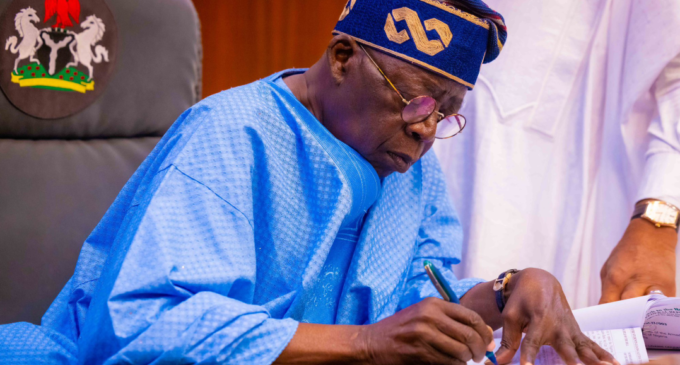
President Bola Tinubu is expected to present the 2024 Appropriation Bill before a joint session of the National Assembly during the third week of November 2023, according to multiple sources.
In an effort to maintain the January-December budget implementation cycle, the President is anticipated to present the document to lawmakers in the week beginning November 20, 2023.
Following the recent visit of German Chancellor Olaf Scholz to Nigeria, President Tinubu’s program includes participation in a Berlin event for Germany’s Compact-with-Africa initiative. President Tinubu will propose the budget after his return to Nigeria, THE PUNCH reports.
Furthermore, Biz Watch Nigeria reports that the 2024 appropriation bill, the most comprehensive to date, aligns with the Tinubu administration’s goals of financing the budget through a combination of savings generated by the removal of the petroleum subsidy in late May, tax revenues, and new borrowings.

Continue Reading
Click to comment

Leave a Reply

Your email address will not be published. Required fields are marked *

2027 General Elections

ADC Asks INEC to Postpone November 28 Mock Election Exercise

Published

on

By Edisemi Andrew

The African Democratic Congress (ADC) Presidential Campaign Council has asked the Independent National Electoral Commission (INEC) to postpone its nationwide mock accreditation and results collation exercise scheduled for November 28, 2026, citing insufficient preparation time for political parties.

The council also raised concerns about the electronic transmission and publication of election results at different collation levels, warning that limited public access to results could undermine transparency ahead of the 2027 general elections.

The demand was made in a statement issued in Abuja on Wednesday, November 18, by the council’s Director of Media and Publicity, Kola Ologbondiyan.

The ADC-PCC alleged that INEC gave political parties inadequate notice to nominate, mobilise and train their agents for the nationwide exercise.

According to the council, the commission’s invitation letter, dated November 16, gave parties until November 18 to submit the names of their participating agents, leaving them with barely two days to meet the deadline.

The exercise is expected to cover all 774 local government areas and two polling units in each of the country’s 8,838 Registration Areas, a scale the council said would require sufficient time for effective preparation and participation.

Describing the arrangement as hasty and unfair, the ADC-PCC urged INEC to reschedule the exercise to enable political parties to deploy representatives who could properly observe and assess the process.

The commission had announced the November 28 exercise through its chairman, Professor Joash Amupitan, during a high-level dialogue at Chatham House in London on November 12.

Amupitan said the exercise would test the commission’s upgraded Bimodal Voter Accreditation System (BVAS), accreditation procedures and electronic transmission of election results ahead of the 2027 polls.

He acknowledged that controversies surrounding the 2023 general elections had significantly damaged public confidence in INEC, adding that the commission had introduced additional technical safeguards to address identified weaknesses.

Among the measures announced were the procurement of additional BVAS devices and a reduction in the maximum number of registered voters assigned to each device from 1,250 to 850. Polling units with more than 850 registered voters are expected to receive additional devices.

The commission is also constructing climate-controlled storage facilities across the states to address equipment malfunctions previously associated with extreme heat and storage conditions.

Beyond the proposed postponement, the ADC-PCC criticised what it described as INEC’s position that results from Ward, Local Government and State collation levels would not be electronically transmitted and published on its Result Viewing Portal (IReV) during the 2027 elections.

The council’s concern followed reported comments by INEC’s Director of Information and Communication Technology, Lawrence Bayode, that the commission had neither developed nor tested the necessary system for uploading results from those collation levels.

The ADC-PCC argued that limiting electronic publication to polling-unit results could reduce transparency and create opportunities for manipulation during subsequent stages of collation.

It specifically questioned the reported position regarding Forms EC8B, EC8C and EC8D, which relate to Ward, Local Government and State collation results respectively.

However, the campaign council’s interpretation of the reported comments should be distinguished from a definitive statement of INEC’s final policy or the legal requirements governing electronic transmission and publication of election results.

The disagreement comes as INEC intensifies preparations for the 2027 general elections, with the commission under pressure to demonstrate that its upgraded technology and operational safeguards can address public concerns arising from previous elections.

While political parties have a legitimate interest in observing electoral preparations, INEC is also expected to ensure that its testing exercises are conducted within a workable operational framework.

The ADC-PCC has urged the commission to demonstrate impartiality, competence and independence, insisting that meaningful stakeholder participation is necessary to build confidence in the electoral process.

With the November 28 exercise approaching, attention is now on INEC’s response to the postponement request and the concerns raised over electronic transmission and public access to results.

The credibility of the 2027 elections will depend not only on the technology deployed but also on the transparency of the procedures through which votes are accredited, recorded, collated and declared.

Continue Reading

2027 General Elections

Coalition Gives 2027 Candidates 48 Hours to Condemn Violence

Published

on

By Edisemi Andrew

The Coalition Against Electoral Violence in Nigeria (CAEVN) has given presidential candidates of major political parties 48 hours to publicly caution their supporters against political violence, following reports of attacks, intimidation and confrontations at political gatherings ahead of the 2027 general elections.

The coalition issued the ultimatum at a press conference in Abuja on Tuesday, November 17, warning that the reported incidents could undermine public safety and threaten the credibility of the country’s democratic process.

Speaking on behalf of the group, Dr Opialu Fabian Opialu expressed concern that Nigeria was returning to patterns of election-related violence witnessed during previous electoral cycles.

“Nigeria is sliding back into the familiar pattern of election-season bloodshed, and the warning signs can no longer be ignored,” he said.

CAEVN cited several reported incidents involving attacks on political gatherings, campaign convoys and supporters of rival parties across different parts of the country.

Among the incidents highlighted was an alleged attack on a Nigeria Democratic Congress (NDC) town hall meeting in Oregun, Lagos, where the coalition said cutlasses, cudgels and stones were used during a confrontation, leaving some participants injured and vehicles damaged.

The group also raised concerns over reported confrontations associated with political activities in Asaba, Calabar, Enugu, Ebonyi, Warri and Benue. It further mentioned reported attacks on convoys, disruptions of political meetings and the use of dangerous weapons in Delta, Cross River, Ekiti, Kebbi and Oyo states.

The coalition accused the NDC and its vice-presidential candidate, Rabiu Musa Kwankwaso, of allowing aggressive political mobilisation to contribute to rising tensions, urging the party’s leadership to rein in its supporters.

However, it said the ruling All Progressives Congress (APC) should also be held accountable for allegations involving its supporters.

“We do not exonerate the All Progressives Congress. There have been credible reports of APC-linked thugs attacking opposition processions,” the coalition said, alleging that some opposition activities had been disrupted and campaign materials destroyed.

CAEVN also condemned reported clashes between rival factions of the Peoples Democratic Party (PDP) in Gombe State over candidates and control of party structures, maintaining that political violence should not be excused on the basis of party affiliation.

Beyond its appeal to presidential candidates, the coalition called on the Inspector-General of Police and commissioners of police across the states to investigate reported incidents, identify alleged sponsors and prosecute anyone found culpable, irrespective of political affiliation.

It also urged the Independent National Electoral Commission (INEC) and relevant security agencies to treat verified cases of electoral violence as national security concerns rather than ordinary disagreements between political supporters.

Traditional rulers, religious leaders and community elders were also urged to discourage the recruitment of young people as political enforcers.

“Traditional rulers, religious leaders and community elders must stop looking the other way. Your sons are the ones being used as foot soldiers. Speak up now,” the coalition appealed.

The 48-hour ultimatum specifically addressed presidential candidates of the APC, African Democratic Congress (ADC), NDC, PDP and African Action Congress (AAC), asking them to publicly instruct their supporters to abandon thuggery, intimidation and other forms of political violence.

The demand comes amid growing public attention to reported confrontations involving political supporters as preparations for the 2027 general elections gather momentum.

The coalition maintained that political parties and their candidates must demonstrate their commitment to peaceful elections by taking responsibility for the conduct of their supporters.

Continue Reading

2027 General Elections

Jonathan Warns of Post-2027 Crisis Amid Rising Campaign Violence

Published

on

By Edisemi Andrew

Former President Goodluck Jonathan has warned that Nigeria could face a serious post-election crisis after the 2027 general elections if rising political intolerance, thuggery, ethnic rivalry and declining public confidence in democratic institutions are not urgently addressed.

Jonathan gave the warning on Tuesday at the 2026 Goodluck Jonathan Foundation Peace Conference in Abuja, where he expressed concern that political parties and campaign organisations were increasingly being run like rival cult groups, with opponents treated as enemies rather than competitors.

He said he had received calls from Nigerians at home and friends of the country abroad expressing concern about the direction of the nation and the possibility of unrest after the elections.

The former President also raised concerns about the judiciary, citing conflicting court decisions on similar matters and growing perceptions that litigants could seek favourable judgments from different courts.

He warned that declining public confidence in the courts could encourage citizens to resort to self-help, with potentially dangerous consequences. He also cautioned politicians against exploiting ethnic divisions for electoral advantage.

Drawing an analogy with football, Jonathan described the Independent National Electoral Commission (INEC) as the referee, the judiciary as the Video Assistant Referee (VAR), and the electorate as the fans, stressing that every stakeholder had a responsibility to protect the integrity of the democratic process.

He urged religious leaders, traditional rulers and other influential figures to promote tolerance and discourage political violence.

Jonathan’s warning comes amid a series of reported attacks, protests and confrontations involving political parties and their supporters ahead of the 2027 elections.

INEC Chairman, Prof. Joash Amupitan, acknowledged that the 2023 general elections left a significant trust deficit, while condemning attacks on campaign convoys and party supporters.

He warned that individuals who sponsor or participate in political violence would face the law, adding that the Commission would work with security agencies to prevent further incidents.

In his keynote address, former President of the ECOWAS Commission, Dr Omar Alieu Touray, identified public trust, consensus on democratic principles, responsible political competition, early-warning systems, inclusive development and responses to misinformation as essential elements of peaceful elections.

Touray also cited Jonathan’s decision to concede defeat in the 2015 presidential election as an example of leadership that placed national stability above personal ambition.

The conference, now in its third edition, followed earlier editions in 2019 and 2022.


APC, ADC Trade Accusations

Meanwhile, the ruling All Progressives Congress (APC) and opposition African Democratic Congress (ADC) have exchanged accusations over alleged attempts to sponsor violence and disrupt political activities.

In a statement issued on Tuesday, APC Presidential Campaign Council spokesperson Dele Alake accused the ADC and the Nigeria Democratic Congress (NDC) of recruiting young people to disrupt its campaign activities, spread misinformation and create tension ahead of the 2027 elections.

Alake alleged that opposition elements were deploying deepfakes, artificial intelligence-generated images, fake news and sponsored protests to manipulate public opinion against President Bola Tinubu and the APC.

He cited the November 13 incident near the Shehu Shagari Central Mosque in Abuja, where protesters reportedly confronted the President’s motorcade after Friday prayers, alleging that individuals mobilised by the opposition threw stones at the convoy.

The APC spokesperson also alleged that some of the party’s members in the South-East had been threatened and labelled saboteurs for refusing to support Peter Obi, the NDC presidential candidate.

However, the campaign council did not publicly provide evidence establishing the ADC’s or NDC’s involvement in the alleged sponsorship of the Abuja incident.

The ADC Presidential Campaign Council rejected the allegations in a statement by its Director of Strategic Communication, Phrank Shaibu, challenging the APC to produce evidence or withdraw its claims.

The opposition council argued that public dissatisfaction with the Tinubu administration should not be dismissed as an opposition-sponsored campaign, pointing to the rising cost of food, fuel and other essential commodities.

It also questioned what it described as conflicting accounts from the Presidency and the APC over the Abuja incident, asking why those reportedly arrested were released if authorities had evidence linking them to opposition-sponsored violence.

The ADC denied sponsoring attacks or recruiting young people to confront political opponents, while calling for impartial investigations into all reported incidents.


ADC Challenges Kaduna Government Over Rally Venue

Separately, the ADC condemned the Kaduna State Government’s refusal to grant it access to Ranchers Bees Stadium for its scheduled campaign activities on November 17 and 18.

The party said its application to use the facility was rejected in a letter dated November 12 by the state Ministry of Local Government, which reportedly cited ongoing renovation work.

ADC National Publicity Secretary, Bolaji Abdullahi, questioned the explanation, noting that the APC had used the same stadium for its presidential campaign flag-off on October 24.

The party described the decision as an attempt to restrict its political activities and threatened to take its rally to the streets if access to the facility remained denied.

The Kaduna State Government’s explanation for refusing the request has not been independently established beyond the reason cited in the letter.

Senate Condemns Political Violence, Orders Investigation

In a related development, the Senate on Tuesday expressed concern over growing political violence and attacks on political leaders, candidates and supporters ahead of the 2027 elections.

The debate followed a motion sponsored by Senator Abdul Ningi, representing Bauchi Central, who cited the disruption of an NDC procession in Sapele, Delta State, on November 7, which reportedly left one person dead and five others injured.

He also referenced the reported attack on the convoy of former Vice-President and ADC presidential candidate Atiku Abubakar in Sokoto, alongside other incidents in Benue and Edo states.

During the debate, Senator Babangida Husaini accused the National Assembly of complicity in the persistence of electoral violence, arguing that successive governments had failed to implement important recommendations of the 2008 Justice Muhammadu Uwais Electoral Reform Committee.

He recalled that the committee had recommended the establishment of a two-tier framework involving a commission and a tribunal to address electoral offences and violence.

Husaini also referenced a proposal to remove the President’s power to appoint the INEC chairman and commissioners, transferring the responsibility to the National Judicial Council.

He argued that the failure to implement such reforms had weakened the country’s ability to prevent and prosecute electoral offences.

Other lawmakers called for stronger action against political violence, including the prosecution of sponsors and the establishment of specialised courts to handle electoral offences.

Senator Ali Ndume condemned the reported confrontation involving Tinubu’s convoy in Abuja, while Minority Leader Abba Moro urged politicians to reconsider a political culture increasingly characterised by verbal and physical attacks.

Senate President Godswill Akpabio, however, pointed to provisions of the Electoral Act 2026 prescribing sanctions for electoral offences, including intimidation and attacks involving dangerous weapons.

He called on INEC to enforce the law, noting that candidates could face disqualification where the applicable legal conditions, including established court convictions, are met.

The Senate subsequently called on security agencies to investigate reported incidents in Abuja, Edo, Delta and Sokoto states, identify the perpetrators and sponsors, and prosecute those found culpable.

It also mandated its committees on National Security and Intelligence, Police Affairs, and INEC to engage relevant institutions and report back within four weeks on measures to prevent political violence and safeguard the 2027 elections.

The lawmakers further urged the government to strengthen security around political gatherings and establish early-warning and rapid-response mechanisms to prevent further attacks.

As political activities gather momentum, Jonathan’s warning, the exchanges between the ruling party and opposition, and the Senate’s intervention have renewed attention on the need to protect political participation and ensure that the 2027 elections are conducted without intimidation or violence.

Continue Reading

Trending

taraftarium24Maslak EscortMaslak EscortmarsbahisggrandpashabettGrandpashabet Girişgiftcardmall/mygiftcasibomjustin tvtrlisans pinterestgiftcardmall/mygiftdinamobetgrandpashabet girişgrandpashabetdinamobetGrandpashabettaraftarium24dizipalgiftcardmall/mygiftjustin tvGrandpashabetGrandpashabetGrandpashabetGrandpashabetCasibomultrabettaraftarium24taraftarium24rojadirectajustin tvesbetbetpuanamgbahismercurecasinobetplaycasinoroyalcasinolevantcasinolevantpalacebetteosbetgameofbetbetgitholiganbetcasibommarsbahisgrandpashabetJojobet GirişJojobetJojobetnatobetbetgitromabetgameofbetgrandpashabet girişgrandpashabetradissonbetpalacebetpalacebetcratosroyalbetgrandpashabetbetgarantitambetmarsbahismatbetimajbetpusulabet girişmarsbahisholiganbet girişholiganbetholiganbetcasinolevantmarsbahis girişcasibomcasinolevantgrandpashabetbetbeytambetesbetjojobetgrandpashabet