News
Profiles of the 5 Judges Set to Decide Tinubu, Atiku, Obi’s Fates Tomorrow


The eyes of the nation are fixed on the impending verdict of the Presidential Election Petition Tribunal, which is set to be delivered tomorrow. As the fate of key political figures hangs in the balance, it’s essential to take a closer look at the five judges who will make this pivotal decision. These jurists hold the responsibility of assessing the merits of the petitions filed by Asiwaju Bola Tinubu, Atiku Abubakar, and Peter Obi, shaping the course of Nigerian politics.
Below are the list of judges of judges presiding over Presidential Election Petitions Tribunal.
1. Justice Haruna Tsammani

Justice Haruna Tsammani is the longest-serving Justice of the Court of Appeal on the five-man panel, Though this is his first time participating in the panel of a presidential election petition court, an opportunity that only a handful of judges in a generation are availed to be involved in. Justice Tsammani has presided over various election and financial matters as a judge. He also presided over the VAT case between the Rivers State Government and the federal government.
Justice Tsammani prepared the lead judgment that dismissed Abiola Ajimobi’s petition challenging the judgment of the 2019 Election Petition Tribunal which had on November 19, the same year, upheld PDP’s Kola Balogun as the winner of the senatorial election for Oyo South held on February that year for lacking in merit, holding that a person who was not part of a political party has no right to challenge the outcome of its primary election.
2. Justice Stephen Adah

Justice Stephen Adah was appointed a judge of the Federal High Court on November 12, 1998, and later elevated to the Court of Appeal on November 5, 2012. He served as a member of the three-man panel that granted Obi and Atiku’s motions to serve Tinubu their petitions by substituted means.
Adah has delivered verdicts on several cases and one of his landmark decisions was in the appeal filed by the Economic and Financial Crimes Commission (EFCC) in 2020 against a trial court’s decision which partially upheld the no-case submission filed by former President Goodluck Jonathan’s cousin, Robert Azibaola.
3. Jusice Monsurat Bolaji-Yusuf

Justice Monsurat was appointed a Judge of the High Court of Oyo State on January 30, 1997, and later elevated to the Court of Appeal on March 24, 2014. as a judge of the High Court of Oyo, Justice Bolaji-Yusuf issued an order that invalidated the steps taken by the then acting Chief Judge of Oyo, Justice Afolabi Adeniran, which led to the illegal removal of the then governor, Rashidi Ladoja.
Although the Acting Chief Judge withdrew the case from her, her ruling was the first major blow to the entire impeachment process which the Supreme Court would also later nullify. The Supreme Court declared the process null and void and reinstated Ladoja in its judgment delivered on November 11, 2006.
She also delivered the lead judgment of the three-man panel of the Benin Division of the Court of Appeal that affirmed the first-term election of Governor Godwin Obaseki in June 2017. She was on the panel that affirmed that candidates of the Obaseki-faction were the authentic candidates to participate in the 2023 elections.
4. Justice Boloukuoromo Ugo

Justice Boloukuoromo Ugo is the youngest among the judges on the panel of the Presidential Election Petition Court.
He was appointed a Judge of the High Court of Bayelsa State on March 21, 2006, and later elevated to the Court of Appeal on March 24, 2014.
Though judge, who is currently serving at the Kano Division of the Court of Appeal, is hardly visible in the media, many see his participation in the court panel as a pivotal turn in his career, placing him on a national, if not global stage where the public can gain insights into the workings of his judicial mind for the first time.
5. Justice Abba Mohammed
Justice Mohammed was appointed a judge of the Federal Capital Territory (FCT) High Court in 2010. After serving for about 10 years, he was promoted to the Court of Appeal on June 28, 2021. He was the Chairman of the Nasarawa State Governorship Election Tribunal in 2019.
The PDP governorship candidate in the 2019 general election, Hon. David Ombugadu had sued INEC and Governor Abdullahi Sule of the All Progressives Congress (APC). But Justice Mohammed dismissed the petition for lacking in merit, holding that the petitioner’s allegation of over-voting and electoral violence could not be substantiated. His participation in the Presidential Election Petition Court as a defining milestone in his profile.


By Samson Adeyanju
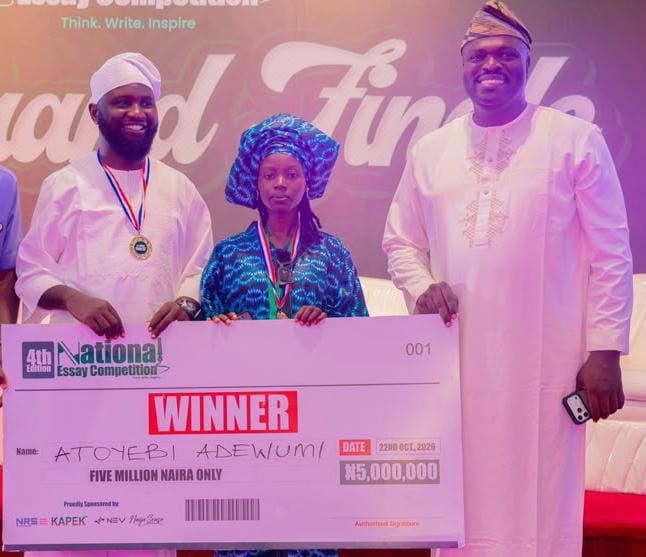
Atoyebi Adewumi has emerged winner of the fourth edition of the National Essay Competition, beating more than 2,000 contestants in an intellectual contest aimed at promoting academic excellence, critical thinking and creative writing among young Nigerians.
The competition, which focused on the relevance of taxation to national development, challenged participants to examine the role of tax revenue in financing public services, stimulating economic growth and strengthening the relationship between government and citizens.
The initiative provided a platform for young Nigerians to demonstrate their writing skills, articulate informed perspectives on national issues and contribute ideas towards building a more responsible and progressive society.
Speaking after being declared winner, an elated Adewumi expressed gratitude to the convener, Foluso Sylvanus Ojo, and the organising team for providing young Nigerians with an opportunity to showcase their intellectual abilities.
“I am so glad, very, very glad, to have this privilege of emerging as the winner. I am grateful to the convener and the entire team, as well as everyone who supported this vision,” Adewumi said.
In his remarks, Ojo expressed concern over the tendency to criticise the attitudes and lifestyles of younger generations without providing adequate opportunities to nurture their talents and channel their energies towards productive pursuits.
He called on the government, corporate organisations and nongovernmental organisations to invest more in educational initiatives that promote intellectual excellence, creativity and responsible citizenship.
According to him, sustained investment in academic competitions and youth development programmes would encourage discipline, innovation and a stronger commitment to national development.
Drawing a comparison with the substantial cash prizes awarded in some reality television competitions in Nigeria, Ojo argued that students and intellectually gifted young Nigerians deserved greater recognition, financial support and encouragement.
“I believe the government should support initiatives like this because individuals need supportive hands, especially from the government. When they receive such support, they become more confident and motivated to continue their good work,” he said.
Ojo maintained that society could not continue to complain about the attitudes and lifestyles of young people without deliberately investing in programmes that encourage positive values and productive engagement.
The fourth edition of the competition also underscored the importance of tax awareness among young Nigerians, highlighting how effective taxation, transparency and accountable governance could contribute to improved infrastructure, education, healthcare and other essential public services.
Beyond celebrating the winner, the competition reinforced the need to identify, encourage and empower emerging intellectual talents capable of contributing meaningfully to Nigeria’s development.

Winner of the 5,000,000 naira 
Winner of 3,000,000 naira 
Winner of 2,000,000
All the participants


By Samson Adeyanju
Twenty finalists from across Nigeria have begun the final stage of the fourth edition of the National Essay Competition in Abuja, following an orientation session designed to prepare them for the decisive examination.
The finalists arrived in the Federal Capital Territory for a four-day, all-expenses-paid programme featuring the essay examination, institutional tours and opportunities for learning and networking.
The competition, the brainchild of Mr Foluso Ojo, is sponsored by the Nigeria Revenue Service (NRS).
Ahead of the examination, the finalists participated in an orientation session led by Professor Omotosho Borisade of Ekiti State University, who serves as the competition’s umpire.
The session familiarised participants with the competition’s rules and regulations, examination guidelines and assessment criteria, helping them understand the requirements of the final stage.
The essay examination is scheduled to begin today at 9 a.m., after which the finalists are expected to embark on institutional tours around Abuja.
The programme is designed to extend beyond the contest itself, exposing the finalists to new learning opportunities, professional connections and experiences in the nation’s capital.
The competition brings together young Nigerians to demonstrate their writing ability, knowledge, creativity and critical-thinking skills as they compete for the top honours.
With the finalists prepared for the examination, attention now turns to their performance and the eventual emergence of the competition’s champion.






Atoyebi Adewumi Wins 4th National Essay Competition, Beats 2,000 Contestants

20 Finalists Begin Final Stage of National Essay Competition

Pastor Ogundipe Decries Lack of Integrity Among Educated Nigerians