Connect with us

Feature

If You Still Doubt PICNG, Ask Taxi Drivers in Nigeria

Published

on

By Ade Iyamoye 

If you still doubt the Presidential Initiative on Compressed Natural Gas (PICNG), ask any taxi driver in Nigeria. Not the political analyst on television, not the serial critic on social media, but the men and women who spend hours under the sun, behind steering wheels, navigating through the bustling cities of Lagos, Abuja, Port Harcourt, Kano, and Enugu. Ask the tricycle riders in the suburbs, the commercial bus drivers who rise before dawn and return home after dusk.

They will tell you in plain language that the shift to Compressed Natural Gas (CNG), is not just welcome; it is a lifeline. It is real, practical, and it is changing lives.

Launched by the administration of President Bola Ahmed Tinubu in response to the fuel subsidy removal in May 2023, the PICNG has become one of the most impactful initiatives of this administration.

At first, there was skepticism. Nigerians, battered by years of unmet expectations, were cautious but within a year, that caution has given way to applause.

Those who have embraced the initiative, especially in the transport sector, are not holding back their excitement. They speak of savings, stability, and sustainability. And it’s not just talk. The numbers are there. The results are visible. The people are experiencing it firsthand.

Since the removal of subsidy, the pump price of Premium Motor Spirit (PMS), commonly known as petrol, has skyrocketed with Nigerians groaning. For commercial drivers whose livelihoods depend on daily fuel consumption, this jump meant a near-collapse of business.

It became common to hear stories of drivers who parked their vehicles or drastically cut their working hours because fueling had become too expensive. Then came CNG, and hope began to return.

Compressed Natural Gas now sells at an average of ₦230 per Standard Cubic Metre (SCM). It is not only cheaper but also more efficient for many vehicle types. When you compare costs, the difference is striking. A standard commercial vehicle consumes more than 50 percent in daily savings.

Over the course of a week, a month, or a year, the economic impact on the driver and his household is transformative. A driver saving ₦7,000 daily on fuel spends ₦210,000 less every month. That is school fees covered, rent eased, and food security improved.

From Lagos to Kaduna, stories abound. A tricycle operator in Benin City, simply known as Osahon, said switching to CNG was the best decision he made in 2024.

He shared that before the switch, he spent ₦4,500 on petrol daily. After conversion, he now uses about ₦1,800 worth of CNG per day. With those savings, Osahon was able to repair his leaking roof and is currently saving towards buying a second tricycle. Like Osahon, many commercial transporters have become passionate advocates of the CNG alternative.

The government, under the leadership of President Tinubu, did not only announce the initiative but backed it with policy, planning, and funding.

The Presidential CNG Initiative was officially unveiled with a commitment to deliver over 11,500 CNG-powered buses and tricycles, 55,000 conversion kits, and over 100 refueling stations nationwide in the first phase. Implementation is ongoing.

According to the PICNG Secretariat, over 6,000 vehicles have already been converted, and over 30 conversion workshops have been licensed and are operational.

In April 2024, the Federal Government launched the pilot phase of its CNG-powered buses, beginning with Abuja and Lagos. These buses now ply several routes in the two cities, offering commuters a cheaper alternative in transportation fare and introducing cleaner fuel technology to urban mobility.

With Nigeria sitting on over 200 trillion cubic feet of natural gas reserves, the country is more than capable of sustaining a transition to CNG. What had been lacking over the years was the political will to prioritize and implement a viable gas transition strategy.

The Tinubu administration has shown that commitment. It is not a quick fix, and the government has never pretended that the transition would be overnight. But what is clear is that Nigerians can see the progress, and many are embracing the change with enthusiasm.

Beyond individual conversions, several state governments have keyed into the initiative. Edo State, for instance, has begun a state-supported conversion scheme for civil service vehicles and commercial operators.

Ogun State has expressed readiness to build CNG refueling stations and encourage the use of CNG-powered government buses.

Private sector players are also not left behind. Ride-hailing companies like Bolt and Uber are in conversations to begin incorporating CNG vehicles into their fleets to reduce operational costs and maximize profitability for their drivers.

The impact extends beyond fuel savings. PICNG is already stimulating economic growth in the automobile, energy, and vocational training sectors. Young Nigerians are being trained as CNG technicians, conversion experts, and maintenance engineers.

A new ecosystem of employment and enterprise is emerging around this green transition. Workshops that were once idle are now filled with vehicles waiting for conversion.

Entrepreneurs are setting up refueling stations. Investors are expressing confidence. For every driver who saves money, there is a technician who earns money, creating a cycle of economic activity that benefits the nation.

Critics argue that the infrastructure is not yet sufficient. But no serious-minded person expects a nationwide switch of this magnitude to happen without gradual scaling.

Rome was not built in a day. And in just two years, what the Tinubu administration has done is to lay the foundations of an energy revolution that is already impacting thousands and poised to impact millions.

The pace may not be perfect, but the direction is clear. Nigerians are watching and benefiting. The momentum is visible.

From a climate perspective, the use of CNG also contributes to Nigeria’s climate commitments under the Paris Agreement. CNG burns cleaner than petrol, releasing significantly less carbon dioxide and almost no particulate matter.

This means better air quality in cities, reduced greenhouse gas emissions, and a healthier population in the long term. It is not just an economic decision but an environmental one. Cleaner, cheaper, and better.

What the PICNG has done is to demystify the transition to gas in a way that is relatable and accessible. No longer is it just a boardroom policy. It is in the streets. It is at the motor parks. It is in the workshops. It is on the roads. And it is in the smiles of Nigerian drivers who now spend less and earn more.

Every litre of petrol saved is more food on the table. Every successful conversion is a step toward national energy independence.

So, if you still doubt PICNG, don’t read another social media post. Don’t rely on hearsay or political commentary. Just ask the drivers who live this reality every day. Ask them how it has changed their businesses. Ask the mechanic who now has steady work. Ask the commuter who pays less on a CNG bus route. The answers will be consistent, honest, and enthusiastic.

This is not propaganda. This is not guesswork. It is the Nigerian experience; real, measurable, and unfolding before our eyes. The Presidential Initiative on CNG is not perfect, but it is working. The people know it. The drivers feel it. The country is benefiting.

So again, if you still doubt PICNG, ask taxi drivers in Nigeria. They are the truest witnesses of a policy that is finally making sense where it matters most-on the road.

Abuja Reports

Dutse-Bwari Road Turns Deadly Again as Residents Demand Action

Published

on

By Patrick Idowu

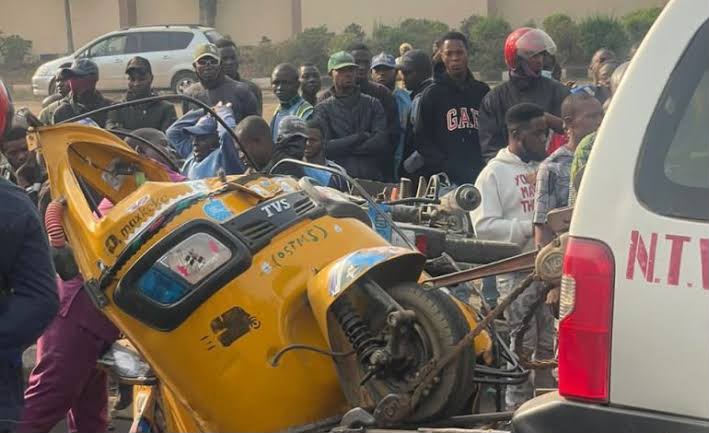
Recurrent road accidents along the Dutse-Bwari Highway have renewed concerns over road safety in the Federal Capital Territory (FCT), following another fatal multiple-vehicle collision at Tipper Garage Junction that reportedly killed four people and injured seven others.

The latest accident occurred at about 5 p.m. on Sunday, November 15, 2026, in Baupma community, involving three heavy-duty trucks, two cars and commercial tricycles.

According to eyewitness accounts, one of the trucks, reportedly descending from the Usuma Dam hill, lost control and rammed into two other trucks at the junction. The impact sent one of the vehicles crashing into the premises of a nearby Shafa filling station, where it struck parked vehicles.

An eyewitness, Anas Muazu, an employee of the Bwari Area Council Revenue Department, said the collision affected several road users and people around the junction.

The incident also raised concerns over the safety of motorists, commercial transport operators, pedestrians and businesses operating around the busy intersection.

Initial reports put the number of people affected at about 18, although subsequent casualty figures were different. A report published by Daily Trust on Tuesday, November 17, put the death toll at four, with seven others injured.

The victims were reportedly taken to Kubwa General Hospital for medical attention, with some requiring further treatment for severe injuries.

A Junction Haunted by Recurring Accidents

Beyond the latest tragedy, residents say Tipper Garage Junction has become a recurring accident hotspot, particularly for vehicles descending from the Usuma Dam and Bwari axes.

Comrade Ose Idasho, a member of the mining workers’ union at a nearby quarry, said accidents occur almost every week at the junction, with heavy-duty vehicles frequently involved.

The latest crash is not the first major tragedy recorded along the corridor this year. In February 2026, a truck reportedly lost control near Tipper Garage Junction, killing its assistant driver and hitting two other vehicles. Another fatal crash was reported at the junction in April 2025, when a trailer reportedly lost control and killed three people.

These incidents have intensified calls for urgent interventions to prevent further loss of lives along the highway.

Residents Appeal to FCT Minister

Following the latest accident, residents have renewed demands for the construction of a flyover at Tipper Garage Junction, alongside other measures to address the recurring crashes.

Idasho appealed to the FCT Minister, Nyesom Wike, to visit the community, engage directly with residents and initiate practical solutions to the persistent safety concerns.

Residents are particularly concerned about the risks posed by heavy-duty vehicles navigating the descending route and the danger to people waiting for commercial transport or conducting business around the junction.

With repeated crashes continuing to raise alarm, residents say the situation requires more than temporary emergency responses, urging the FCT Administration and relevant road safety authorities to prioritise lasting interventions before another tragedy occurs.

Continue Reading

Abuja Reports

UniAbuja Staff, Students Protest Alleged Land Allocation

Published

on

By Patrick Idowu

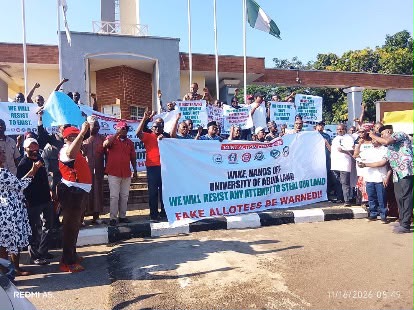
Staff, students and alumni of the University of Abuja have protested the alleged allocation of portions of the institution’s land to private individuals and companies, calling on President Bola Tinubu to intervene and direct FCT Minister Nyesom Wike to reverse the decision.

The protesters, led by ASUU, SSANU, NASU and the Students’ Union Government, accused the FCT Administration of disregarding a subsisting court order restraining encroachment on the disputed land.

The ASUU chairman, Prof. Sylvanus Ugoh, described the alleged allocation as a threat to the university’s future development and warned that the dispute could trigger legal action and industrial unrest.

However, Wike has defended the FCTA’s land recovery plans, arguing that large portions of the university’s allocated land remain undeveloped and lack adequate documentation.

The unions insist that the land is critical to the institution’s academic expansion, while students say the university’s over 55,000 population urgently needs additional hostels and infrastructure.

Continue Reading

Feature

When You Blame Tinubu, Don’t Spear Governors for Nigeria’s Woes

Published

on

By Ade Iyamoye 

Nigeria’s economic hardship has increasingly been laid at the doorstep of President Bola Tinubu. While the pain Nigerians are experiencing is real and undeniable, blaming the President alone ignores a critical fact: Nigeria operates a federal system, and much of what affects citizens daily falls squarely within the powers and responsibilities of state governors.

A factual and balanced assessment shows that Nigeria’s crisis is as much a subnational governance failure as it is a federal challenge.

Nigeria’s Federal Structure: Shared Responsibility, Not Sole Authority

Under the 1999 Constitution (as amended), Nigeria runs a federal system where powers, resources and responsibilities are shared among the federal, state and local governments.


Key areas that directly affect citizens’ welfare, such as:

-Primary and secondary education

-Primary healthcare

-Agriculture and food production

-Local roads and markets

-Rural security and policing support

are largely under the control of state and local governments, not the Presidency.

There are 36 governors and the FCT Minister, each with significant autonomy, budgets and executive powers. It is therefore inaccurate to attribute nationwide underperformance solely to one individual at the centre.


Governors Control Massive Resources

Statistically, Nigerian states are not poor on paper.

-Between FAAC allocations and Internally Generated Revenue (IGR), states collectively receive trillions of naira annually.

–Many states receive over ₦5-10 billion monthly from the Federation Account.

–In addition, states benefit from:

*Budget support facilities

*World Bank and donor-funded programmes

*Security votes running into hundreds of millions monthly

Yet, despite these inflows:

–Civil servants are owed salaries and pensions in some states

–Public schools and hospitals remain dilapidated

–Rural infrastructure is largely absent


This raises a fundamental question: Where is the money going?

Food Inflation: A Governor-Level Failure

One of the biggest drivers of Nigeria’s current hardship is food inflation. But agriculture is constitutionally a residual matter, meaning states have wide latitude to act.


Governors:

–Control vast arable land

–Can establish ranches, farm estates and storage facilities

–Can invest in irrigation, extension services and agro-processing


Yet, many states:

–Depend almost entirely on food transported from a few regions

–Fail to secure farmlands against banditry

–Allocate little of their budgets to agriculture despite its strategic importance

Blaming Tinubu for high food prices while governors leave fertile land idle is economically dishonest.


Security: States Are Not Helpless

While the federal government controls the armed forces, state governments play a decisive role in internal security.


Governors:

–Are Chief Security Officers of their states

–Fund logistics for police and security agencies

–Establish and support outfits like Amotekun, Ebube Agu and local vigilantes

–Control land-use decisions that affect conflict dynamics


In several states, insecurity persists not because Abuja has done nothing, but because:

–Local intelligence is weak

–Security votes lack transparency

–Political will is absent

Security failures cannot be blamed on the President alone when governors sit at the centre of local coordination.


Education and Healthcare: Governors’ Direct Mandate

Public outrage over failing schools and hospitals often targets the federal government, yet:

-Primary healthcare centres are owned and funded by local and state governments

-Basic education is a state responsibility, with UBEC funds often left unaccessed due to counterpart funding failures

Reports have repeatedly shown that billions of naira in UBEC funds remain unutilised because states fail to meet basic requirements.

It is misleading to accuse the President of neglecting education when governors fail to access funds already allocated to them.


Tinubu’s Policies vs. Governors’ Implementation

President Tinubu’s administration has implemented controversial but structural reforms, including:

-Removal of fuel subsidy

-Exchange rate unification

-Fiscal tightening

These policies are painful, but they are macro-level decisions aimed at long-term stability.


What has been largely missing is state-level cushioning:

-Few governors have introduced effective transport subsidies

-Very few states have rolled out large-scale food intervention programmes

-Social safety nets at subnational level are weak or non-existent

Governors cannot support harsh federal reforms rhetorically while failing to mitigate their local impact.

The Political Convenience of Blaming Abuja

Blaming the President has become politically convenient.


Governors:

-Attend FAAC meetings monthly

-Approve state budgets annually

-Control local governments

-Exercise near-total influence within their states

Yet, when hardship bites, they point fingers at Abuja, shielding themselves from accountability.

This culture weakens federalism and robs citizens of the right to demand performance from their closest leaders.


Conclusion

Nigeria’s problems are complex and multi-layered. President Tinubu should be scrutinised, but he should not be scapegoated for failures rooted in poor subnational governance.


If Governors:

-Invest in agriculture

-Improve security coordination

-Prudently manage resources

-Strengthen education and healthcare

-Deploy targeted social interventions the impact of federal economic reforms would be significantly reduced.

In a federation, no single man can ruin or rescue, a nation alone.

If Nigeria must work, governors must work too.

Continue Reading

Trending

taraftarium24seo ajansıseo ajansıiptvtrlisans pinterestgiftcardmall/mygiftdinamobetgrandpashabet girişgrandpashabetdinamobetGrandpashabettaraftarium24dizipalgiftcardmall/mygiftjustin tvGrandpashabetGrandpashabetGrandpashabetDeneme BonusuCasibomiptvkavbettaraftarium24taraftarium24rojadirectajustin tvbetsalvador xteosbetbahiscasino x1win xbetgitbets10casinolevantcasinolevantsonbahis xgrandpashabetgrandpashabetcasinolevantgrandpashabet girişmarsbahis girişholiganbet girişholiganbet güncel girişcasibom girişgrandpashabetgrandpashabetholiganbetholiganbetholiganbetholiganbetjojobetjojobetgrandpashabetsonbahis xsonbahis xgrandpashabetbetbey xesbet xcashwin ximajbetpusulabetsahabetonwin girişmarsbahissahabet girişmatbetholiganbetmarsbahismarsbahis girişibizabet xcasinolevantfixbetbetpuan xnesinecasino xwbahis xbetgaranti xgrandpashabetjojobetjojobet