News
President Tinubu’s Bold Reforms Attract Major Investments from Swedish Firms

President Bola Ahmed Tinubu’s administration in a significant push for foreign investment, has secured multi-million-dollar commitments from Swedish businesses to Nigeria’s digital economy, agriculture, and renewable energy sectors. The announcement was made during Vice President Kashim Shettima’s two-day working visit to Stockholm, Sweden, aimed at strengthening trade and bilateral ties between both nations.
During the business forum, themed “Trade and Investments with a Focus on the Digital Economy, Agriculture, and Renewable Energy”, VP Shettima emphasized that Tinubu’s administration has introduced bold reforms, including the unification of exchange rates and the removal of fuel subsidies, to restructure the economy for sustainable growth. He noted that these steps were part of the government’s Renewed Hope Agenda, which focuses on creating a competitive business environment for both foreign and domestic investors.
“Under the leadership of His Excellency, President Bola Ahmed Tinubu, we are creating vast investment opportunities. The Renewed Hope Agenda promotes financial inclusion, fosters innovation through a cashless policy, and has enabled transformative financial services,” Shettima told attendees at the Epicenter in Stockholm.
Shettima called on Swedish investors to seize opportunities in sectors such as digital technology, agriculture, and renewable energy, which are critical to Nigeria’s economic transformation.


“Our partnership holds immense potential for mutual benefit. Sweden’s expertise in agriculture, technology, and renewable energy aligns with our national goals. Together, we can address challenges like food security, climate change, and job creation,” he said.
The forum yielded significant commitments, with Gluwa, a digital wallet service, announcing plans to invest $100 million in Nigeria and train over 30,000 citizens in digital skills. Gluwa’s Director, Akinola Jones, revealed that the company is actively working to promote financial inclusion by banking the unbanked and enhancing connectivity through satellite-enabled WiFi networks.
“Our mission extends beyond just issuing loans. We want to create impact by collaborating with the government to train people in digital skills. This partnership will significantly boost Nigeria’s tech ecosystem,” Jones said.
In addition, Ericsson, a global leader in telecommunications, announced a $19 million investment to establish a tech hub in Nigeria. According to Ericsson Nigeria’s Managing Director, Peter Olusoji Ogundele, the initiative aims to nurture local talent and position Nigeria as a global player in the tech industry.
“Nigeria’s youth are the real engine of its economy, and we aim to develop their potential. Our goal is to make Nigeria a hub like India, exporting skilled professionals worldwide,” Ogundele remarked.
Shettima stressed that Nigeria’s economic diversification efforts, especially following the COVID-19 pandemic, have strengthened partnerships and positioned the nation as a pillar in the global economy. He also highlighted the country’s progress in closing the gender gap, particularly in STEM fields, citing the potential $229 billion boost to GDP by 2025 through improved gender parity.
“MSMEs account for 96% of Nigerian businesses and 84% of employment. However, they face challenges accessing capital and markets. Swedish expertise can play a crucial role in unlocking their potential,” Shettima added, inviting Swedish companies to collaborate in areas such as agriculture and digital finance.
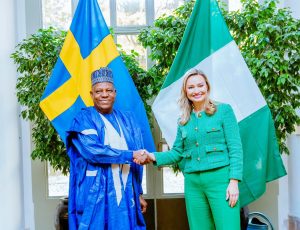
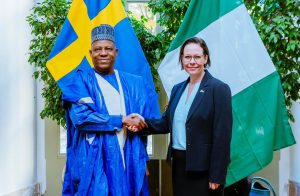
The Vice President also held bilateral talks with Swedish government officials, including Foreign Affairs Minister Maria Malmer Stenergard and Deputy Prime Minister Ebba Busch, focusing on expanding trade and cultural partnerships.
Participants at the business forum expressed optimism about the partnership’s future. Mikaela Edstrom of the Swedish Export Credit Agency praised Nigeria’s economic reforms, pledging support through export credit systems. Representatives from Epicenter, Swedfund, and other Swedish organizations echoed similar sentiments, committing to deepening collaboration.
“The future is digital and sustainable, and we are ready to work with Nigeria to build a prosperous future,” said Edgar Luczak, Chairman of Epicenter.
Nigeria’s delegation included key government officials such as Plateau State Governor Caleb Mutfwang, Minister of Foreign Affairs Yusuf Tuggar, and senior executives from the National Information Technology Development Agency (NITDA) and Nigerian Communication Commission (NCC).
Shettima concluded by reaffirming that Nigeria’s growing business climate, combined with Tinubu’s bold reforms, offers limitless opportunities for serious investors. “Together, we can build a sustainable and prosperous future for both Nigeria and Sweden,” he said.