News
Adobe Faces Criticism for Selling AI-Generated Images of Israel-Hamas War

Recent reports highlight concerns over Adobe’s sale of AI-generated images depicting the Israel-Hamas conflict. While some images are easily identified as computer-generated, others are more realistic, leading to worries that they could contribute to misinformation when shared on smaller websites and social media.
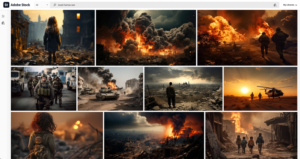
A search on Adobe Stock for “Israel Hamas war” reveals various AI-generated images portraying war scenes, explosions, soldiers, tanks, and damaged buildings. Although Adobe Stock requires AI-generated images to be labeled as such, some are only marked in fine print, not in their titles.
Despite the title of one image reading “Wounded Israeli woman clings to military man, begging for help,” it is AI-generated. While some titles mention AI, others do not, potentially misleading viewers. A Google reverse-image search shows instances where the AI-generated image has been used online alongside presumably real images from the conflict, raising uncertainty about users’ awareness of its authenticity.
An Adobe spokesperson stated that the images were labeled as generative AI during submission and licensing, emphasizing the importance of customers knowing how Adobe Stock images were created. Adobe is committed to combating misinformation through initiatives like the Content Authenticity Initiative, aiming to provide context about digital content creation.
The proliferation of misinformation about the Israel-Hamas conflict online, including misleading content and repurposed images from other conflicts, poses challenges in distinguishing real from AI-generated images. As AI-generated content becomes more realistic, it becomes harder to police labeling post-download, leaving room for confusion about the authenticity of digital content.
AI expert Henry Ajder suggests visual cues such as plasticky or overly-stylized appearances and inconsistencies in lighting or shapes as indicators of AI-generated images. He advises asking questions about the image’s sources and context and conducting reverse-image searches to verify authenticity.